
Service guide
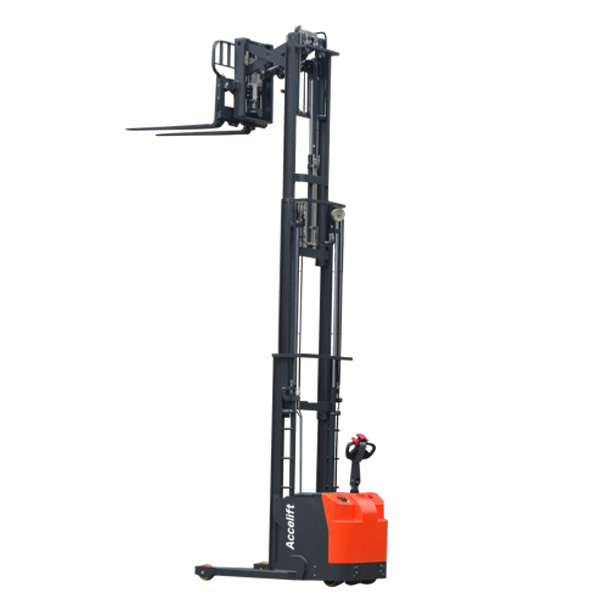
A stacker that lifts with a whine, a squeal or a series of small jerks is usually telling you something specific. Almost every lifting noise comes from one of four places: the pump unit at the bottom of the truck, the mast rollers and channels, the lift chains, or the battery and lift motor. This guide shows how to find the source and fix it, easiest checks first. It applies to walkie and stand-on electric stackers such as our CL15JB walkie stacker (1.5 t, 3.0 m lift, 2.2 kW lift motor).
Safety first. Lower the forks fully, turn the key off and press the emergency stop before you touch anything. Disconnect the battery before working on wiring or hydraulics. Never stand or work under raised forks; if you have to work below them, block the forks and mast securely first. Never climb the mast, and never reach through it while the forks can move. Follow the operating and service manual for your model.
Listen and look first
Before you open any covers, run two full strokes.
- Lift the empty forks to full height, then lower them. Stand to the side, clear of the forks and the mast.
- Do the same with a typical load, of the weight your operators normally handle.
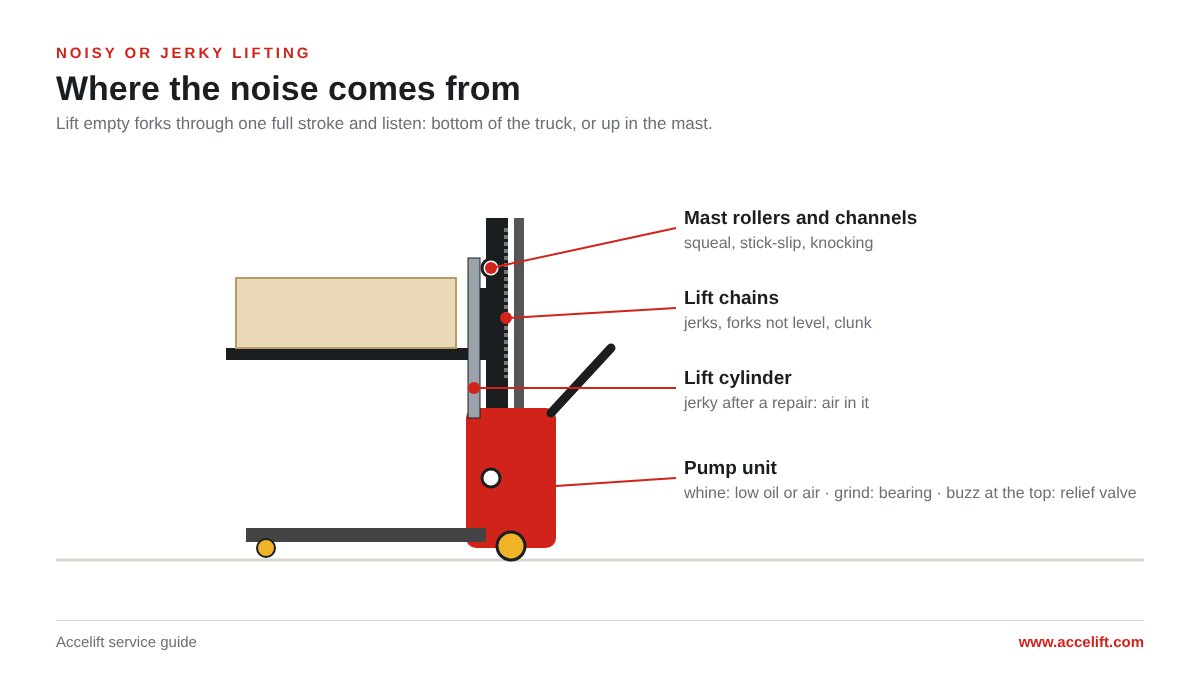
Each time, note two things. Where the noise comes from: the pump unit at the bottom of the truck, or somewhere up the mast. And when it happens: over the whole stroke, at one particular height, or only near the top. Those two answers point to the cause faster than dismantling.
Noises from the pump unit
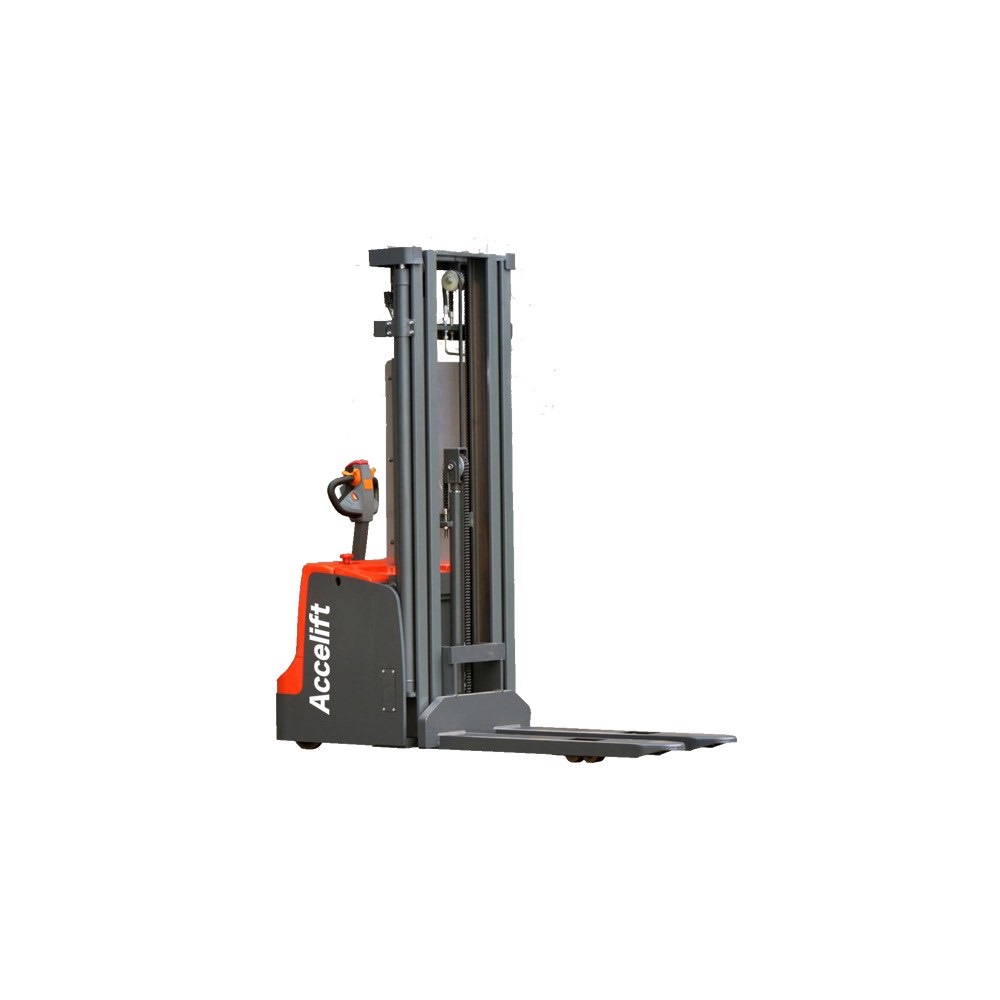
The pump unit is the lift motor, the hydraulic pump, the valves and the oil tank, grouped together low down on the truck. The typical sounds and what they mean:
- Whining or screaming pump. The pump is short of oil or drawing in air. Check the oil level with the forks fully lowered; with the forks raised, much of the oil is in the cylinders and the reading means nothing. If the level is right, look for a blocked suction strainer in the tank, or oil that is foamy with air.
- Grinding. A worn bearing in the lift motor or the pump. It will not get better on its own, so plan the repair before the bearing fails completely.
- Hiss or buzz at full height while the lift button is still pressed. The cylinders have reached the end of their stroke and the pump is pushing oil against the relief valve. That is normal for a moment. Release the button: holding it heats the oil and wastes battery.
- The same buzz below full height, with a load. Either the load is more than the truck can lift at that height, or the relief valve is set too low or worn. Check the load against the capacity plate first. Setting a relief valve is a job for a trained technician working to the figure in the manual.
If the oil keeps going low, find the leak: our guide to stacker forks drifting down shows where they usually start.
Noises and jerks from the mast
If the pump sounds smooth but the forks still squeal, knock or rise in steps, the cause is in the mast.
- Squeal, or stick-slip movement. The mast channels and rollers are dry or dirty. Clean the channels and remove packed dirt and old grease. Grease only where the manual says: on some masts the rollers are meant to run on clean, dry channels, and grease there just collects dust.
- Knock or clunk. A worn mast roller or roller bearing, or a chain touching the mast. Note the height where it happens, lower the forks, and inspect the rollers and chains that are at that point in the stroke.
- Jerky stroke. The usual causes are low oil, so the pump draws air and the cylinders fill in pulses; air left in the cylinders after a repair; cold oil, or oil of the wrong grade; chains with uneven tension; and rollers worn flat in places. After any work on the hydraulics, bleed the cylinders as the manual describes.
On a duplex or triplex mast, the free-lift cylinder raises the forks first and the main cylinders take over after that. A small jolt at the changeover is normal. A hard bang is not: check the mast adjustment and the chains.
Oil and temperature
Hydraulic oil thickens in the cold. A stacker that lifts in jerks first thing in a cold warehouse and smoothly after a few strokes is usually telling you about the oil, not a broken part. Use the grade the manual gives for your climate (commonly ISO VG 32 or 46), keep the oil clean, and do not top up with whatever oil is on the shelf.
Chains
- Lubricate them with chain oil.
- Check elongation with a chain wear gauge and replace the chains when they reach the limit in the manual.
- Adjust them so both chains carry equal tension and the forks sit level. Uneven tension pulls the carriage to one side, which causes jerks and knocking in the mast.
- Replace chains as a pair, never one on its own.
The electrical side
- Lift slows and stutters as the shift goes on. The battery voltage is low. Charge the battery and test again. If a fully charged battery still gives a slow lift early in the shift, the battery may be worn: see when to replace a pallet truck or stacker battery. Many trucks also cut out the lift completely when the charge is low, as explained in electric pallet jack not lifting.
- Weak or uneven pump running on a DC lift motor. Check the carbon brushes.
- Rapid clicking from the electrical panel when you press lift. The pump contactor is chattering. Check the battery voltage and the cable connections first, then the contactor itself.
Check order
Work through it in this order. Most faults are found in the first three steps.
- Oil level, with the forks fully lowered, and a look for leaks around the pump, hoses and cylinders.
- Listen at the pump unit through a full empty stroke.
- Watch the mast lift empty to full height: squeal, knock, steps, changeover jolt.
- Chains: lubrication, equal tension, wear.
- Rollers and mast channels: wear, flat spots, dirt.
- Repeat the full stroke with a typical load.
Symptoms at a glance
| Noise or symptom | Where | Likely cause | What to do |
|---|---|---|---|
| Whine or scream | Pump unit | Low oil, blocked suction strainer, air in the oil | Check level with forks down, top up, clean the strainer |
| Grinding | Pump unit | Worn motor or pump bearing | Replace the bearing or the unit |
| Hiss or buzz at full height | Pump unit | Pump running against the relief valve | Normal: release the lift button |
| Buzz below full height with a load | Pump unit | Overload, or relief valve set too low | Check load against the capacity plate, then the valve |
| Squeal, stick-slip | Mast | Dry or dirty channels and rollers | Clean; grease only where the manual says |
| Knock or clunk | Mast | Worn roller or bearing, chain touching | Inspect at that height, replace the roller |
| Jerky stroke | Mast and pump | Low oil, air in cylinders, cold or wrong oil, uneven chains | Oil level, bleed cylinders, correct oil, adjust chains |
| Lift slows late in the shift | Battery | Low voltage | Charge; test the battery if it persists |
Parts worth keeping on the shelf
Most of these repairs are quick if the parts are already in the workshop. For each stacker model you sell, keep:
- a set of mast rollers with bearings;
- a pair of lift chains;
- hydraulic oil of the right grade;
- a suction strainer;
- a cylinder seal kit.
Our guide to spare parts for a new dealer covers the rest of the shelf, and the maintenance checklist helps prevent many of these faults in the first place.
If one of our stackers is making a noise you cannot place, contact us with the model, the serial number and a short video of a full lift. Dealers who want to carry our stackers and parts can start at our distributor programme.