
Service guide
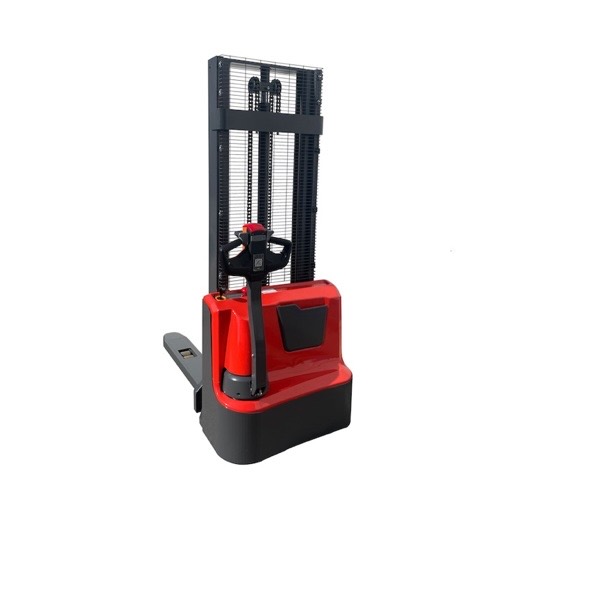
A stacker lifts a pallet to the second beam, the operator leaves it for a few minutes, and on returning the forks are lower than they were left. That is fork drift. It is a common hydraulic complaint on electric stackers, and the cause is usually small and cheap to fix. This guide covers walkie and stand-on electric stackers with single-acting lift cylinders and gravity lowering, such as our CL15JB walkie stacker (1.5 t, 3.0 m lift). For pallet trucks, see electric pallet jack not lifting, which also covers a truck that lifts and then sinks.
Safety first. Before you touch the wiring or the hydraulics, lower the forks fully, turn the key off, press the emergency stop and disconnect the battery. Never stand or work under raised forks, and never reach through the mast. Opening a hose or fitting while the forks are up releases the load, so the forks must be fully down before any part of the hydraulic circuit is opened. If the forks are stuck in the raised position, block the mast and forks securely before you do anything else. Follow the service manual for your model.
What drift is
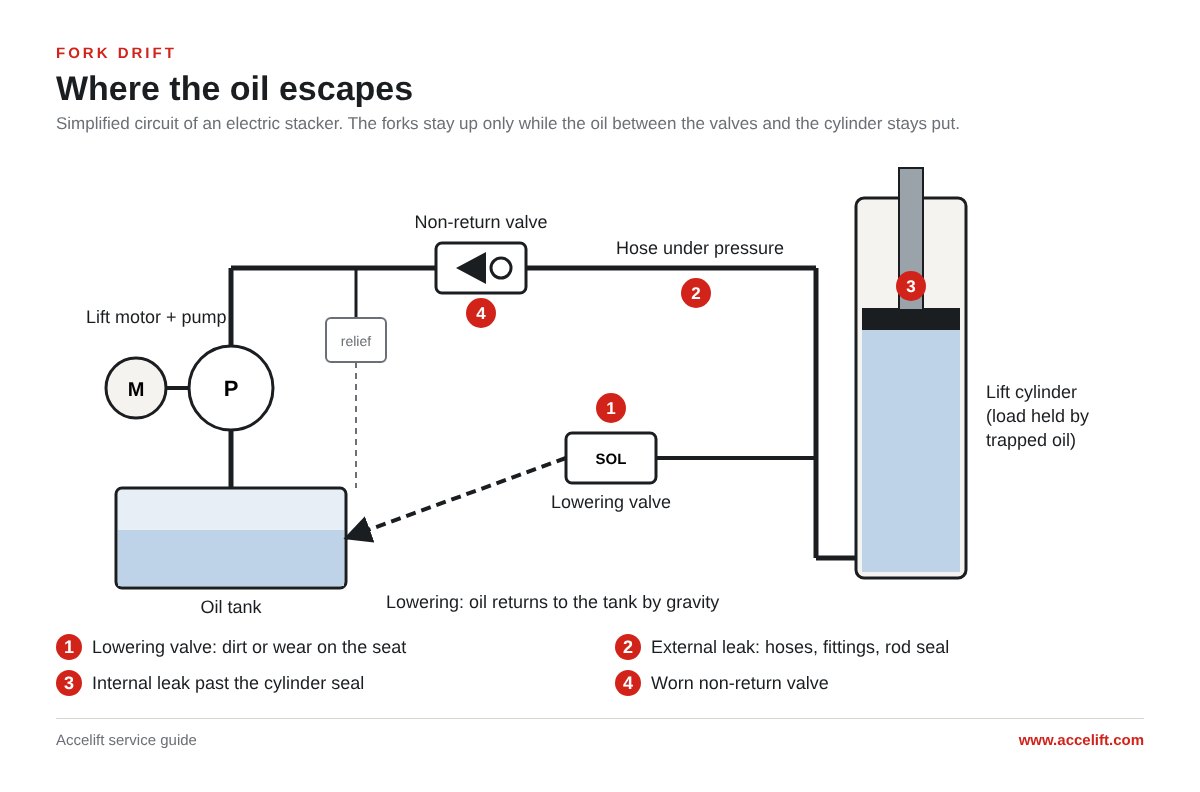
Drift is raised forks, with or without a load, sinking slowly while the truck stands still and nobody presses the lower button. A stacker holds its load on a column of oil. When the pump stops, that oil is trapped between three things: the pump’s non-return (check) valve, the lowering valve and the lift cylinder or cylinders. As long as all three seal, the forks stay where they are.
If the forks drift, oil is escaping from that trapped volume somewhere.
The hydraulic circuit on a typical electric stacker
The details vary, but almost every electric stacker works like this:
- Oil is drawn from the tank by a pump driven by the lift motor.
- It passes a non-return valve, which lets oil out towards the cylinder but not back into the pump.
- A relief valve protects the system against overload by returning oil to the tank if the pressure gets too high.
- A hose carries the oil up to the lift cylinder or cylinders. A duplex or triplex mast has a free-lift cylinder and main cylinders.
- To lower, the lowering valve opens and the weight of the forks and load pushes the oil back to the tank. There is no pump pressure on the way down; lowering is by gravity.
The lowering valve is usually a solenoid valve worked from the lower button on the tiller. Many trucks also have a manual emergency lowering valve, so the forks can be brought down if the electrics fail.
Where the oil escapes, most likely first
- The lowering valve. This is the most common cause. A grain of dirt on the valve seat, a worn seat, or a solenoid that sticks partly open lets oil seep back to the tank. A manual emergency lowering valve that has not been fully closed does the same.
- External leaks. Hoses, fittings and the rod seal at the top of the cylinder. These are easy to find because you can see them: wet oil on the mast, on the cylinder top, along the hoses or on the floor under the truck.
- An internal leak in the cylinder. Oil passes the piston seal inside the cylinder back towards the tank side. Nothing shows on the outside.
- A worn non-return valve. Oil leaks back through the check valve into the pump. This is usually the last place to look.
The drift test
Before you take anything apart, measure the drift. A number lets you check afterwards that the repair worked.
- Pick up a typical load and lift it to about 1 m. Keep it low. Nobody stands under or beside the forks.
- Stop the pump and leave the controls alone.
- Mark the fork height on the mast with a pen or tape, or measure from the floor to the underside of the fork.
- Wait ten minutes, then measure again.
- Lower the load, then repeat the test with empty forks.
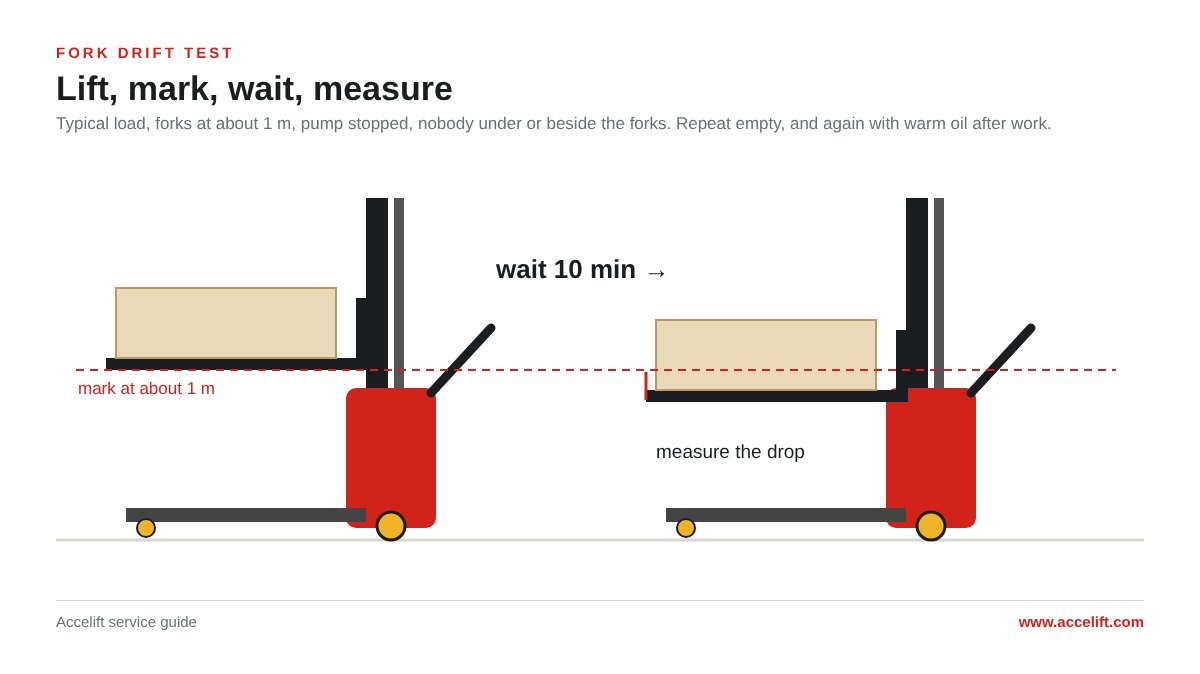
Run the test once with the truck cold and once after a period of hard work. Warm oil is thinner and leaks more easily, so a small leak often only shows after an hour of lifting. Note both results.
If the service manual gives an allowed drift figure for your model, compare against it. As a practical rule, drift you can see within a few minutes with a load on the forks is worth fixing.
Fixing it, in order
Work from the cheapest and quickest step to the most expensive, and repeat the drift test after each one.
- Flush the lowering valve. Lift and lower the empty forks several times over the full stroke. The flow of oil often washes a particle off the valve seat, and the drift disappears.
- Check the emergency lowering valve. Make sure it is fully closed. It is easy to leave slightly open after someone has used it.
- Clean or replace the lowering valve cartridge. With the forks fully down and the battery disconnected, take out the cartridge, clean it and check the seat. If the seat is worn or the solenoid sticks, fit a new cartridge.
- Replace leaking hoses and fittings. Anything you found wet in the visual check.
- Reseal the cylinder. Fit a seal kit if the rod seal leaks on the outside, or if the valve and hoses are good and the forks still drift.
- Pump and non-return valve. Last, when everything else has been ruled out.
After any work on the hydraulics, top up the oil and check that the lift is smooth over the full stroke. If it jerks or the pump whines, see electric stacker lifting jerky or noisy.
Quick reference
| Where you see it | Likely cause | Fix |
|---|---|---|
| Forks drift, no oil visible anywhere | Dirt on the lowering valve seat, or valve sticking partly open | Flush with several full lift and lower strokes; clean or replace the cartridge |
| Forks drift after someone used the manual lowering | Emergency lowering valve not fully closed | Close it fully |
| Wet oil on hoses, fittings or the floor | Leaking hose or fitting | Forks fully down, then replace the hose or fitting |
| Oil on the cylinder top or running down the rod | Worn rod seal | Reseal the cylinder with a seal kit |
| Drift continues with a new valve and no external leak | Internal leak past the piston seal | Reseal the cylinder |
| Drift remains after valve and cylinder work | Worn non-return valve | Repair or replace the pump unit or check valve |
Keep the oil clean
Most hydraulic faults on stackers start with dirt. A particle on a valve seat causes drift; wear from dirty oil damages seals and valves over time. A few habits prevent most of it:
- Check the oil level with the forks fully lowered, otherwise part of the oil is up in the cylinder and the reading is wrong.
- Use the grade given in the manual. This is commonly ISO VG 32 or ISO VG 46, depending on the climate the truck works in.
- Look at the oil when you check it. Dirty or cloudy oil should be changed.
Our maintenance checklist sets out when to check the hydraulics alongside the rest of the truck.
Parts worth keeping on the shelf
For a dealer’s workshop, drift is a quick repair if the parts are there and a week’s wait if they are not. For each stacker model you sell, keep:
- a lowering valve cartridge (and the solenoid coil, if it is sold separately);
- a cylinder seal kit for each cylinder type on the mast;
- the high-pressure hose from the pump to the cylinder;
- a litre or two of the right hydraulic oil.
We supply spare parts for our stackers to our dealers; our guide to spare parts for a new dealer covers the rest of the kit. For parts or service help, contact us with the model and serial number, or see our dealer programme.