
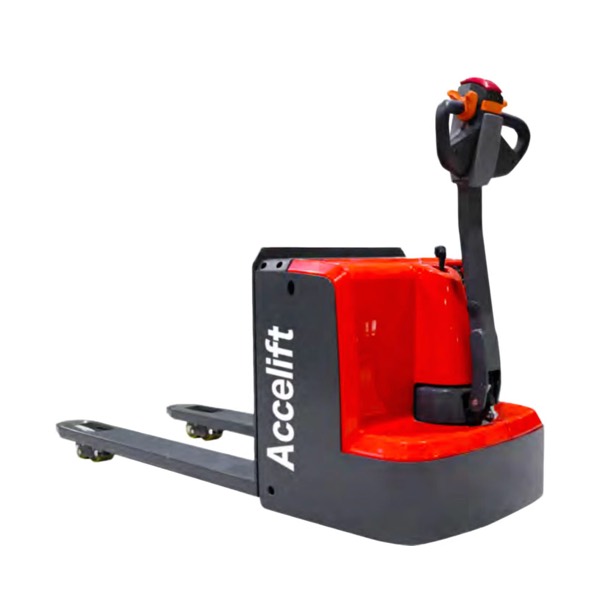
Service guide
An electric pallet jack that drives but will not lift, or lifts and then sinks, is one of the most common service calls in any warehouse. The good news is that most causes are simple and can be found in a few minutes with a methodical check. This guide goes through them in order, from the easiest to the most involved.
Safety first: lower the forks fully, switch off the key, press the emergency stop and disconnect the battery before you touch the hydraulics or the wiring. Never work under raised forks.
Step 1: is it the load?
Before anything else, rule out the obvious.
- Overload. The pump unit has a relief valve that opens when the load is above capacity. A 2 t truck will not lift a 2.5 t pallet, and it is not supposed to. Check the weight on the delivery note.
- Load centre. A long or unevenly packed load puts the weight towards the fork tips and can exceed what the truck will lift even under the rated weight.
- Something in the way. Check that nothing is jammed under the forks or between the fork rollers and the pallet boards.
If the truck lifts empty forks normally, the problem is almost always load, relief valve setting or a weak pump. Go to step 4.
Step 2: is it the battery?
The single most common cause. Many trucks have a low-voltage lift cut-out: when the battery drops below a set level, the controller still lets the truck drive slowly to the charger but blocks lifting, to protect the battery.
- Read the battery indicator. If it is low, charge fully and try again.
- On lead-acid batteries, check the electrolyte. A battery that reads full on the charger but sags immediately under load may have a dead cell.
- Check the battery connector and main cables. A loose or burnt connector can drop enough voltage under the pump’s current to trigger the cut-out.
Step 3: does the pump motor run when you press lift?
Press the lift button and listen.
Silence: the pump motor does not run
The fault is electrical. Check in this order:
- Emergency stop and key switch. Obvious, but often the cause after a shift change.
- Lift button. Buttons on the tiller head wear out and get wet. If the truck has two lift buttons, try the other one.
- Fuse. Check the pump fuse or the main fuse with a meter, not by eye.
- Pump contactor. You should hear it click when you press lift. No click: check the coil supply. A click but no motor: the contacts may be burnt.
- Lift limit switch. Many trucks cut the pump when the forks reach full height. A switch that is stuck, misaligned or damaged can cut the pump at any height.
- Controller fault code. If the truck has a display or a fault LED, read the code before anything else. It often names the circuit.
- Pump motor. On DC motors, worn brushes are a common end-of-life cause.
The motor runs, but the forks do not rise
The fault is hydraulic.
- Oil level. With the forks fully lowered, check the oil in the pump tank. Low oil means the pump draws air. Look for the leak that caused it.
- Air in the system. After an oil change or a seal repair, the system may need bleeding. Raise and lower the empty forks several times; some cylinders have a bleed screw.
- Lowering valve stuck open. The solenoid valve that lets the forks down can stay open if it is dirty or its coil is energised by a faulty button. Oil then goes straight back to the tank. Cleaning the valve often fixes it.
- Relief valve. A relief valve that opens too early, or is stuck open, returns oil to the tank. Adjust or replace it only with the setting from the manual, never by guesswork: setting it too high overloads the truck.
- Worn pump. The motor runs, the oil is fine, the valves are clean, and the forks still rise slowly or not at all with a load. The pump is worn.
Step 4: the forks lift, then slowly sink
This is a leak, inside or outside.
- Outside leak: oil on the cylinder, the hose or the floor. Usually a worn cylinder seal or a damaged hose. Replace the seal kit.
- Inside leak: no oil visible, but the forks creep down with a load. Usually dirt in the lowering valve or the check valve, which stops it sealing. Clean or replace the valve.
Step 5: it lifts, but slowly or jerkily
- Low battery voltage under load (go back to step 2)
- Low oil or air in the oil
- Oil that is too thick in a cold store; check that the oil grade suits the temperature
- A worn pump or a pump motor near the end of its life
- Mechanical binding in the fork linkage: dry pivot points, bent push rods, or debris round the load wheel arms
Quick reference
| Symptom | Most likely causes |
| Drives, will not lift, no pump noise | Low battery cut-out, lift button, fuse, pump contactor, lift limit switch |
| Pump runs, forks do not rise | Low oil, air in system, lowering valve stuck open, relief valve, worn pump |
| Lifts empty forks, not the load | Overload, load centre too far out, relief valve, weak pump |
| Lifts, then sinks | Cylinder seal, hose, dirty lowering or check valve |
| Lifts slowly or jerkily | Low battery, low or cold oil, worn pump, dry linkage |
Preventing the next one
Most of these faults show warning signs first: a slower lift, a drop of oil on the floor, a battery that does not last the shift. A weekly look at the truck catches them early. Our electric pallet jack maintenance checklist sets out what to check and when.
If you own or sell Accelift trucks and need a fault code explained, a hydraulic diagram or a part, contact us with the model and serial number.