
Dealer guide
When a dealer places a first order with us, one of the first questions is which spare parts to keep on the shelf. Dealers in France and Greece have asked us exactly this in recent months, so this guide sets out the answer we give them, based on the parts that appear most often on our spare parts orders for electric pallet trucks and walkie stackers.
The short version: parts are cheap and customers are not. A truck that stands for three weeks waiting for a wheel that costs very little is how a dealer loses a customer. A small, well-chosen stock of parts prevents that, and over time it becomes one of the most profitable parts of the business.
Where the parts wear
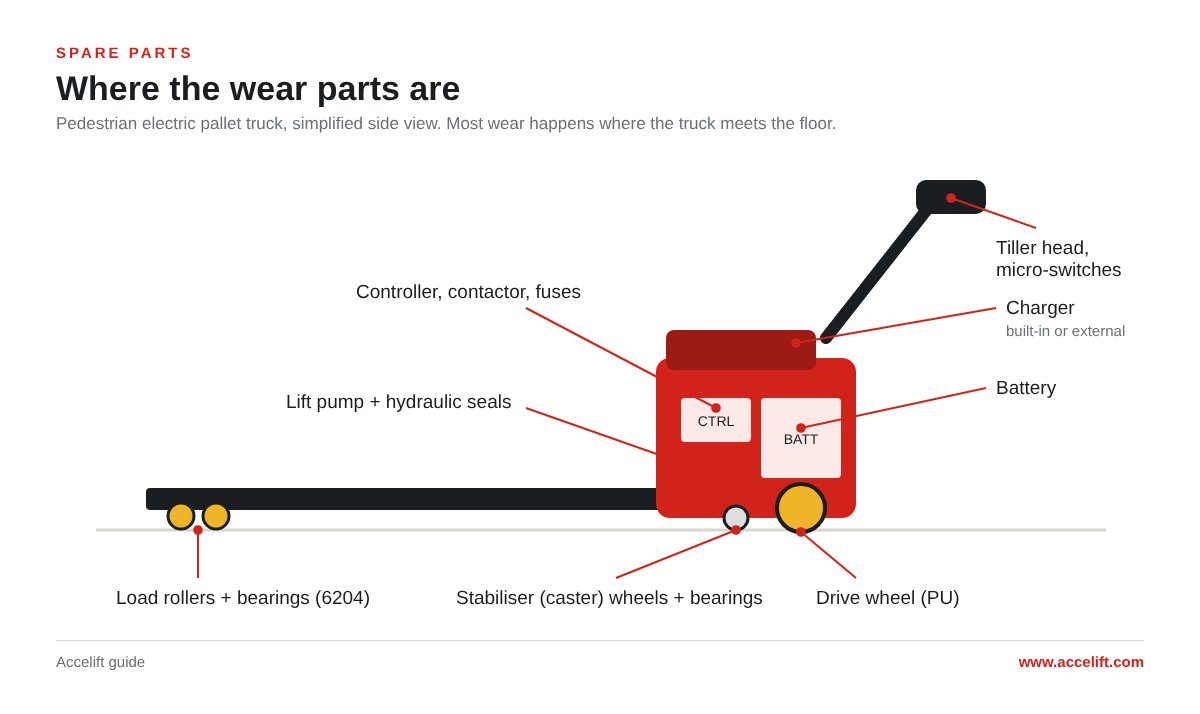
On a pedestrian electric pallet truck, most of the wear happens where the truck meets the floor. The load rollers in the fork tips carry the pallet, the drive wheel under the motor carries the traction, and the stabiliser (caster) wheels either side of the drive wheel keep the truck steady. Every bump, dock plate and piece of shrink wrap on the floor ends up in these wheels and their bearings.
A walkie stacker has the same wheels and bearings, plus a lift cylinder whose hydraulic seals wear with use. Above the floor, the parts that fail are mostly electrical: the controller, the charger, the contactor, micro-switches and fuses. And the tiller arm, the operator’s handle, takes every knock when a truck is driven into a rack or a door frame.
Four groups of parts
It helps to sort parts into four groups, because each group is stocked differently.
| Group | Typical parts | How to stock |
|---|---|---|
| 1. Wear parts | Load rollers (for example 80×70 mm or 80×60 mm PU) and their 6204 bearings; stabiliser wheels (for example 115×55 mm or 50×30 mm) and their 6304 or 6003 bearings; drive wheels (for example 210×75 mm PU); hydraulic seals; carbon brushes for DC motors | Cheap and needed often. Stock plenty. |
| 2. Electrical parts | Controller (Curtis on our trucks), charger (24 V, 10 A or 20 A, external or built-in), contactor, micro-switches, fuses, brake | Needed less often, but each one stops a truck. Keep at least one of each per model. |
| 3. Damage parts | Tiller arm and handle head, covers, forks | Caused by accidents, not age. Keep a tiller head or two for your best-selling model; order the rest when needed. |
| 4. Batteries | Lead-acid or lithium packs | The most expensive item. Keep a small number for your main models. |
Wear parts are the bulk of your parts business. They are inexpensive, they take little shelf space, and a customer whose truck has a flat-spotted load roller wants it fixed the same day.
Electrical parts are where a missing part hurts most. A cracked roller still lets a truck limp on; a failed controller or charger does not. You do not need many, but you need the right one for each model on the shelf.
Damage parts are hard to predict. Tiller arms are the most common, because the tiller sticks out in front of the operator.
Batteries wear out over years, not months, and they age on the shelf too. Keep only a few, for the models you sell most. If you stock spare lithium packs, ship them with the trucks in the same container: they travel as dangerous goods, as our guide to shipping lithium pallet trucks explains.
A starter kit for the first container
The cheapest moment to buy spare parts is with your first container. The freight is already paid, the parts fill gaps between the trucks, and they arrive with the trucks they belong to.
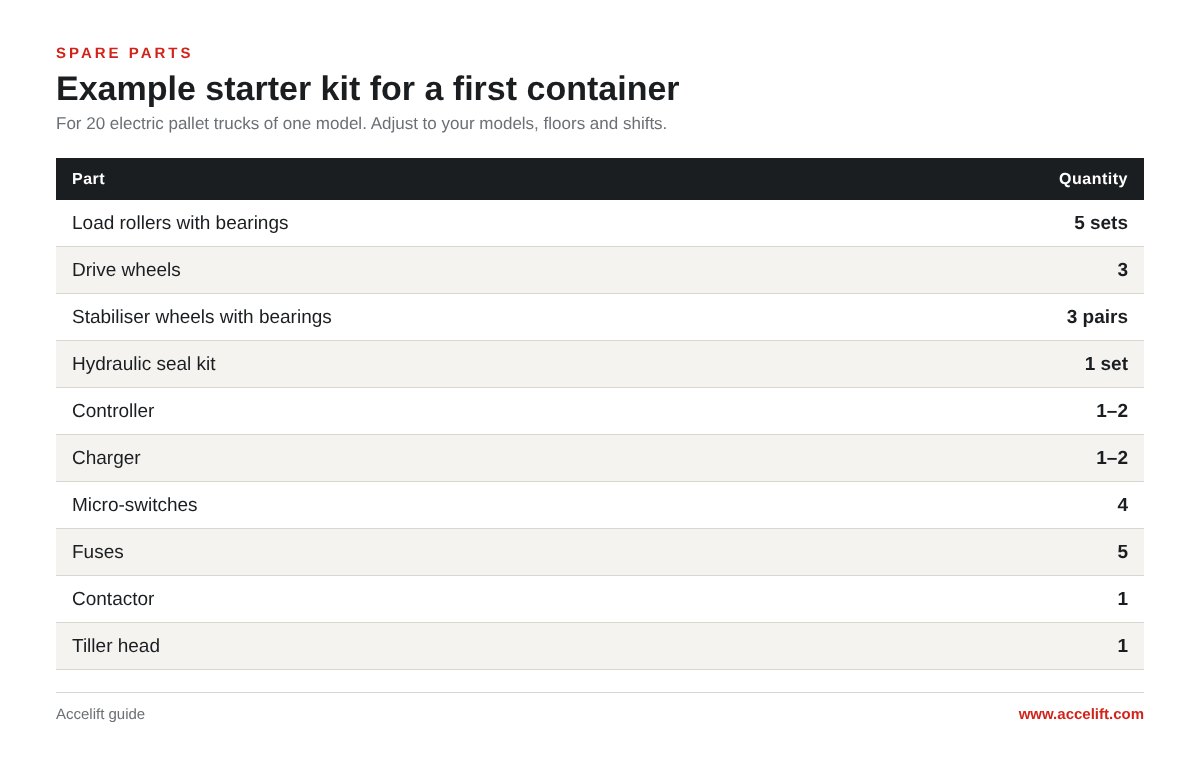
Size the kit by the number of trucks you are bringing in. As a practical guide, for 20 electric pallet trucks of one model we would suggest:
- load rollers and their bearings for about a quarter of the trucks, so five sets;
- a few drive wheels and a few pairs of stabiliser wheels with bearings;
- a set of hydraulic seals;
- one or two controllers and one or two chargers;
- a handful of micro-switches and fuses, and a contactor;
- a tiller head.
For stackers, follow the same logic per model and add seals for the lift cylinder. Then adjust. Trucks that run two shifts on a rough floor or over dock plates wear out rollers far faster than trucks in a shop or a clean store, and cold stores are hard on wheels, batteries and electrics. After a year you will know your own numbers better than any rule of thumb.
Record the model and serial number of every truck
When a customer calls with a broken truck, the first thing you need is the model and the serial number. Record both for every truck you sell, together with the customer and the date of sale. The same model can change detail between production batches, and the serial number tells us exactly what was built into that truck.
When you order a part from us, send a photo of the part and the truck’s serial number. It takes a minute, and it means the right part goes in the box the first time.
Fewer models, fewer parts
Every model you add brings its own wheels, seals, controller settings and tiller. A dealer selling three models can cover them with a small shelf; a dealer selling twelve needs a warehouse. Standardise where you can: choose a few core models, and keep the same configuration from order to order.
The same applies to the electrics. Using the same controller brand across your models means one set of diagnostic knowledge for your technicians, and often fewer different parts. Our trucks use Curtis controllers, which are widely used across the industry.
How we supply spare parts
We supply spare parts directly from the factory to our dealers at our lowest price. Most dealers add their parts order to each container, which keeps the cost low. For urgent cases we send parts by air or express, so a truck that is down does not wait for the next ship.
Our warranty is one year. Agree with us at the start how a claim works: what you send us (photos, serial number, a short description of the fault), and how the replacement part reaches you.
Priced sensibly, parts and repairs turn after-sales service from a cost into a steady profit centre. A truck is sold once; it needs wheels, seals and eventually a battery for years. Dealers who sell under their own brand get the most from this, because the end customer can only buy the parts from them. Our guide to private label pallet trucks and stackers covers that side, and importing warehouse equipment from China covers containers and lead times.
Help your customers avoid breakdowns
Many repairs can be prevented, and many faults that look like broken parts are not. Two of our guides are written for exactly this, and dealers often send them on to their customers and technicians:
- the electric pallet jack maintenance checklist, for the regular checks that keep wheels, batteries and hydraulics in good order;
- electric pallet jack not lifting, a step-by-step guide to one of the most common complaints, which often turns out to be something simple rather than a major part.
A checklist for your parts shelf
- A parts list for every model you sell
- Wear parts in quantity: load rollers, drive wheels, stabiliser wheels, bearings, seals
- At least one controller, charger, contactor and set of micro-switches and fuses per model
- A tiller head for your best-selling model
- A few batteries for your main models
- Model and serial number recorded for every truck sold
- Warranty claim procedure agreed in writing
- A parts order added to every container
If you are setting up as a dealer, see our distributor and private label programme. And if you already know which models you will sell, contact us and ask for the spare parts list for those models. We can also suggest a starter kit for your first container.