
Buying guide
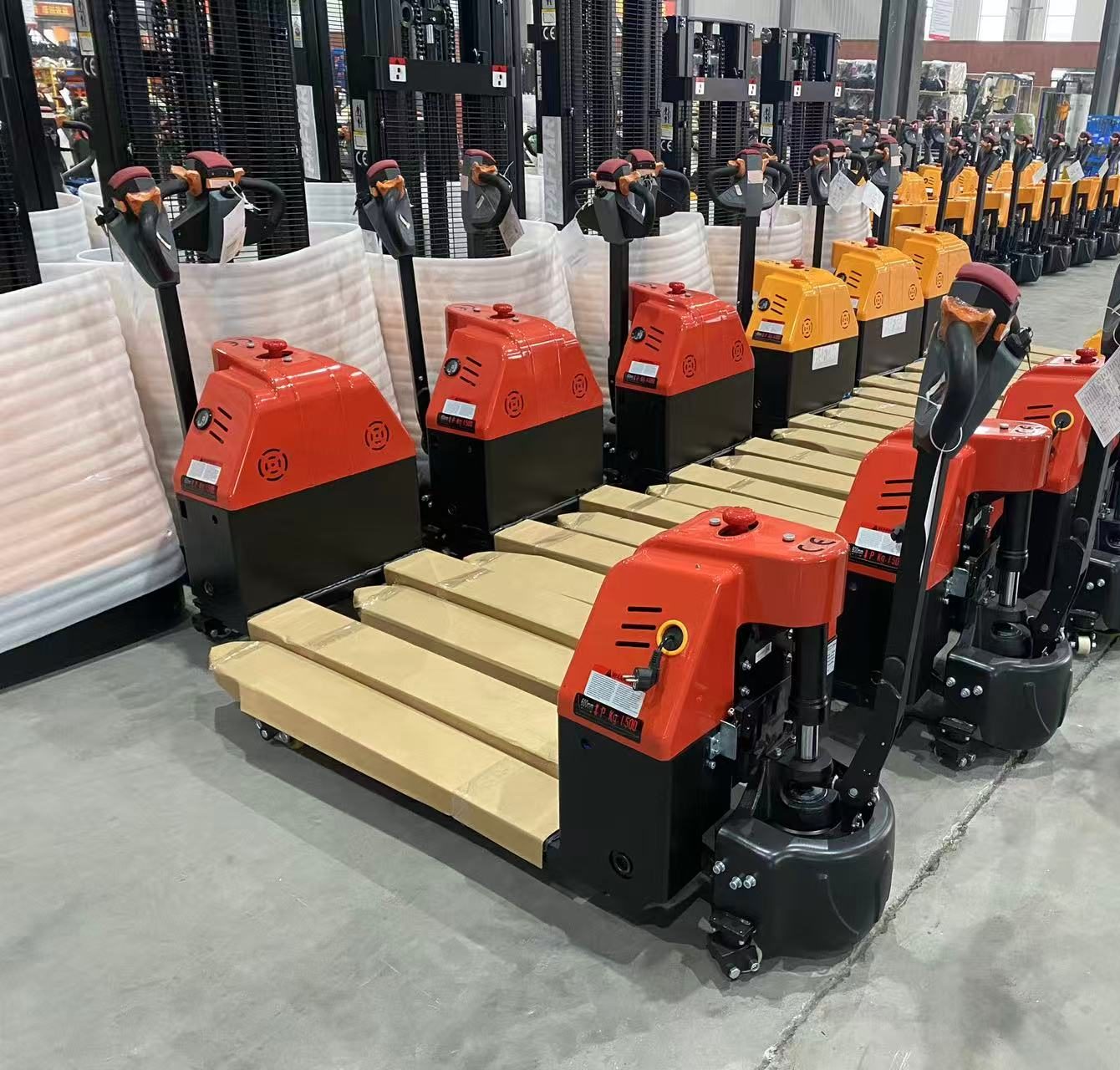
A logistics company in Poland recently asked us for fully electric pedestrian pallet trucks to load and unload TIR semi-trailers. Their list was clear: electric travel, lifting and lowering; a capacity of 1,500 to 2,000 kg; a compact truck with a small turning radius; lithium batteries; and about 20 hours on one charge.
Most of that list is straightforward. The last point needs an honest answer, and the rest comes down to measuring the right things. This guide covers what decides whether a pallet truck works well inside a trailer, using our SL15L3 and SL20L3 lithium pallet trucks as the example.
The space you work in
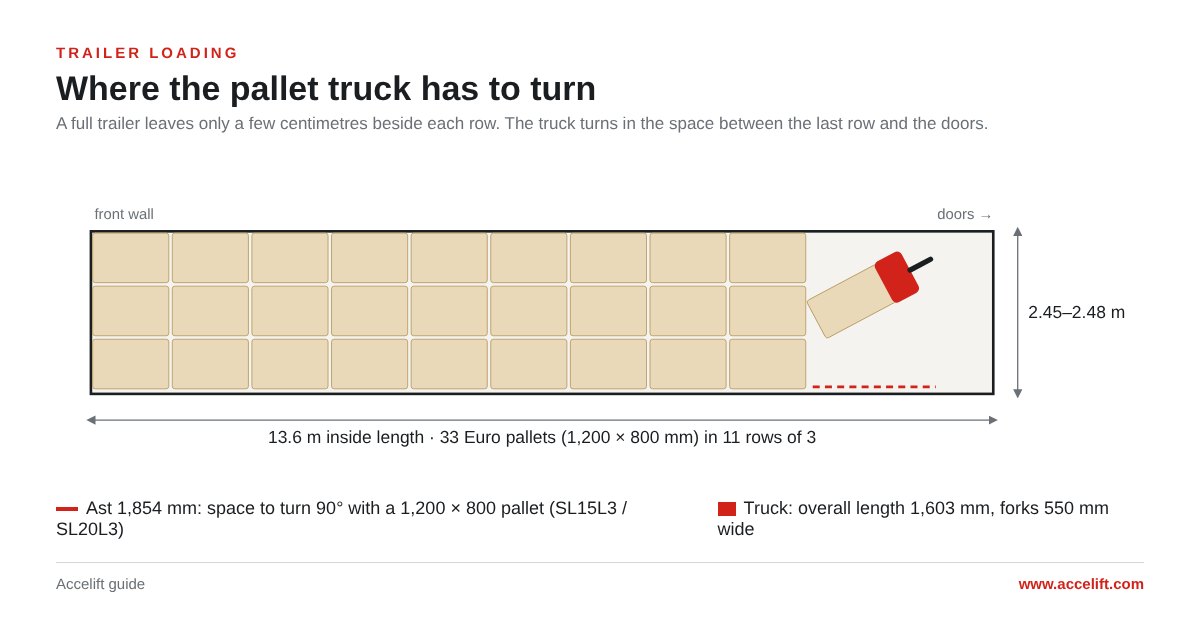
A standard European curtainsider or box semi-trailer has a load space about 13.6 m long and about 2.45 to 2.48 m wide inside. In one layer it takes 33 Euro pallets (1,200 × 800 mm), three across with the 800 mm side facing the doors, or 26 industrial pallets (1,200 × 1,000 mm), two across.
The width is the number to remember. It is barely wider than two 1,200 mm pallets side by side, so there are only a few centimetres to spare once a row is in. The pallet truck has to bring each pallet in, turn it and set it down between the pallets already loaded and the trailer wall, usually with no room to straighten up and try again.
The trailer floor carries the truck as well as the load. A 1,000 kg pallet on a truck of around 140 kg puts more than a tonne on a few small wheels as they cross the dock leveller and the trailer floor. A light truck is easier on both.
Overall length, turning radius and aisle width
Three figures on the spec sheet tell you whether a truck will be comfortable in a trailer:
- Overall length (l1), from the fork tips to the back of the truck. A short chassis leaves more of the trailer width free for the turn.
- Turning radius (Wa), the radius the outer corner of the chassis sweeps as the truck turns on the spot. It decides whether the truck can turn round inside the trailer at all.
- Aisle width (Ast), the width needed to turn through 90° with a pallet on the forks and set it down. For trailer work, compare it directly with the inside width of the trailer.
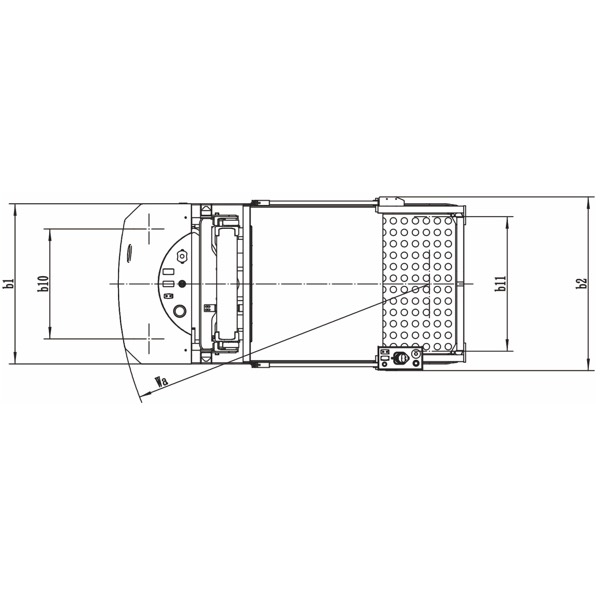
Our SL15L3 and SL20L3 have an overall length of 1,603 mm and a turning radius Wa of 1,398 mm. Ast is 1,854 mm with an 800 × 1,200 mm pallet carried lengthways, and 1,804 mm with a 1,000 × 1,200 mm pallet carried across. Against an inside trailer width of about 2,450 mm, that leaves a working margin of around 600 mm.
When you compare trucks from different suppliers, check that Ast is quoted for the same pallet carried the same way. On our own sheet the two figures differ by 50 mm, so it is easy to compare the wrong pair.
Forks, wheels and dock levellers
- Fork length. Keep 1,150 mm forks for 1,200 mm pallets. Longer forks stick out of the pallet and push into the one in front; shorter forks leave the end of the pallet unsupported.
- Fork width. The SL15L3 and SL20L3 come with forks 550 mm wide overall, which suits Euro pallets. A 685 mm version also exists; tell us which pallets you handle and we will fit the right one.
- Wheels. Choose polyurethane (PU) for the drive wheel and the load rollers. PU grips well on trailer floors and marks them less than hard nylon.
- Dock levellers. The leveller between the dock and the trailer is a ramp, and its slope changes with the floor height of each trailer. Ask the supplier for the truck’s gradeability, laden and unladen, and compare it with the steepest slope your leveller reaches.
- Brakes and safety. The SL15L3 and SL20L3 have an electromagnetic brake and a reverse anti-collision (belly) switch on the tiller head, which drives the truck away from the operator if it touches him.
Driving in a trailer
The operator walks behind the tiller. In a trailer the truck usually goes in forks first, with the operator following it in and then reversing out, so the precise work happens in a narrow space. Two features help:
- A creep or “turtle” speed with the tiller upright. The truck moves slowly through the last few centimetres while the operator stands close to it.
- Electric lifting and lowering. The pallet goes down exactly where it should, without pumping.
Travel speed on the SL15L3 and SL20L3 is 4.2 km/h laden and 4.5 km/h unladen, from a 0.75 kW drive motor, which is a normal walking pace. If the trucks also have to carry pallets a long way from the dock into the warehouse, a stand-on truck may be the better tool for that part of the job. Our guide to pedestrian, stand-on and rider pallet trucks explains where the line falls.
Twenty hours on one charge
No pedestrian pallet truck in this class will drive for 20 hours continuously on one charge, and ours are no exception. What makes trailer loading workable on a long shift is that the work is intermittent: the truck loads a trailer, waits for the next one, and starts again. The time it actually spends driving and lifting is much shorter than the shift.
Three things cover a long shift:
- The biggest battery. The SL15L3 runs on 24 V lithium packs of 20, 30, 40 or 60 Ah; the SL20L3 on 48 V packs of 10, 15, 20 or 30 Ah. The biggest pack of each, 24 V/60 Ah or 48 V/30 Ah, holds the same energy, about 1.44 kWh.
- A spare battery. The packs weigh only 6 to 13.2 kg and lift out of the truck by hand. With a second pack on the charger, a flat battery is swapped in a minute and the truck carries on.
- Charging in the breaks. Lithium batteries accept short partial charges during breaks and between trailers. Lead-acid batteries do not like partial charging, which is one more reason to choose lithium for this work.
To size the battery properly, tell us how many trailers each truck loads or unloads per shift, how far it travels with each pallet and how long the breaks are. With those figures we can tell you whether one pack is enough or a spare is worth having.
The SL15L3 and SL20L3 at a glance
| Item | SL15L3 | SL20L3 |
|---|---|---|
| Capacity | 1,500 kg | 2,000 kg |
| Overall length l1 | 1,603 mm | 1,603 mm |
| Fork length / width overall | 1,150 / 550 mm (685 mm option) | 1,150 / 550 mm (685 mm option) |
| Turning radius Wa | 1,398 mm | 1,398 mm |
| Ast, 800 × 1,200 lengthways | 1,854 mm | 1,854 mm |
| Travel speed laden / unladen | 4.2 / 4.5 km/h | 4.2 / 4.5 km/h |
| Lithium battery | 24 V, 20/30/40/60 Ah | 48 V, 10/15/20/30 Ah |
| Service weight | 129 to 146 kg, depending on version | |
Because they are compact and light, about 140 of these trucks fit in one 40 ft high-cube container, which keeps the freight cost per truck low. Lithium trucks travel as dangerous goods; our guide to shipping lithium pallet trucks explains what that means for the booking.
A checklist for trailer work
- The inside width of your trailers, and the pallets you load: Euro or industrial
- Ast for your pallet, compared with the trailer width
- Overall length l1 and turning radius Wa
- Service weight, for dock levellers and trailer floors
- Gradeability, compared with your steepest dock leveller slope
- Fork length of 1,150 mm and the right fork width
- PU drive wheel and load rollers
- Battery size, a spare pack and charging in the breaks, based on trailers per shift
For a wider view of the choices, read electric pallet trucks: what they do, and how to choose one. If you load and unload trailers and want trucks sized for your shift, contact us with the number of trailers, your pallet type and your shift pattern, and we will recommend a configuration.