
Service guide
An electric pallet truck or walkie stacker that will not charge is usually back at work the same day. Most often the fault is in the supply, a plug or a connector, not in the charger or the battery. Here are the checks in the order we would make them, easiest first, for built-in (on-board) and external chargers, with lead-acid or lithium batteries.
Safety first. Lower the forks fully, turn the key off and press the emergency stop before you start. Disconnect the battery before you touch any wiring or the hydraulics, never work under raised forks, and follow the manual for your model. Charge lead-acid batteries in a ventilated area: they give off hydrogen while charging, so no smoking, naked flames or sparks nearby.
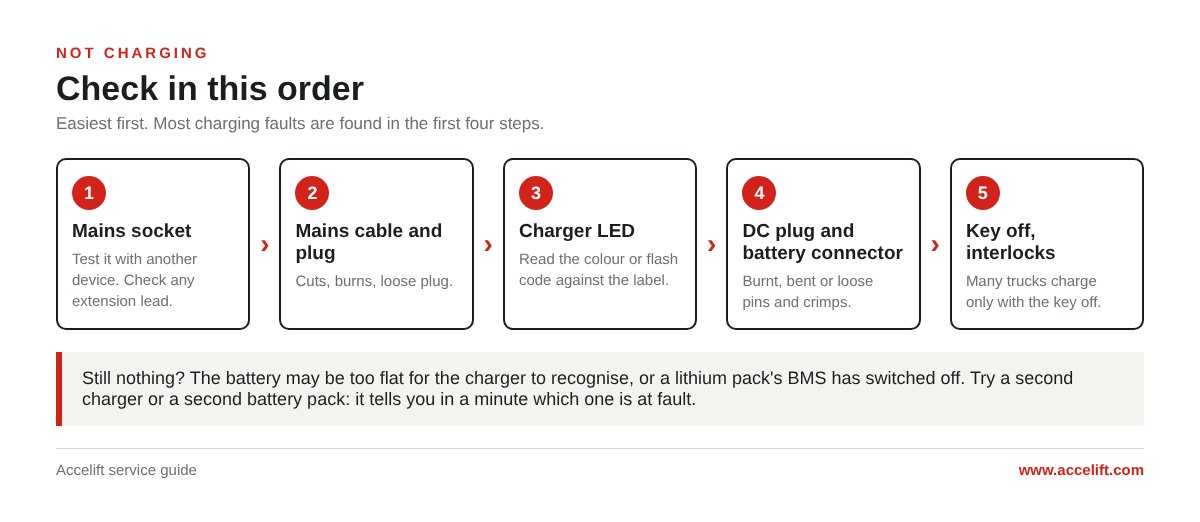
Five checks, easiest first
- The mains socket and any extension lead. Plug another device into the same socket to prove it is live. Then plug the charger straight into the wall: long or damaged extension leads and multi-way adaptors often cause a “dead” charger. Check the circuit breaker too.
- The charger’s mains cable and plug. Look for crushed or cut insulation, a loose plug and scorch marks. On a built-in charger the cable lives on the truck and gets trapped or run over.
- The status LED or display. Most chargers show what they are doing. Read the light against the label or the manual: many show a fault colour or a flash code. If nothing lights on a socket you know is live, the charger is not getting mains or has failed.
- The DC charging plug and the battery connector. With the battery disconnected, look at the pins: burnt or discoloured, bent, pushed back into the housing, or loose in their crimps. A connector that gets warm in use has a poor contact, which can stop a charger starting or make it stop early.
- The key switch. On many trucks the key must be off for charging to start. With a built-in charger, the truck will not drive while the mains plug is in. That is a safety interlock, not a fault.
If the truck charges but will not drive, see our guide to a pallet truck that lifts but won’t drive.
The charger will not start with a flat battery
Many automatic chargers measure the battery voltage before they start. If the battery reads below their minimum, the charger does not recognise that a battery is connected and stays idle or shows a fault. This is the classic problem after a long holiday.
- Lead-acid. A battery left flat for weeks can drop below the charger’s starting voltage. A battery service technician can bring it up carefully, but a battery that has stood flat for a long time is often sulphated and may not recover. As a general guide, a 12 V lead-acid block at rest that reads well below 12 V is deeply discharged. On a walkie stacker such as the CL15JB, which runs on two 12 V/100 Ah sealed blocks, measure each block on its own.
- Lithium. After an over-discharge, the pack’s battery management system (BMS) may switch its output off to protect the cells. The charger then sees nothing at the terminals. Some packs wake up when a charger is connected; otherwise contact the supplier. Never bypass the BMS or try to charge the cells directly.
The prevention is simple: never park a truck for a long break with a flat battery.
The charger shows “full” after a few minutes
The battery has lost capacity or has a dead cell, or the charger has the wrong profile. A worn battery can look fine at rest and drop sharply when the truck lifts or drives, so check the voltage under load. If the battery is the problem, our guide on when to replace a pallet truck battery explains the signs.
The charger never finishes
A charge that never reaches “full” usually has one of four causes:
- a weak cell that will not come up to voltage;
- low electrolyte in a flooded lead-acid battery;
- a charger set for a different battery type or voltage;
- a fault in the charger itself.
Lithium and lead-acid chargers are not interchangeable. If a charger has been borrowed from another truck, check its label first. On flooded lead-acid batteries, check the electrolyte level after charging and top up with distilled water only.
Cold stores and cold mornings
Lithium iron phosphate (LiFePO4) batteries must not be charged below 0 °C, and the BMS will block charging in the cold. In a cold store or an unheated building, bring the truck or the pack into a warmer area first and let it warm through. Lead-acid batteries also charge slowly in the cold.
Removable packs: the one-minute swap test
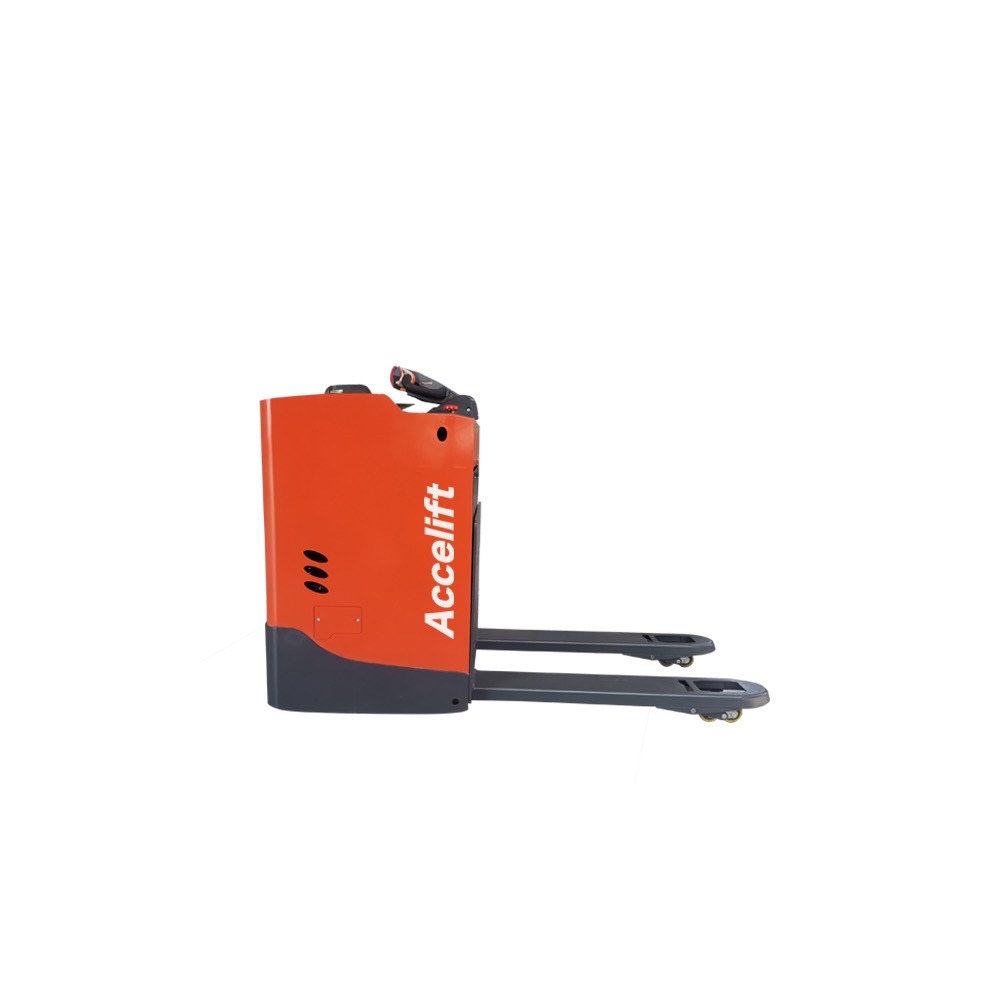
On trucks with a removable lithium pack the quickest diagnosis is a swap. Our SL15L3 and SL20L3 pallet trucks, for example, take a 24 V or 48 V pack weighing 6 to 13.2 kg, which comes out in a minute and can be charged off the truck.
- Put the suspect pack on a second charger of the same type.
- Put a known good pack on the suspect charger.
If the suspect pack charges on the good charger, the first charger is the problem. If the good pack charges on the suspect charger, look at the first pack. With a fixed battery, a second charger of the right type and voltage tells you the same.
Multimeter checks for a technician
A technician with a multimeter can go further:
- Measure at the battery terminals, at rest, charger disconnected.
- Measure the voltage at the charger’s DC output plug.
- Measure at the battery terminals again during charging: the voltage should rise slowly above the resting value.
If the charger output is present but the battery voltage does not move, look at the connector and cables between them, or at the battery. If there is no output at all, the charger has failed or is not detecting the battery. Compare readings with the values in the manuals for that truck.
When to stop and not charge
Do not charge, and take the truck out of service, if:
- the charger smells burnt or is very hot;
- the battery case is swollen or cracked;
- a lithium pack is swollen or hot.
Move the truck or pack to a ventilated area away from other stock if it is safe to do so, and call your dealer.
Symptoms at a glance
| Symptom | Likely cause | What to do |
|---|---|---|
| No light on the charger at all | No mains: socket, extension lead, breaker, charger mains cable | Test the socket with another device, plug in direct, inspect the cable |
| Charger shows a fault colour or flash code | Charger has detected a problem | Read the code against the label or manual |
| Charger will not start, battery very flat | Voltage below the charger’s minimum, or lithium BMS has switched off | Lead-acid: battery technician. Lithium: contact the supplier, never bypass the BMS |
| “Full” after a few minutes | Worn battery, dead cell or wrong charger profile | Check voltage under load and the charger label |
| Charge never finishes | Weak cell, low electrolyte, wrong charger, charger fault | Check electrolyte, charger type and voltage, try a second charger |
| Lithium will not charge in a cold store | BMS blocks charging below 0 °C | Warm the truck or pack first, then charge |
For dealers: parts worth keeping on the shelf
A charging fault stops a truck completely. A spare charger on your shelf turns a two-day breakdown into a ten-minute swap.
- A spare charger of each type you sell: lead-acid and lithium, for each voltage.
- Battery connectors and DC charging plugs, with crimp contacts.
- A charged spare pack for models with removable lithium batteries, for the swap test.
- A multimeter and, for flooded batteries, a hydrometer in the service van.
Our spare parts guide for new dealers lists the rest of a starter kit, and our maintenance checklist catches cable damage early. For chargers, packs and spare parts for your trucks, contact us, or see our partner programme if you want to sell Accelift trucks.