
Service guide
Every traction battery wears out. The questions are when, and whether the problem in front of you really is the battery. A battery is one of the most expensive parts of an electric pallet truck or stacker, so it pays to be sure before you order one. This guide covers lead-acid, flooded and sealed (maintenance-free), and lithium.
Before you check anything, lower the forks fully, turn the key off and press the emergency stop. Disconnect the battery before you touch terminals, cables or connectors. Never work under raised forks. Lead-acid batteries contain acid and give off hydrogen while charging, so wear gloves and eye protection and keep sparks and flames away. Follow the manual for your model.
What “worn out” means
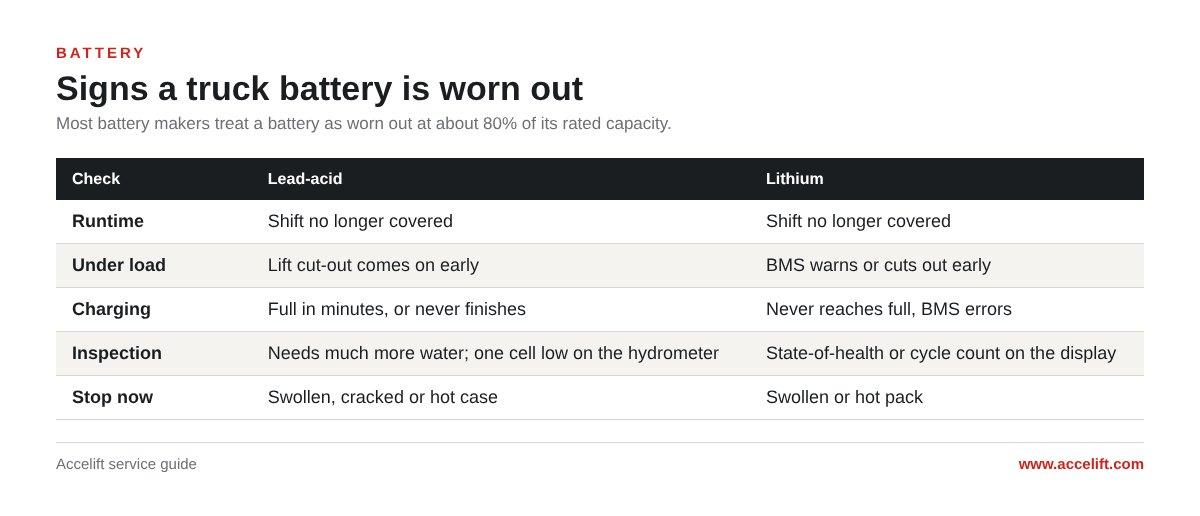
Most battery makers count a battery as worn out when it can only deliver about 80% of its rated capacity. A 100 Ah battery that now holds 80 Ah does a fifth less work on every charge.
In the warehouse, it shows up as a truck that no longer gets through the shift.
Rule out the other causes first
A short runtime is not always the battery. Check these first:
- The charger finishes its charge. A charger that stops early or is set for the wrong battery type leaves a good battery half full. See our guide to an electric pallet truck not charging.
- The truck is charged fully every night. If the charger is unplugged before it finishes, the truck starts the shift part-empty.
- The battery connector and cables. A burnt, loose or corroded connector loses voltage under load and mimics a weak battery.
- The work has changed. More lifts, longer runs or a second shift. The battery may simply be too small for today’s job.
Signs on a lead-acid battery
- The runtime is clearly shorter than when the truck was new.
- The lift cut-out comes on early. A worn battery’s voltage sags under load, even when the gauge looked fine.
- A flooded battery needs much more water than it used to.
- After a full charge, one cell reads well below the others on a hydrometer (specific gravity).
- The case is swollen or cracked, or the battery gets hot during charging.
- Heavy corrosion on the terminals, connectors or battery tray.
Sealed batteries have no water to check and no cells to test with a hydrometer, so judge them by runtime and by voltage under load. A technician can measure each block while the truck lifts a load; in a pair of blocks, one that reads clearly lower than the other is the weak one.
For planning, a lead-acid battery lasts three to four years in normal single-shift use. It lasts less if it is regularly run flat, or if it is opportunity-charged with short top-ups during breaks, which wears lead-acid out faster than anything else. In year four the signs above usually mean a new battery; in year one, look harder at the charger and how the truck is used.
Signs on a lithium battery
- The runtime is shorter than it was.
- Many packs report a state-of-health (SOH) figure or a cycle count through the battery management system (BMS) or the truck’s display. A falling SOH is the clearest sign you will get.
- BMS error messages.
- A large voltage difference between cells, read by the BMS.
A swollen or hot lithium pack must be taken out of service immediately. Move it to a ventilated area away from anything that burns, do not charge it and call your dealer.
Lithium lasts longer and accepts opportunity charging. Ask your supplier how many cycles the pack is rated for and at what depth of discharge. With a removable pack, such as those on our SL15L3 and SL20L3 pallet trucks, the quickest check is to run a shift on a second pack and compare.
A runtime test anyone can do
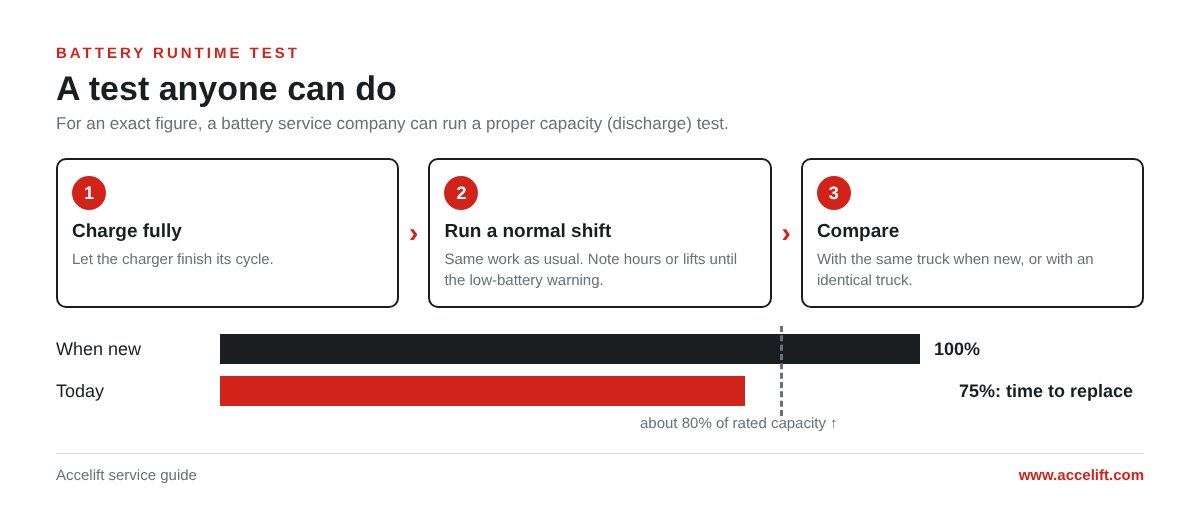
- Charge the battery fully and let the charger finish its cycle.
- Run a normal shift with normal loads.
- Note the hours worked and, roughly, the number of lifts or pallets moved before the low-battery warning or the lift cut-out.
- Compare with the same figures from when the truck was new, or with an identical truck doing the same work.
If the truck now manages clearly less, a fifth or more, the battery is close to the point most makers call worn out. For a firm answer, a battery service company can run a proper capacity test: they discharge the battery at a controlled current and measure what it actually delivers.
Note the runtime of every new truck in its first weeks, so there is a figure to compare with later.
Repair or replace
On a large flooded traction battery with bolted cell connectors, a single bad cell can sometimes be replaced by a battery service company. If the cells have simply drifted apart, an equalising charge, done as the battery maker describes, can bring them back into line. On a battery where every cell is near the end, a new cell buys little time.
Sealed 12 V blocks cannot be repaired. When one block of a pair fails, replace both together, never one. A new block wired in series with a worn one is dragged down by it and wears out early.
A lithium pack is not a job for a general workshop. Do not open it. Contact the supplier with the BMS readings.
Choosing the replacement
- The same voltage.
- A capacity (Ah) at least as large as the original.
- The same dimensions.
- The same weight, or a weight the manufacturer has approved.
- A charger that matches the chemistry. Lithium and lead-acid chargers are not interchangeable.
On stackers, and especially on counterbalanced stackers such as the CPD20J-R, the battery is part of the counterweight. A 24 V/210 Ah traction battery on one of our larger AC stackers weighs about 190 to 195 kg. Replacing a battery like that with a much lighter lithium pack changes the truck’s stability, and must be approved by the manufacturer first.
The CL15JB walkie stacker runs on two 12 V/100 Ah sealed lead-acid blocks of 27 kg each, a common size local battery suppliers usually stock. The SL15L3 and SL20L3 pallet trucks use removable lithium packs (24 V on the SL15L3, 48 V on the SL20L3) weighing 6 to 13.2 kg. If you are weighing up a change of chemistry, read lead-acid or lithium for an electric stacker and our five-year cost comparison.
Disposal
Lead-acid batteries are recycled. Return the old one to the supplier of the new one or to a licensed recycler. Lithium packs are hazardous waste and also go to a licensed recycler.
Quick reference
| Sign | Lead-acid | Lithium | What to do |
|---|---|---|---|
| Shorter runtime | Normal with age; check the charger first | Check the SOH figure or cycle count | Run the runtime test and compare with new |
| Lift cut-out comes on early | Voltage sags under load | Read the BMS for errors | Technician checks voltage under load |
| One cell different from the rest | Low hydrometer reading after full charge | Large cell voltage difference in the BMS | Lead-acid: equalising charge or cell replacement; lithium: contact the supplier |
| Needs much more water | Flooded batteries only | Not applicable | Check the charger, then the hydrometer readings |
| Swollen, cracked or hot | Stop using it | Stop using it immediately | Take out of service, ventilated area, call the dealer |
For dealers: battery sales you can plan
A lead-acid battery sale in year three or four is predictable business. A few habits make the most of it:
- Record the battery type, size and date fitted for every truck you sell or service.
- In year three, offer the customer a runtime test, and quote a battery if it is due.
- Keep a pair of the common 12 V sealed blocks in stock, or know a local supplier who does.
- For lithium trucks, keep a spare pack of each type you sell. It settles the “battery or charger” question on the spot.
For the rest of the shelf, see spare parts for a new dealer. If you need a replacement battery, pack or charger for an Accelift truck, contact us with the model and serial number; dealers can read about our partner programme.