
Buyer’s guide
We have written about the battery question in general, in the five-year cost of a warehouse truck battery. Electric stackers deserve their own answer, because a stacker uses its battery differently from a pallet truck. Most of the energy goes into lifting, and that changes when lithium is worth paying for.
Where the energy goes on a stacker
Look at the motor ratings on any stacker spec sheet. On our CL1530JB walkie stacker the drive motor is rated at 0.75 kW and the lift motor at 2.2 kW. On the larger CL2030GF it is 1.5 kW for driving and 3.0 kW for lifting.
The lift motor is the heavy consumer. It only runs for seconds at a time, but every lift of a loaded pallet to the top level of the racking draws the largest current the battery ever delivers. So a stacker’s battery life depends far more on how many lifts it makes, how high and how heavy than on how many hours it is switched on. Two identical stackers on the same eight-hour shift can use very different amounts of energy: one moving a few pallets onto the first beam level, the other putting full pallets on the third level all day.
The batteries in our stacker range
| Stacker | Type | Standard battery | Nominal energy | Battery weight |
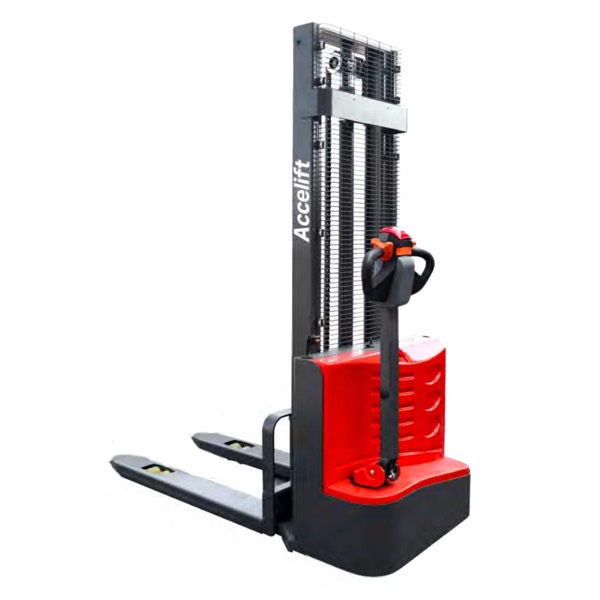
| CL1230J, CL1530JB | Walkie, DC drive | 2 × 12 V / 100 Ah | 2,400 Wh | 2 × 27 kg |
| CL15SE | Walkie, DC drive | 2 × 12 V / 120 Ah | 2,880 Wh | 2 × 34 kg |
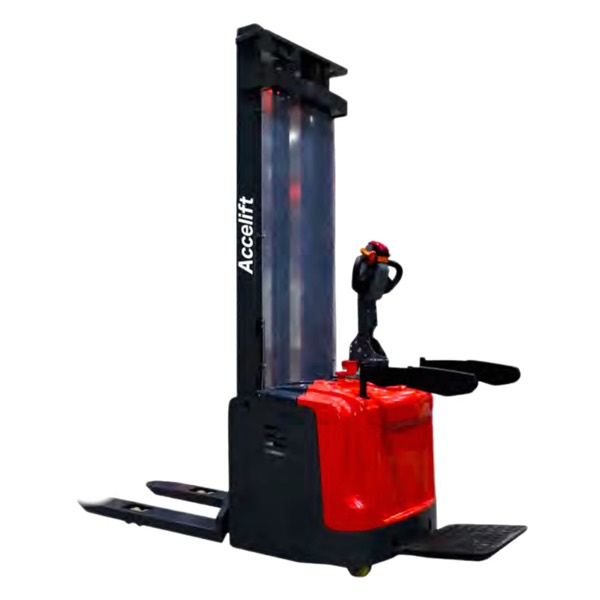
| CLGA | Stand-on, AC drive | 24 V / 210 Ah | 5,040 Wh | 190 kg |
| CL2030GF | Walkie, AC drive | 24 V / 210 Ah | 5,040 Wh | 195 kg |
There are really two classes here. The light walkie stackers carry two 12 V blocks, a common battery size that can be bought in most countries. The heavier AC stackers carry a full traction battery with five kilowatt-hours or more.
When lead-acid is the right choice
For many stackers, it still is. A shop, a small warehouse or a workshop that makes a few dozen lifts a day, works one shift and charges overnight will not use a lithium battery’s advantages. Sealed maintenance-free batteries, like the pair on the CL1530JB, need no watering, cost least to buy, and when they wear out after a few years they can usually be replaced from a local battery supplier. For a dealer, that last point matters: a customer who can buy a replacement battery down the road is a customer who does not call you angry.
When lithium pays
- Two shifts, or one long one. Lithium accepts short charges in the breaks without harm. A lead-acid battery that is topped up in every break wears out early, so a second shift on lead-acid usually means a second battery and a battery change.
- A lot of high lifts. As a lead-acid battery discharges, its voltage falls, and on a stacker you notice: the forks rise more slowly towards the end of the shift. A lithium battery holds its voltage almost flat until it is nearly empty, so the last lift of the day is as fast as the first.
- Usable capacity. Lead-acid should only be discharged to about half its capacity if it is to last; lithium can use 80–90% of it. A smaller lithium pack does the same work as a bigger lead-acid battery.
- No battery room. No acid, no watering and no gassing while charging. The stacker charges wherever it is parked.
The price difference is smaller than most buyers expect. On our CLGA stand-on stacker, the 24 V / 150 Ah lithium option costs about USD 210 more than the standard 24 V / 210 Ah lead-acid battery. In April 2024 the difference was about USD 370.
Two cautions
Weight is part of the design. A 24 V / 210 Ah lead-acid battery weighs about 190 kg; a lithium pack of the same usable energy weighs a fraction of that. On a straddle stacker the support legs carry the stability, but on any truck that relies on its own weight as a counterweight, such as a counterbalanced stacker, a lighter battery changes the stability. Fit lithium as a factory option, with the ballast the manufacturer specifies, and never swap in a lighter battery yourself.
Lithium needs its own charger. A lithium pack has a battery management system and a charging profile of its own. Charge it only with the charger supplied for it, never with a lead-acid charger.
Lithium also changes how the stacker ships: a lithium battery travels as dangerous goods. It is routine, but your forwarder needs to know. See lithium pallet truck shipping for what that involves.
The short version
| How the stacker is used | Battery |
| One shift, light use, overnight charging | Standard maintenance-free lead-acid |
| One long shift, many lifts to the top level | Lithium, or a larger lead-acid battery |
| Two or three shifts | Lithium, charged in the breaks |
| No space for a battery charging area | Lithium |
If you are choosing a stacker as well as a battery, start with how to choose an electric stacker. To ask about lithium on a particular model, contact us with the model, the shifts per day and roughly how many lifts per hour. See all electric stackers →