
Buyer’s guide
More and more of our customers now ask for lithium. A few years ago the battery was the reason to say no: the lithium version of a truck cost a lot more than the lead-acid one. That gap has narrowed. On most pallet trucks and stackers, the question is no longer whether you can afford lithium. It is why the freight quote looks different, and why your forwarder suddenly wants more paperwork.
The answer is simple: a lithium battery travels as dangerous goods. This guide explains what that changes, which documents you need, and how to keep a lithium order as easy to ship as any other.
The price gap is no longer the problem
Lithium iron phosphate (LFP) packs have become standard on warehouse trucks, and their price has fallen fast. Here is what the lithium option costs on three of our own trucks, compared with the standard lead-acid battery. The figures are what we charge on top of the lead-acid version, converted from RMB at today’s exchange rate.
| Truck | Standard lead-acid | Lithium option | Extra for lithium, April 2024 | Extra for lithium now |
| SL20GE pedestrian pallet truck | 24 V / 210 Ah | 24 V / 150 Ah | about USD 270 | about USD 100 |
| CLGA stand-on stacker | 24 V / 210 Ah | 24 V / 150 Ah | about USD 370 | about USD 210 |
| E-GS three-wheel counterbalanced truck | 24 V / 400 Ah | 24 V / 200 Ah | about USD 510 | no extra charge |
The smaller amp-hour figure on the lithium packs is not a trick. Lead-acid should only be run down to about half its capacity, while lithium can use 80–90% of it. So the 150 Ah lithium pack on the pallet truck and the stacker does about the same work per charge as the 210 Ah lead-acid battery. The 200 Ah pack on the counterbalanced truck holds somewhat less usable energy than the 400 Ah lead-acid battery. For a single shift with charging in the breaks it is enough; for long continuous shifts, ask us for a larger pack.
Against the savings — no watering, no charging room, opportunity charging and no second battery for a second shift — a hundred or two hundred dollars is small. We work through the numbers in Lead-Acid or Lithium? The Five-Year Cost of a Warehouse Truck Battery.
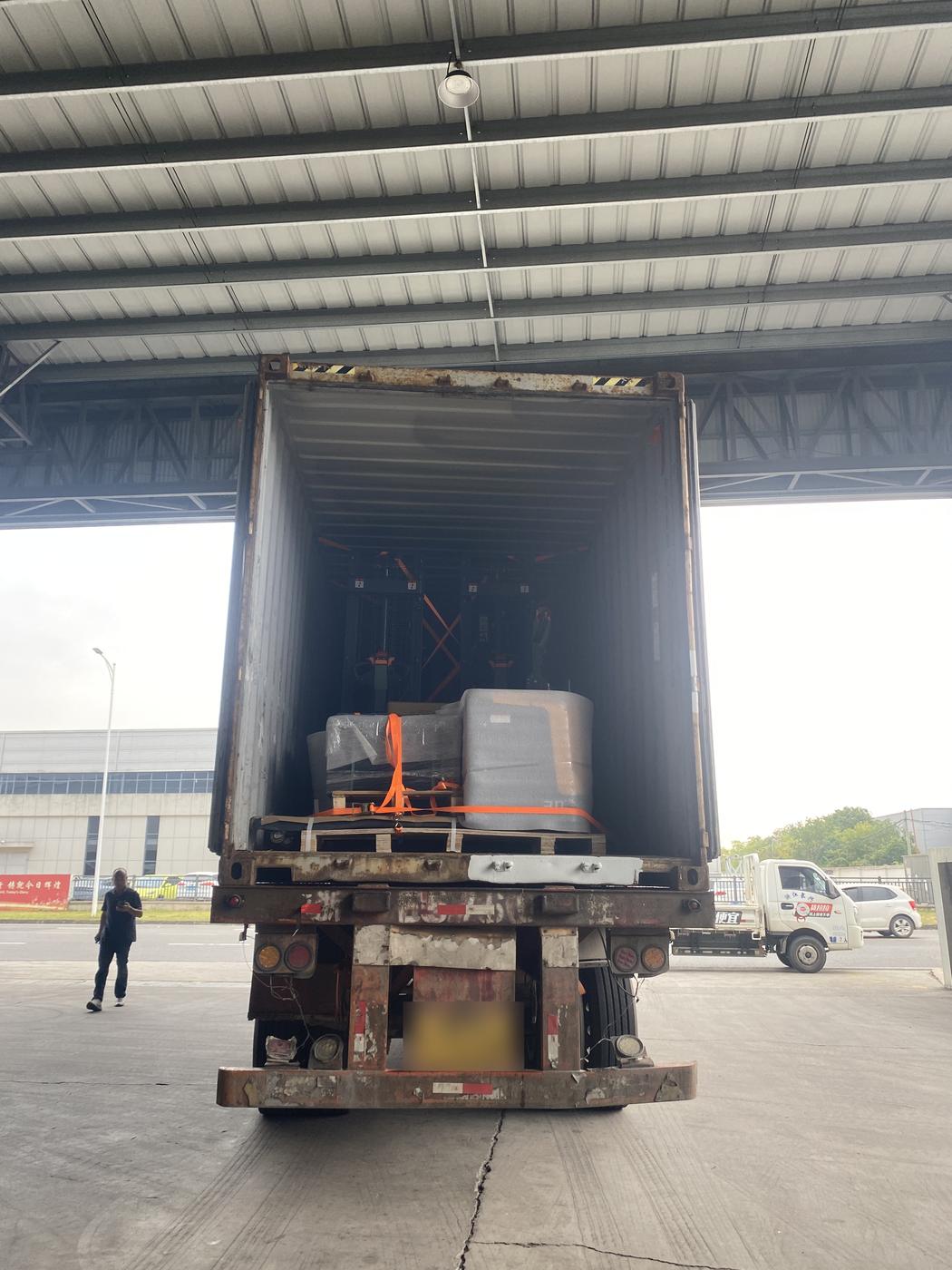
The cost that buyers do not expect is in the logistics. A lithium battery ships as dangerous goods, and that is true whether it is fitted to the truck or packed on its own.
A lithium truck is dangerous goods at sea
Lithium-ion batteries are Class 9 dangerous goods under the IMDG Code, the rulebook for dangerous goods at sea. What changes is the UN number on the papers:
| What you ship | How it is usually declared |
| Truck with its lithium pack fitted | UN 3556, Vehicle, lithium ion battery powered |
| Spare lithium packs, packed on their own | UN 3480, Lithium ion batteries |
| Small machine with a pack inside, classed as equipment | UN 3481, Lithium ion batteries contained in equipment |
Since 1 January 2026, when IMDG Amendment 42-24 became mandatory, the old entry UN 3171 (“battery-powered vehicle”) can no longer be used for lithium-powered vehicles. Bookings that still use it can be delayed or rejected. If your forwarder or an old supplier template says UN 3171 for a lithium truck, have it corrected before booking.
Which entry fits a particular model is decided by the classification report for that model (see the documents below), so agree it with your forwarder before you book. Two more points catch people out:
- One lithium truck makes the whole container a dangerous-goods shipment. In a mixed container of lead-acid and lithium trucks, the whole box is booked, labelled and handled as dangerous goods.
- Labels and placards. Lithium-powered vehicles carry the Class 9A lithium battery label, and the container is placarded. Maersk, for example, recommends placards on all four sides of the container.
What changes when you book
| Step | What to expect with lithium |
| Booking | The shipping line must approve the dangerous-goods booking before it is confirmed. Not every sailing, route or transshipment port accepts Class 9, so it takes longer to get space. |
| Freight | Most lines add a dangerous-goods surcharge to the ocean freight. Ask your forwarder for an all-in quote that includes it. |
| Less-than-container loads | Many consolidators will not take dangerous goods. A full container is simpler, and often cheaper in the end. |
| Destination | Expect dangerous-goods handling charges at the port. Local trucking and warehousing may have to be done by companies licensed for dangerous goods. |
The documents you will need
Your forwarder needs most of these before it can book. On our side we prepare them for every lithium model we ship:
- UN 38.3 test summary for each battery pack model. Every lithium cell and battery must pass the UN 38.3 transport tests, and the test summary has to be available to anyone in the shipping chain.
- Safety data sheet (SDS, MSDS), with the transport section (section 14) showing the correct UN number.
- Transport classification report from a recognised test lab in China. Chinese ports and shipping lines ask for it for lithium shipments, and it must match the UN number on the booking.
- Dangerous goods declaration, made out by the shipper for the specific shipment.
- Container packing certificate, signed when the container is loaded, confirming that the load is packed, secured, labelled and placarded correctly.
Air freight: almost never worth it
Now and then a customer wants a spare pack by air. It can be done, but the rules are strict. Lithium batteries shipped on their own (UN 3480) may only fly on cargo aircraft, at a state of charge of no more than 30%. Since 1 January 2026 the IATA rules also limit packs shipped with or inside equipment, and battery-powered vehicles, to 30% charge. A pallet truck pack is far above the size where these limits start. Sending the truck itself by air is rarely worth the cost.
The cheaper answer is to plan ahead: order a spare pack with the trucks, and it travels in the same container.
Five ways to make lithium shipping easy
- Put spare packs in the same container as the trucks. The container is already a dangerous-goods booking, so the spares add paperwork but no extra booking.
- Use a forwarder that ships dangerous goods every week. Ask before you place the order, not when the goods are ready. A forwarder who rarely handles Class 9 will be slow and expensive.
- Book earlier than you would for a lead-acid order. Add a few days for the dangerous-goods approval, more on routes with few sailings.
- Prefer full containers. If you are buying a few trucks, combine them with other models in one container rather than shipping them as a part load. See how we plan a mixed 40HQ.
- Tell us your destination port early. We can check which lines accept lithium on that route before you commit.
When the trucks arrive, give each pack a full charge before the first shift and follow the storage instructions in the manual if the trucks will wait before going into service.
Is lithium still worth it?
For most buyers, yes. The shipping is more work, but it is work done once per order, mostly by the people who do it every day. The savings in the warehouse keep coming for years. If you have not looked at lithium since the price was the obstacle, it is worth another look. For what to check in the pack itself, read Lithium-Ion Batteries for Warehouse Trucks. For the trucks, see our electric pallet trucks, or send us your models and destination port and we will tell you what the shipment involves.