
Dealer guide
Before a first order, our European dealers nearly always ask the same things: which port, how long at sea, what changes with lithium batteries, and which papers customs will want. This guide answers them the way we see it on our own shipments from Shanghai and Ningbo.
The sea times below are typical ranges, not promises. Schedules vary by carrier, route and season, so ask your forwarder for the current sailings before you give your customer a delivery date.
FOB, CIF or DAP
We quote FOB Shanghai or Ningbo. FOB (free on board) means we deliver the trucks, cleared for export, on board the ship at the Chinese port. From there, sea freight, insurance, import clearance and delivery are on the buyer’s side.
- FOB: you book the freight with your own forwarder. Most of our dealers work this way, and FOB prices from different factories are easy to compare.
- CIF (cost, insurance and freight): the seller pays freight and insurance to your destination port. The risk still passes to you when the goods are loaded in China, and you clear customs at your end.
- DAP (delivered at place): the seller arranges transport to a named place, such as your warehouse, but import duty, VAT and customs clearance stay with the buyer.
If you would rather not arrange the freight yourself, we can quote CIF to your port once the models and quantities are known. We ask our forwarder for a price on each shipment, because sea freight rates change from month to month.
Typical sea times to European ports
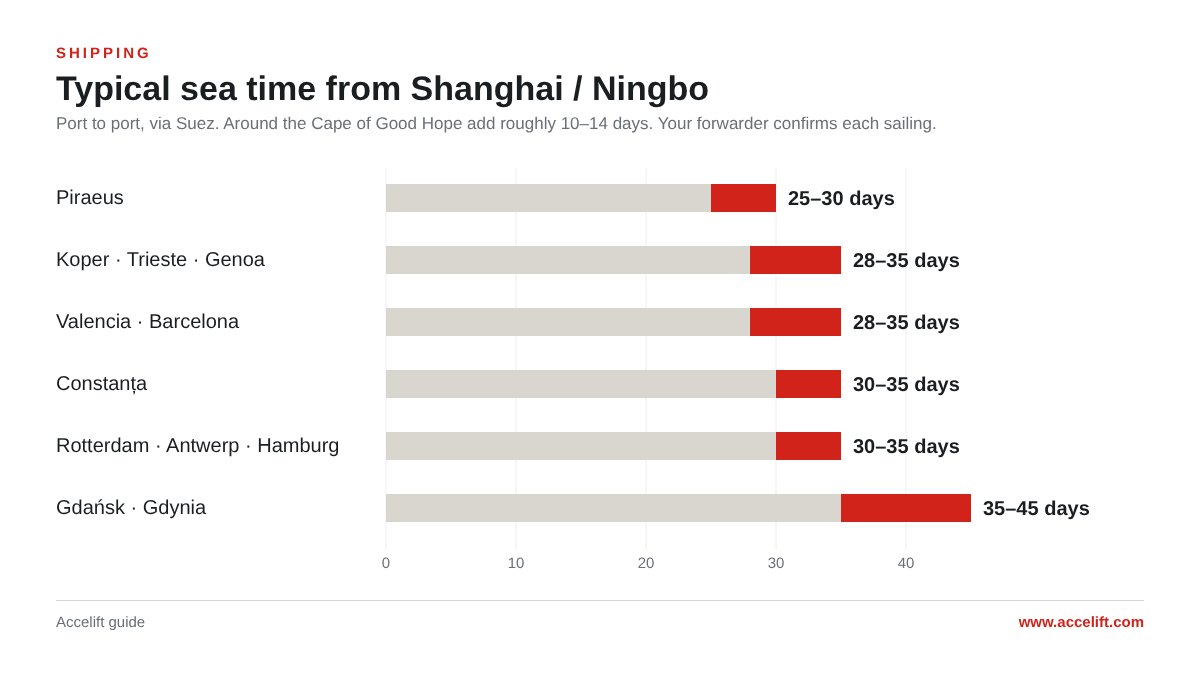
These are typical port-to-port times from Shanghai or Ningbo when ships use the Suez Canal:
| Destination port | Typical sea time | Note |
|---|---|---|
| Piraeus | about 25–30 days | |
| Koper, Trieste, Genoa | about 28–35 days | |
| Valencia, Barcelona | about 28–35 days | |
| Constanța | about 30–35 days | |
| Rotterdam, Antwerp, Hamburg | about 30–35 days | |
| Gdańsk, Gdynia | about 35–45 days | Often via transhipment |
When carriers route around the Cape of Good Hope instead of through Suez, add roughly 10 to 14 days to these figures. Lines have changed their routing more than once in recent years, so check which way your sailing goes, not just the departure date.
A transhipment means the container is moved to another ship at a hub port on the way. It adds time and some risk of a missed connection, which is why the Baltic ports show the widest range.
The nearest port on the map is not always the cheapest or fastest way to your warehouse. If you are inland, for example in Central Europe, ask your forwarder to compare a Mediterranean port with a North Sea port, including the trucking from each.
From order to warehouse
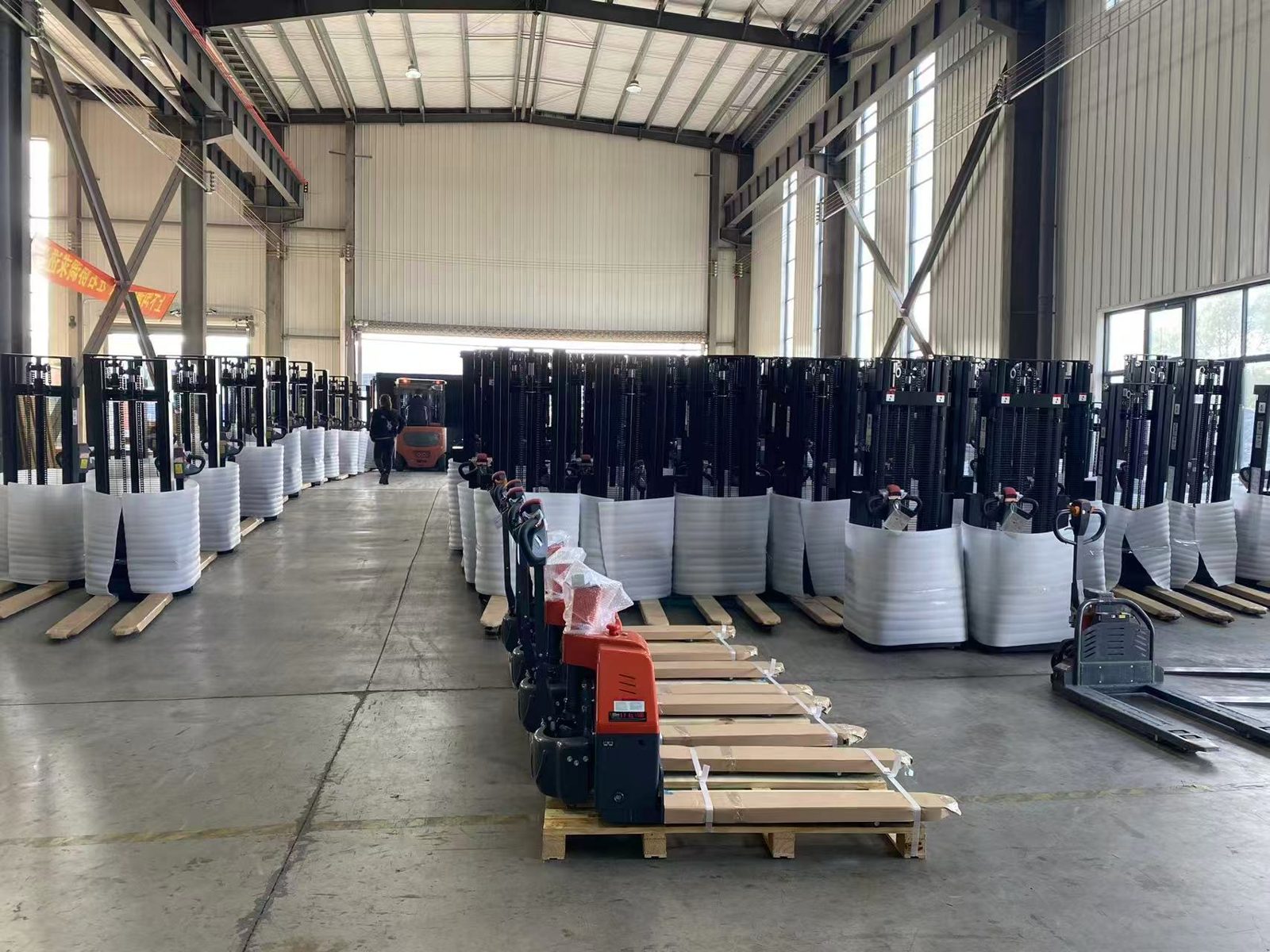
Production takes about one month from order confirmation. After that come booking and loading, the sea voyage, customs clearance and the delivery to your door. For most European ports, plan two to two and a half months from order to warehouse.
Allow more time if your container goes to a Baltic port via transhipment, if ships are going around the Cape, or if your order falls near Chinese New Year, when factories and ports in China close for the holiday. For stock you need in the first quarter, order early.
Planning the container
Pallet trucks pack tightly; anything with a mast takes much more space. As a guide, one 40 ft high-cube container holds about:
- 140 compact lithium pallet trucks such as the SL15L3 or SL20L3
- 114 standard pedestrian 1.5 t pallet trucks
- 35 small stackers (1.0–1.5 t, up to 3.5 m lift)
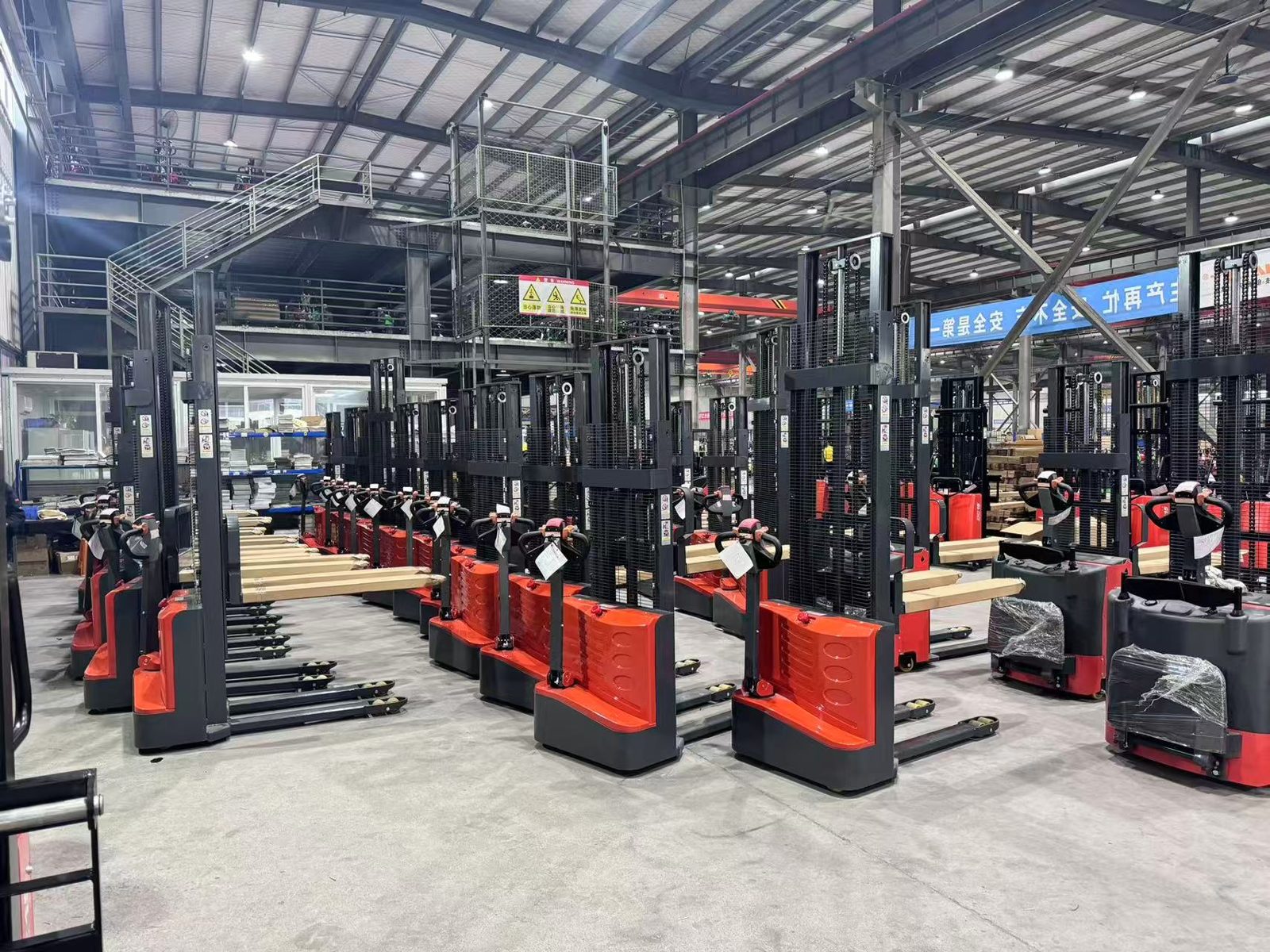
Most dealer containers are mixed. Stackers go in first, and pallet trucks are packed around and between them, so a full starter range arrives in one shipment and the freight cost per truck stays low. Our guide to a small mixed first order shows how a first container is usually put together.
We wrap and strap every truck and secure the load inside the container, so the trucks arrive ready to sell. You can see how this looks in practice in our log of a mixed 40HQ container loaded for a dealer in Peru.
Lithium batteries ship as dangerous goods
A truck with a lithium battery travels as Class 9 dangerous goods. That changes the shipment in four ways:
- Documents. Your forwarder needs the battery’s UN 38.3 test summary and the safety data sheet (MSDS). We supply both with the shipment.
- Booking. The container is booked as dangerous goods, and the shipping line has to accept it. Tell your forwarder about the lithium at the start, not when the container is ready.
- Cost. Lines and terminals charge dangerous-goods surcharges, so freight costs more than for the same trucks with lead-acid batteries.
- Container type. In practice lithium trucks ship by full container. Shipping them as part of a shared (LCL) load is possible, but the surcharge per unit makes it expensive.
For a small mixed trial order, lead-acid versions avoid the dangerous-goods handling altogether. Many dealers start that way and move to lithium once their forwarder has the routine. Our guide to shipping lithium pallet trucks covers the rules in more detail.
The documents
For each shipment we send:
- commercial invoice and packing list, with models, quantities, weights and the Incoterm;
- bill of lading, issued once the container is on board;
- certificate of origin;
- CE Declaration of Conformity for each model, which EU customs and market surveillance may ask to see;
- for lithium trucks, the battery documents listed above.
Electric pallet trucks are classified under HS 8427 10, self-propelled trucks powered by an electric motor. Import duty and VAT depend on the code and on the country where you clear the goods, so confirm the duty with your customs broker before the first shipment and use the same code every time.
One point causes confusion. The EU charges an anti-dumping duty on manual hand pallet trucks from China, but it does not apply to electric pallet trucks or stackers. Our guide to the EU anti-dumping duty on hand pallet trucks explains where the line is drawn.
A checklist before you book
- FOB with your own forwarder, or a CIF quote from us
- Your destination port, and the trucking cost from it to your warehouse
- The current sailing schedule and route: Suez or the Cape
- Container size and model mix
- Lithium or lead-acid, and a forwarder who accepts dangerous goods
- The HS code and import duty, confirmed with your broker
- A delivery date to your customer that allows for transhipment and holidays
For lead times, spare parts and container loads in more detail, read importing warehouse equipment from China. When you know the models and your destination port, contact us and we will come back with a quotation, FOB or CIF.