
Buyer’s guide
“How much is an electric pallet truck?” has no single answer. Two trucks with the same capacity on the nameplate can differ in price by a factor of three or more, and both prices can be fair. This guide explains what actually moves the price, gives typical retail ranges, and shows where a dealer or importer can save.
Typical retail prices
Published retail prices in 2026 fall roughly into these bands. They are indicative only: currency, taxes, delivery and local competition all move them.
| Type | Typical retail range |
| Manual hand pallet truck | About USD 300–700 |
| Compact pedestrian electric, 1.5 t, small lithium battery, sold online | From about GBP 950 in the UK |
| Pedestrian electric walkie pallet truck | About USD 1,500–4,000 in the US |
| Industrial lithium pedestrian truck | About AUD 6,000–8,000 and up in Australia |
| Rider or stand-on electric pallet truck | About AUD 8,000–15,000 and up in Australia |
Trucks from the large international brands, sold through their own dealer networks with service contracts, usually sit at the top of these ranges or above them.
What moves the price
1. Duty class
The biggest single factor. A light-duty truck built for a shop back room, with a small battery and a light chassis, is a different machine from an industrial truck built to run every shift in a distribution centre. Look at the drive motor rating, the chassis steel, the wheel size and the stated duty cycle, not only the capacity on the nameplate.
2. Battery
Battery type and size can account for a large share of the price. Lithium costs more to buy than lead-acid but needs no watering, charges faster and accepts short top-up charges during breaks. A small lithium pack suits occasional use; a full shift needs a larger one. Compare usable watt-hours rather than amp-hours alone. For the full calculation, see lead-acid or lithium: the five-year cost.
3. Capacity
Moving from 1.5 t to 2 t adds less than you might expect. Moving to 3 t adds more: a heavier chassis, bigger motor and larger battery. Buy the capacity your heaviest regular load needs, with a margin, not the biggest number available. Our guide to choosing an electric pallet truck covers sizing.
4. Operator position
A pedestrian truck is the cheapest. A folding platform for the operator adds cost; a stand-on or rider truck with side protection adds more. The difference pays back only on long travel distances. See pedestrian, stand-on or rider.
5. Components
Controllers, motors, pumps and wheels from known suppliers cost more but are easier to service and to source locally later. Ask which controller and which battery cells are fitted.
6. Options and special builds
Longer or wider forks, stainless steel for wash-down areas, cold-store versions, scales and special wheels all add cost. A stainless steel truck is a specialist product with its own price level.
7. The sales channel
The same truck carries very different prices depending on who sells it. A retail price includes the dealer’s demonstration fleet, stock, service van, technicians, warranty handling and margin. That is not waste: for an end user, a local dealer who fixes the truck the next day is worth paying for.
Looking past the purchase price
Over five years, the purchase price is only part of the cost. Add:
- Battery replacement. A lead-acid battery typically needs replacing after three to five years; lithium lasts longer but costs more to replace.
- Wear parts. Drive and load wheels, contactors and seals. Cheap wheels wear fast on rough floors.
- Downtime. A truck that waits two weeks for a part costs more than the part. Availability of spare parts matters more than a small difference in price.
- Energy. Small: electricity for a pallet truck is a minor line in the budget.
Our maintenance checklist shows how to keep these costs down.
Buying factory-direct
Dealers, distributors and companies that run larger fleets often buy directly from the manufacturer. The price per truck is lower, but the buyer takes on what the retail price normally covers:
- A minimum order, usually a container or a mixed container
- Sea freight, import duty and customs clearance
- A stock of wear parts, and someone to fit them
- Lead time, typically weeks rather than days
For a dealer that is the business model: buy at factory price, add service, sell locally. For a single end user who needs one truck next week, a local dealer is usually the better deal. Our guide to importing warehouse equipment from China covers containers, lead times and documents, and how to become a forklift and pallet truck dealer covers the business side.
How to get a price you can compare
Quotes are only comparable when they describe the same truck. Send every supplier the same list:
- Capacity and fork length
- Pedestrian, platform or rider
- Battery chemistry, voltage and capacity, and the charger
- Hours of use per shift and shifts per day
- Floor conditions and any ramps
- Quantity, and the delivery terms (FOB, CIF or delivered)
- Warranty terms and the spare parts included
Accelift electric pallet trucks
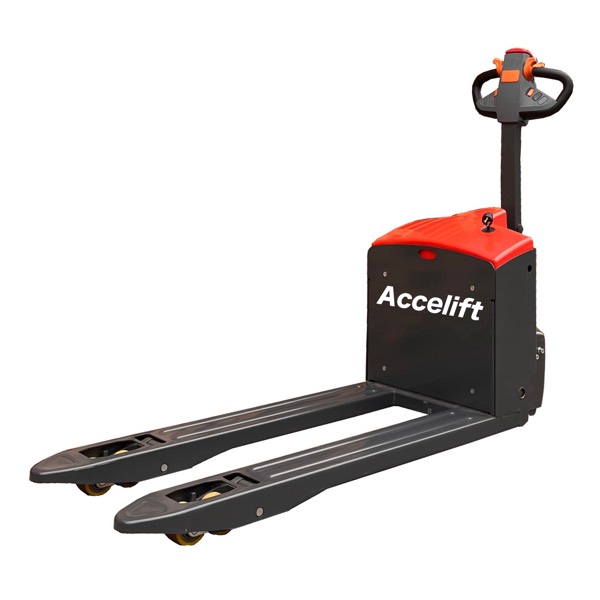
We build electric pallet trucks from 1.5 to 3 t, pedestrian, platform and rider, with lead-acid or lithium batteries, including the SL15GI, SL20GH, SL20L3, SLGA and SL30R. We supply dealers and distributors at factory prices, with OEM branding available.
For a quotation, send us the list above and your country. See all electric pallet trucks →