
Dealer guide
A dealer thinking about a factory on the other side of the world asks the same question sooner or later: what happens when a truck stops working? Nobody from the factory will drive over with a van. The answer is a simple division of work. You are close to the customer, so you make the repair. We supply the part, pay for it and pay to send it.
This guide describes how that works on our pallet trucks and stackers: what the warranty covers, how a claim runs, how parts reach you, and which repairs a dealer's own technician can do.
What the warranty covers
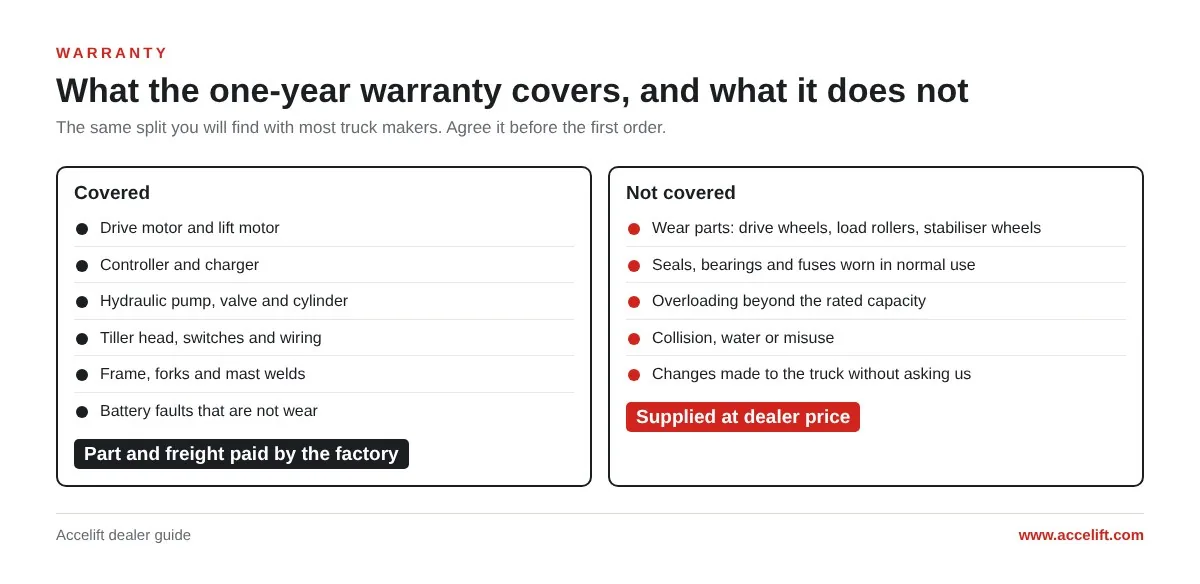
Our warranty is one year. If a part fails in that time because of a fault in the material or in the way we built it, we replace the part free of charge and we pay the freight to you.
Two things are outside it:
- Wear parts. Drive wheels, load rollers, stabiliser wheels, seals, bearings and fuses wear out with use. How fast depends on the floor and the hours, so they are sold as spare parts.
- Damage from misuse. Overloading, collisions, water, and changes made to the truck without asking us.
How a claim works
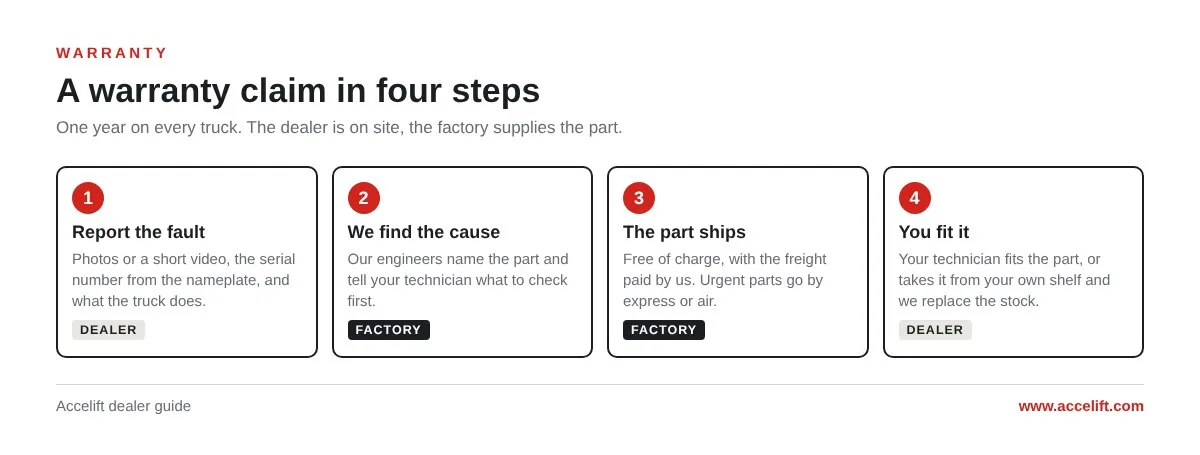
- Send us the evidence. Photos or a short video of the fault, the serial number from the nameplate, and a line or two on what the truck does and does not do.
- We find the cause. Most faults can be traced from a video: a fault code on the display, a contactor that does not pull in, a cylinder that leaks. Our engineers tell you which part it is and what to check first.
- We send the part. Free of charge, freight paid by us.
- Your technician fits it. If something is unclear, send another video and we go through it with you.
The serial number matters. It tells us the build date, the controller, the motor and the battery that went into that truck, so the part we send is the right one.
How parts reach you
- Urgent parts go by express or air. A controller, a charger or a switch is small and light, and reaches most countries within days.
- Heavy parts wait for a ship if they can. A mast section or a drive unit is expensive to fly. If the truck can keep working, it can travel with your next order.
- The fastest part is the one on your shelf. This is the point we press hardest with every new dealer.
Order spare parts with the trucks
Your customer does not measure you by the warranty paper. They measure how long their truck stood still. A part from China takes days at best. A part from your own shelf takes an hour.
So put a small parts kit on your first order, in the same container as the trucks. It travels at sea-freight cost, it clears customs once, and it is there on the day a customer calls. If you use a part from your stock for a warranty repair, tell us, and we replace it.
Dealers buy parts from us at our lowest price. That stock is not only insurance; after the first year it is your service business. What to put in the kit, model by model, is in our guide to spare parts for a new dealer.
What your own technician can fix
A pallet truck or a walkie stacker is a simple machine: a battery, a controller, a drive unit, a pump and a cylinder. A technician who services forklifts, or any good electrician with basic tools, can do almost every repair it will ever need.
- Wheels and rollers. Drive wheel, load rollers and stabiliser wheels, with a jack and hand tools.
- Electrical parts that plug in. Controller, charger, contactor, micro-switches, emergency stop, key switch, the tiller head as a unit.
- The battery. Lead-acid or lithium, it lifts out and the new one connects with one plug.
- Hydraulics. Cylinder seals, the lowering valve, hoses, or the complete pump unit.
- Adjustments. Brake gap, chain tension on stackers, lift limit switch.
What we ask you not to do is weld or straighten forks, frames or masts. If a structural part is damaged, send us photos and we will tell you whether it is to be replaced.
For the common faults there are step-by-step guides on this site: a pallet truck that will not lift, one that lifts but will not drive, one that will not charge, and stacker forks that drift down.
Before your first order
- Ask for the warranty terms in the quotation and in the proforma invoice.
- Ask for the parts list of every model you order.
- Add a parts kit to the order.
- Keep a record of the serial numbers and of the customer each truck went to.
- Agree with us who your technician should write to, and send the first video before you need to.
If you are comparing suppliers, ask each of them these same questions. And if you would like our warranty terms and a parts list for the models you have in mind, write to us.