
Buying guide
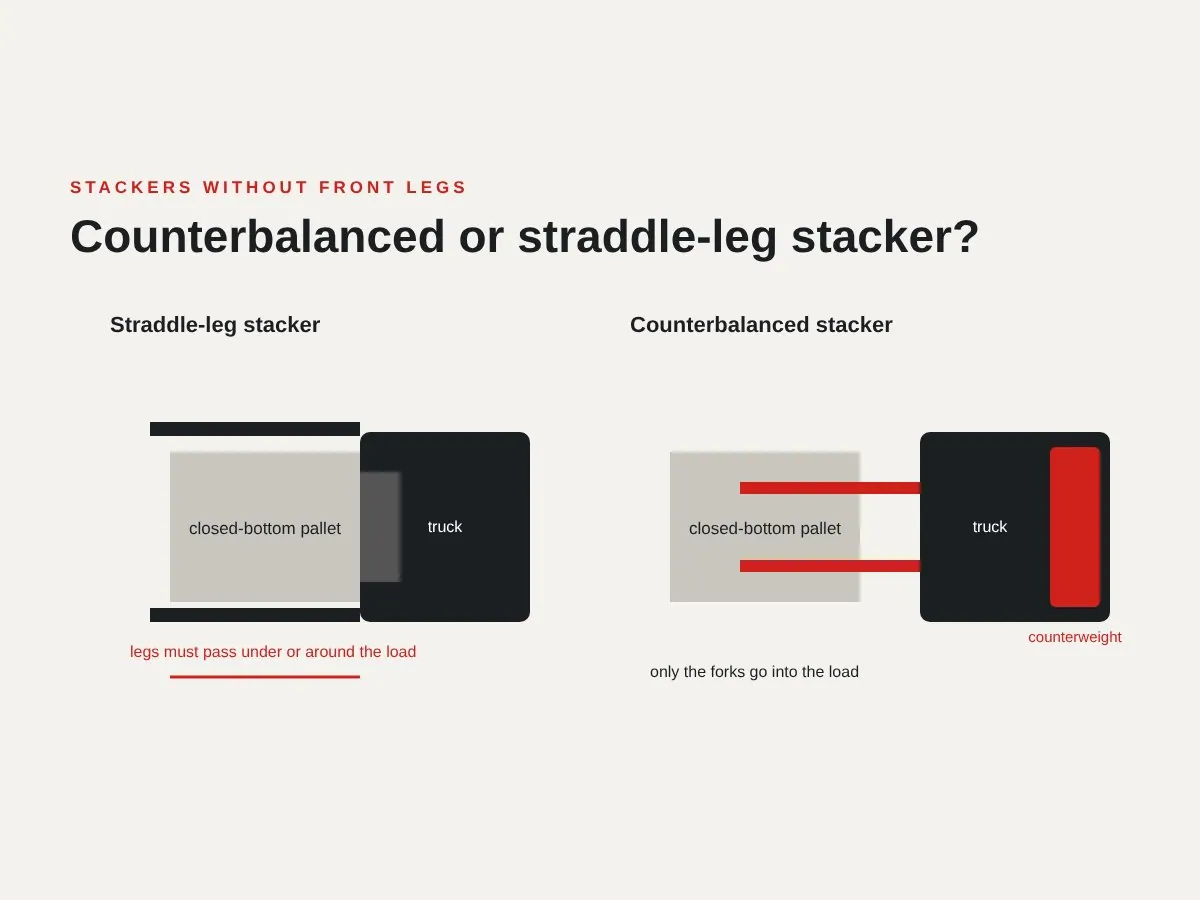
Most walkie stackers carry the load between two front legs, or between straddle legs that pass around the pallet. The legs keep the truck stable without a heavy counterweight, which makes the truck light, short and cheap. But the legs have to go somewhere. When they cannot go under or around the load, you need a counterbalanced stacker: a stacker with no front legs, where a counterweight at the back balances the load on the forks, as on a forklift.
Where straddle legs fail
A straddle-leg stacker such as our CL13GHY has straddle legs with a track width adjustable from 1,024 to 1,424 mm. They pass either side of the pallet, so the truck can lift a closed-bottom pallet, as long as there is room on both sides of it. Problems start when there is no such room:
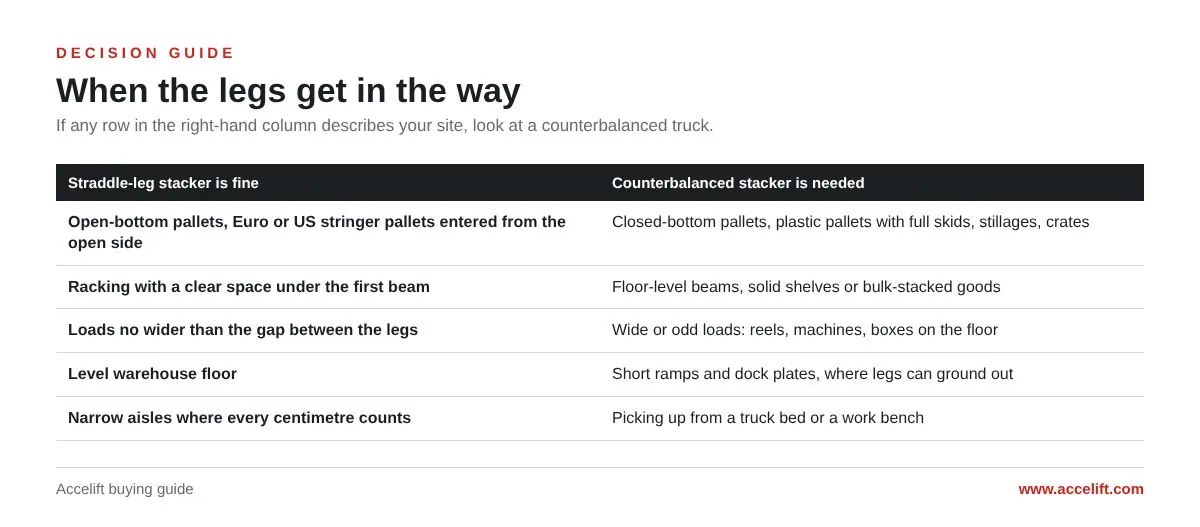
- Racking with a beam at floor level or solid bottom shelves. The legs hit the beam before the forks reach the back of the pallet.
- Pallets standing side by side on the floor, in block stacks, with no gap for the legs.
- Loads wider than the legs: cable reels, machines, long boxes, stillages.
- Work benches and truck beds, where the legs would need to pass under something that sits on the floor.
In all of these cases a counterbalanced truck drives its forks straight in and lifts.
Walk-behind counterbalanced stackers
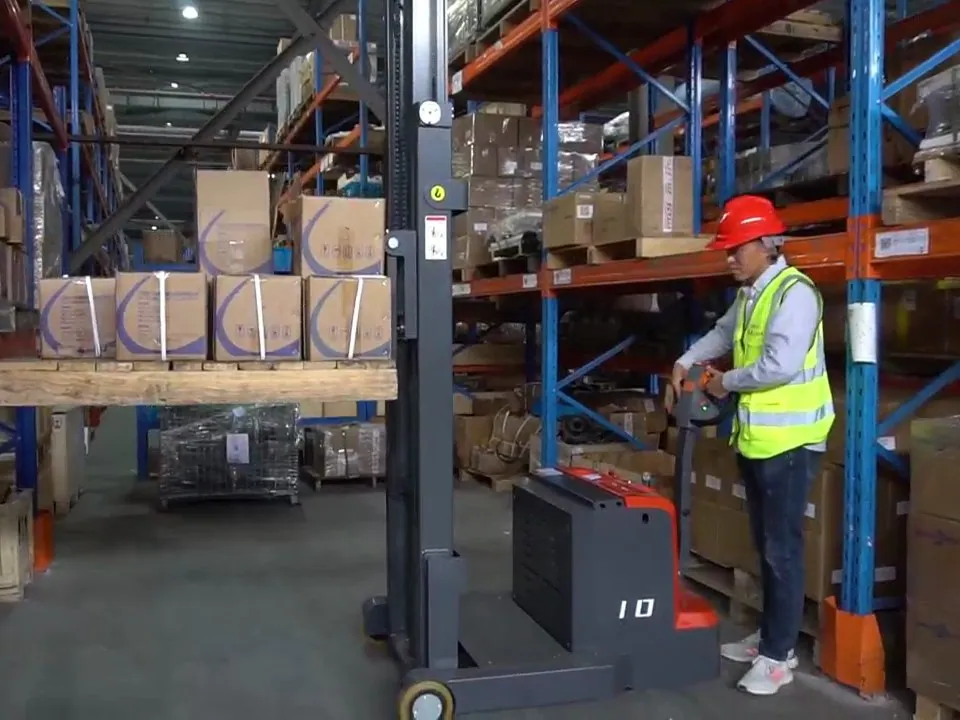
A counterbalanced stacker is the middle ground between a walkie stacker and a forklift. It has a forklift's open front but is operated on foot, like a pallet jack, and costs well below a seated forklift.
- E0530JZ / E0730JZ: 500 or 700 kg (1,100 or 1,540 lb) to 3,000 mm, turning in a 1,000 mm radius.
- E1016J to E1035J: 1,000 kg (2,200 lb), five lift heights from 1,600 to 3,500 mm on one chassis.
- CPD20J-R: 2,000 kg (4,400 lb) to 4,500 mm, with a folding stand-on platform and AC drive, for longer runs.
What the missing legs cost
A counterweight is heavy, and it sits behind the drive wheel. That changes three things.
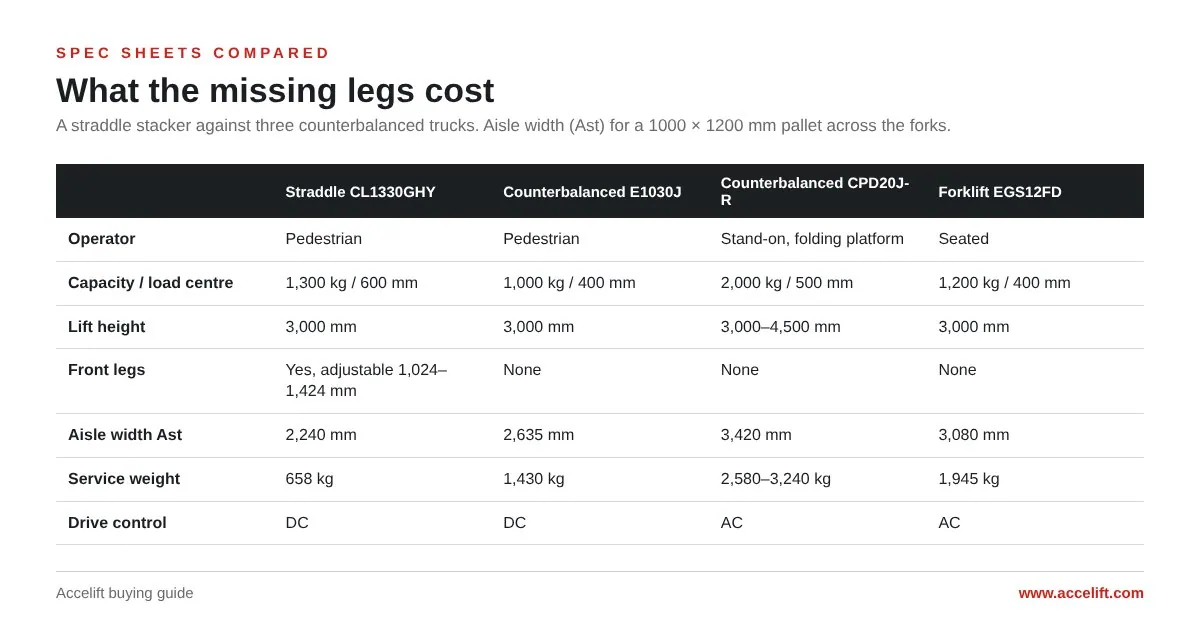
- Weight. The 1,000 kg E1030J weighs 1,430 kg; the 1,300 kg straddle stacker weighs 658 kg. Check your floor, any mezzanine and any lift you plan to use it in.
- Aisle width. A longer truck needs a wider aisle. For a 1000 × 1200 mm pallet across the forks, the straddle stacker needs 2,240 mm and the E1030J 2,635 mm. Our guide to stacker spec sheets explains how Ast is calculated.
- Load centre. Counterbalanced stackers are rated at a shorter load centre, 400 mm for the pedestrian models against 600 mm for the straddle stacker. With a long or deep load the capacity falls; check the load chart.
Counterbalanced stacker or small forklift?
If the truck has to cover long distances, climb ramps of more than about 5% or work outdoors on rough ground, a seated three-wheel electric forklift such as the EGS12FD does it better: 7 to 9 km/h, 10% gradeability laden and mast tilt. A walk-behind counterbalanced stacker wins where the space is tight, the runs are short and the operator does other work between lifts.
See all counterbalanced stackers and forklifts, or compare stackers, pallet jacks and forklifts in which one do you need. Not sure which fits your loads? Send us a photo of the pallet and the rack.