
Buying guide
Spec sheets for electric pallet trucks and stackers list the "type of drive control": DC or AC. Both run on the same battery, since a forklift battery always supplies direct current. The difference is the drive motor and the controller that feeds it. A DC truck uses a brushed DC motor. An AC truck uses an AC induction motor, and its controller turns the battery's direct current into alternating current.
Same truck, two drives
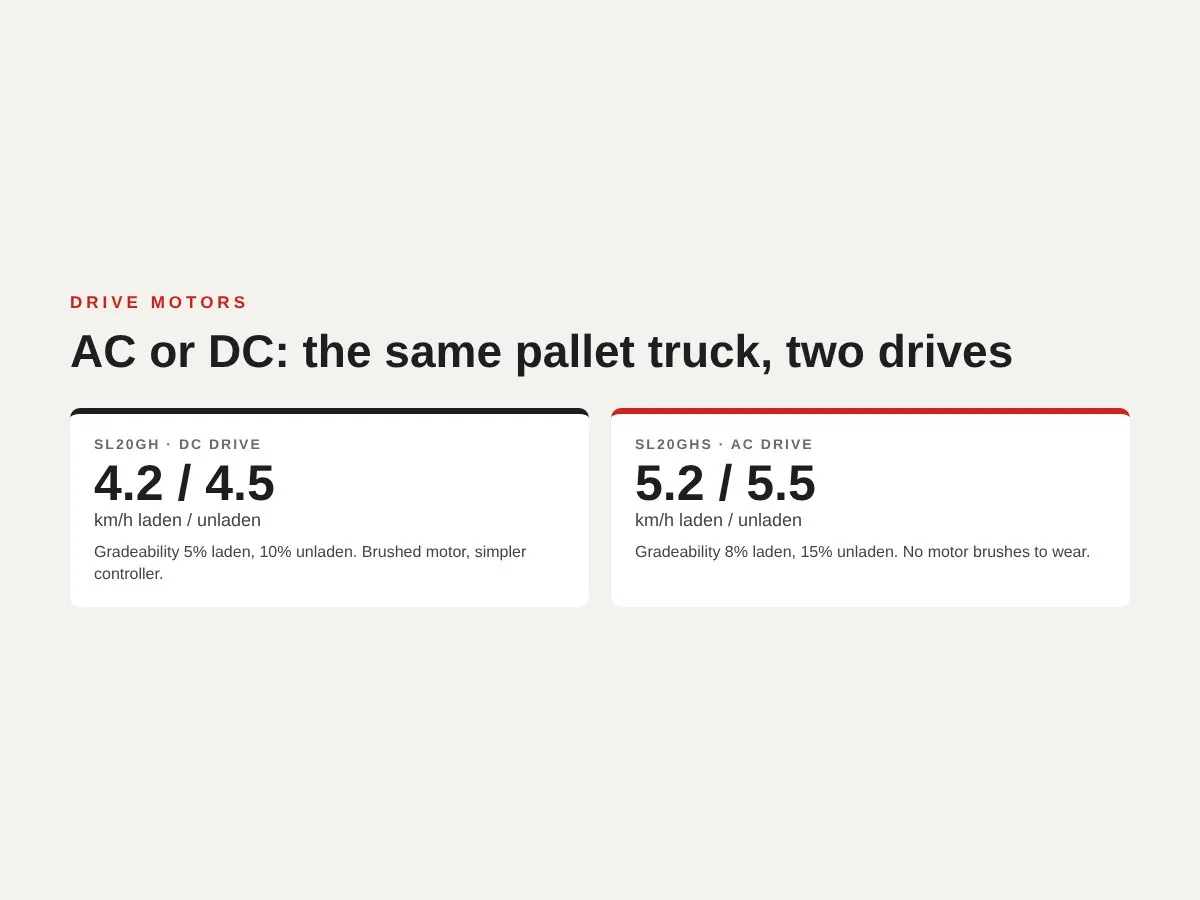
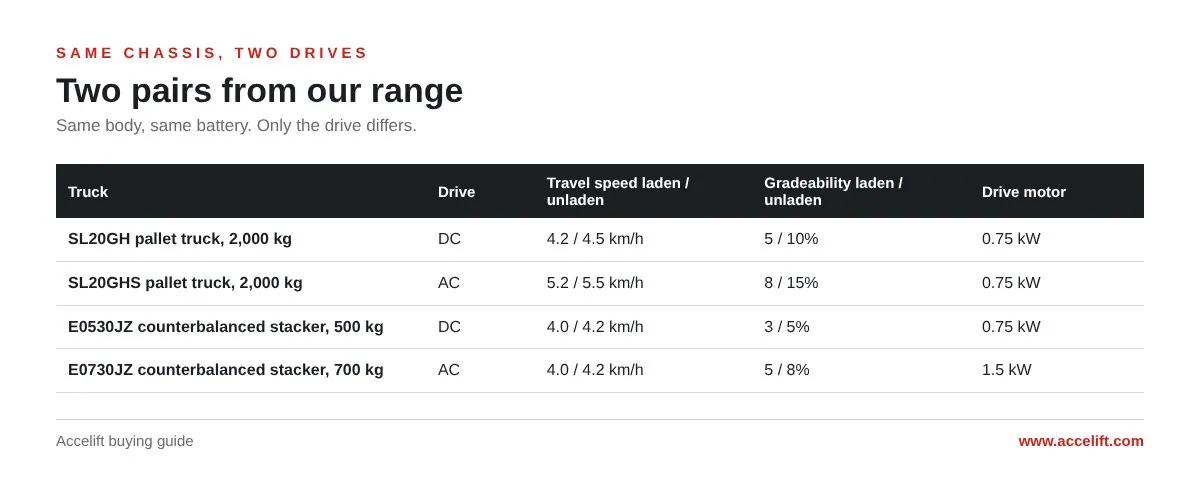
The clearest way to see the difference is a truck built both ways. Our SL20GH and SL20GHS are the same 2,000 kg pedestrian pallet truck, with the same battery and the same 0.75 kW motor rating. The DC version travels at 4.2 km/h laden; the AC version at 5.2 km/h. On a ramp the AC version climbs 8% laden against 5%.
What AC drive gives you
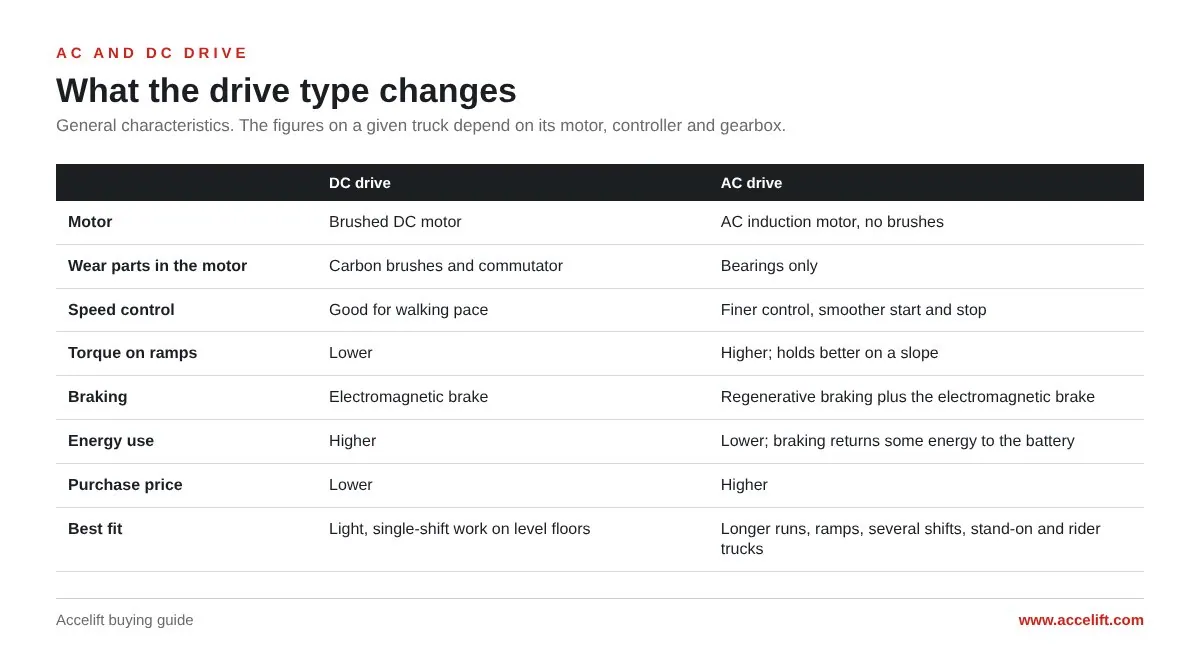
- No motor brushes. A DC motor transmits current through carbon brushes that wear and have to be replaced, and they leave dust in the motor. An AC induction motor has no brushes; apart from its bearings there is nothing to wear.
- More torque and better ramp control. An AC controller holds the truck on a slope and starts it again smoothly, without rolling back.
- Regenerative braking. When the operator releases the throttle or reverses, the motor slows the truck and returns some energy to the battery. Brakes wear less, and a charge lasts longer.
- Finer speed control. Smooth acceleration and creep speed matter on stand-on and rider trucks, in trailers and in tight racking.
What DC drive gives you
- A lower price. The motor and controller are simpler and cheaper.
- Simple repair. A DC motor and controller are familiar to almost every forklift mechanic, and parts are cheap.
- Enough for light work. A walk-behind truck that moves a few dozen pallets a shift on a level floor never uses the extra torque of an AC drive.
Which to choose
Choose DC for a pedestrian pallet jack or walkie stacker used for one shift or less on a level floor, where price matters most. Choose AC when:
- the truck is a stand-on or rider model, travelling faster and further;
- the route has ramps, dock plates or trailer loading (see pallet trucks for trailer loading);
- the truck works two or more shifts, where brush changes and battery charge add up;
- the work needs precise positioning, such as stacking at height.
That is why most of our pedestrian entry models, such as the SL20GH pallet truck and the CL13GHY stacker, use DC, while our stand-on stackers, reach trucks, order pickers and tow tractors use AC.
A note on faults
On both types, a truck that lifts but will not drive is usually not a motor problem at all; the interlocks come first. See pallet truck lifts but won't drive. On an AC truck, the controller stores fault codes, which makes diagnosis faster when you have the handset.
Browse electric pallet trucks and electric stackers; each spec sheet lists the drive type. Dealers can ask us for either version on most models.