
Buying guide
A self-propelled scissor lift raises a platform straight up and can be driven with the platform raised. It is the standard tool for installing lights, sprinklers, signage and ducting, for building maintenance and for high stock checks. Choosing one comes down to five questions: how high, how narrow, how heavy, indoors or outdoors, and which battery.
1. Working height, not platform height
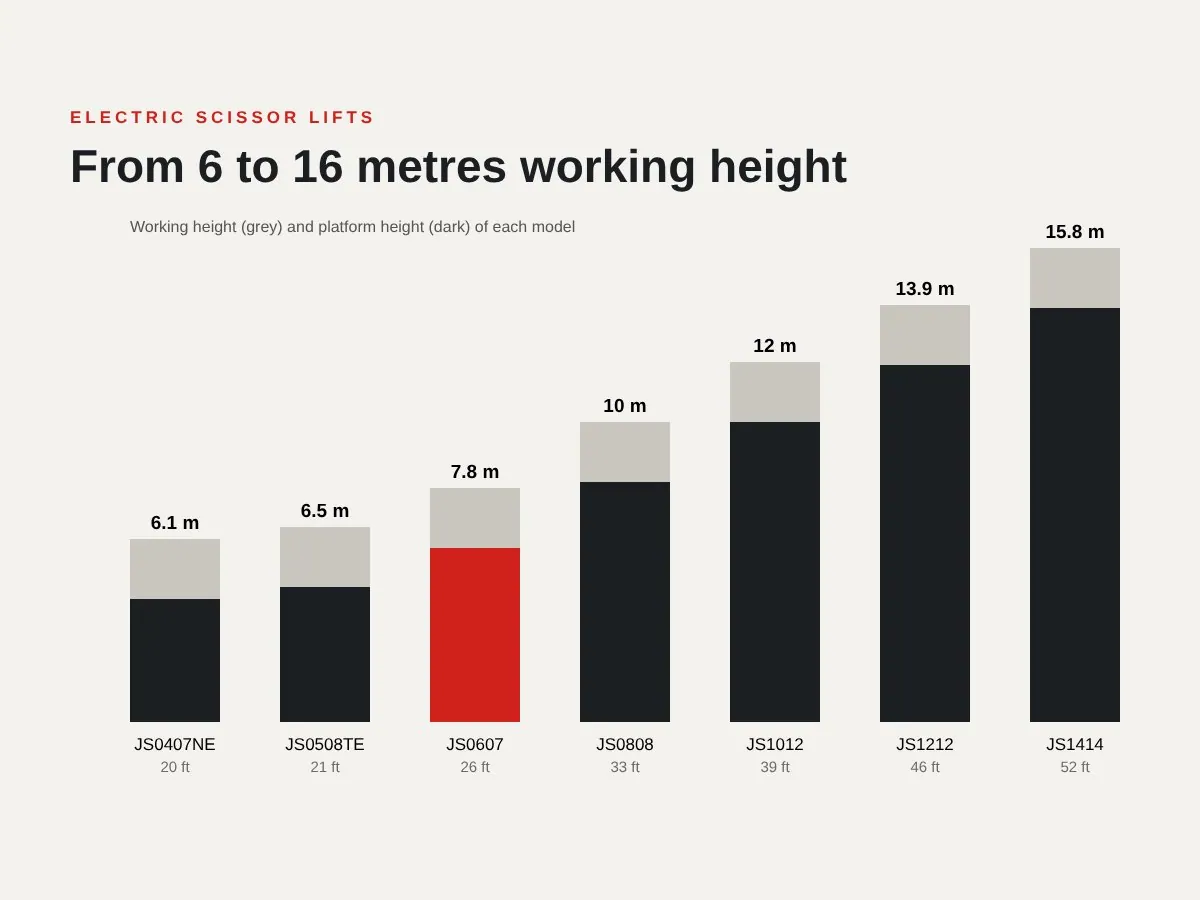
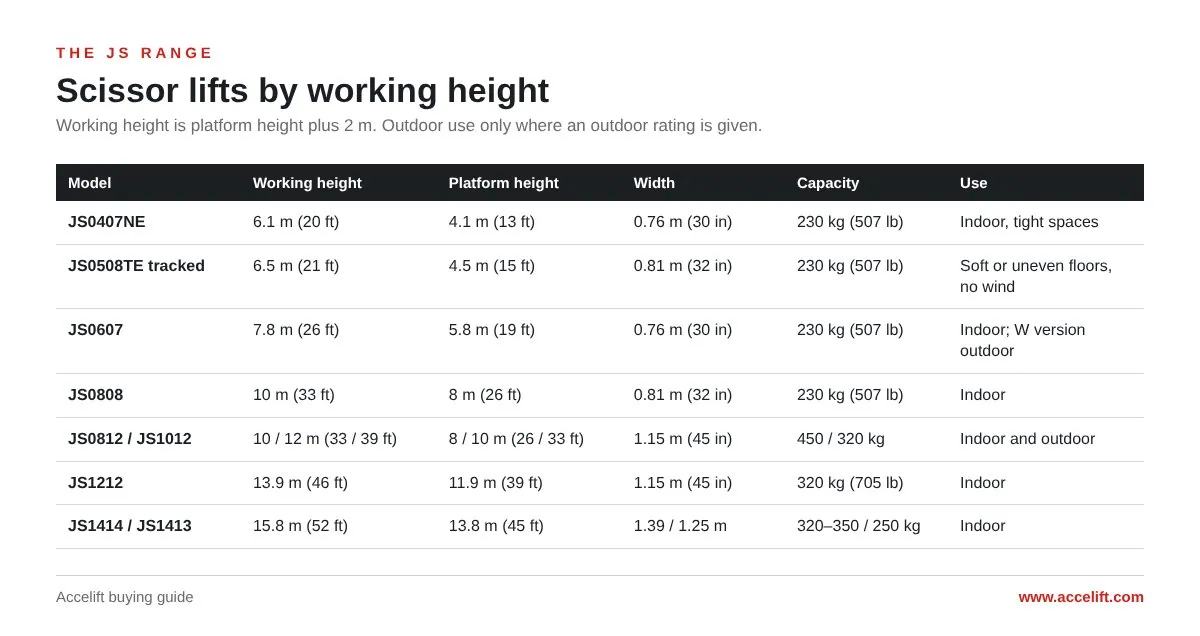
Scissor lifts are quoted with two heights. Platform height is the height of the floor of the platform. Working height is the height a person standing on it can reach, taken by convention as platform height plus 2 m (about 6 ft). In North America lifts are often named by platform height in feet: a "19-foot" lift has a platform at 19 ft (5.8 m) and a working height of about 26 ft.
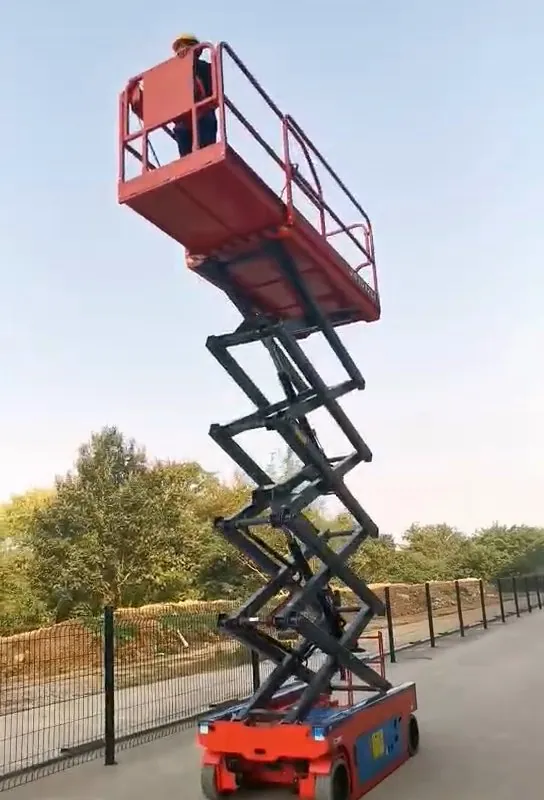
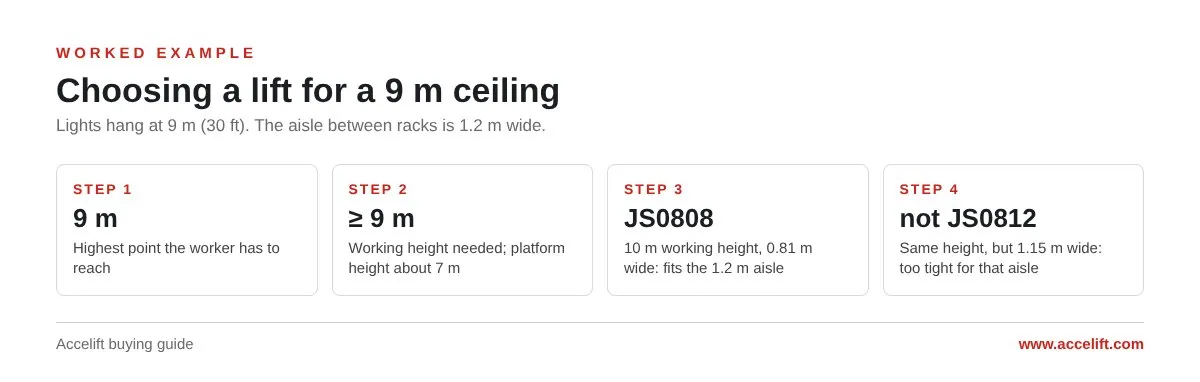
Measure the highest point the work needs, then choose the lift whose working height reaches it. There is no benefit in going far higher: taller lifts are wider, heavier and slower to raise. The JS1414 takes 85 seconds to reach its full 13.8 m platform height; the JS0607 takes 18 seconds to reach 5.8 m.
2. Width and turning
Doorways, aisles between racks and lifts in the building decide the width. Our narrow models are 0.76 m (30 in) wide, which goes through a standard door. These are the JS0407NE and the JS0607, a classic "1930" class machine: 19 ft platform, 30 in wide. The JS0808 is 0.81 m (32 in). From 10 m upwards the platform grows to 1.15 m (45 in) and more, for stability. Most JS models have a zero inside turning radius: the inner wheel stays on the spot as the lift turns.
3. Capacity
Rated capacity covers people, tools and materials together. The narrow models carry 230 kg (507 lb), enough for two people with hand tools indoors. Wider models carry 320 to 450 kg (705 to 992 lb). The extension deck, which slides out at the front, has its own lower limit of 100 to 120 kg. Count the materials: a box of panels or a coil of cable is quickly heavier than a second worker.
4. Indoor or outdoor
A scissor lift rated for indoor use only must not be raised in wind. Outdoor-rated models are tested for a maximum wind speed, 12.5 m/s on ours, usually with fewer people on board. In our range the JS0812 and JS1012, and the wide-track W version of the JS0607, are rated for outdoor use on firm, level ground. For soft or uneven floors indoors, the tracked JS0508TE spreads its weight over rubber tracks.
5. Drive and battery
All JS lifts are battery powered, with no exhaust, so they can work in occupied buildings. Lifting is hydraulic. Two options change the running cost:
- AC drive (E versions): AC motors instead of a DC motor, with higher gradeability, 30% instead of 25% on most models. The reasons are the same as on a pallet truck: see AC or DC drive.
- Lithium battery (Li versions): a 25.6 V lithium pack in place of the 24 V lead-acid set. Faster charging, top-up charging in breaks and no watering. For a lift that works every day, lithium usually pays; see the five-year battery cost.
Every JS lift has proportional controls, an overload alarm, emergency lowering and a burst-hose valve as standard, and most models add pothole protection. Training, inspection and use are governed by local rules, which differ by country.
See the full range of scissor lifts and boom lifts. Tell us the working height, the narrowest door and whether the lift will work outdoors, and we will suggest a model.