
Battery guide
The battery is the most expensive wear part on a floor scrubber, and it decides how the machine fits into the working day. Two types are on the market: lead-acid, in gel, AGM or flooded form, and lithium, almost always lithium iron phosphate (LiFePO4). This guide compares them on the points that matter for a cleaning machine.
Charging decides the working day
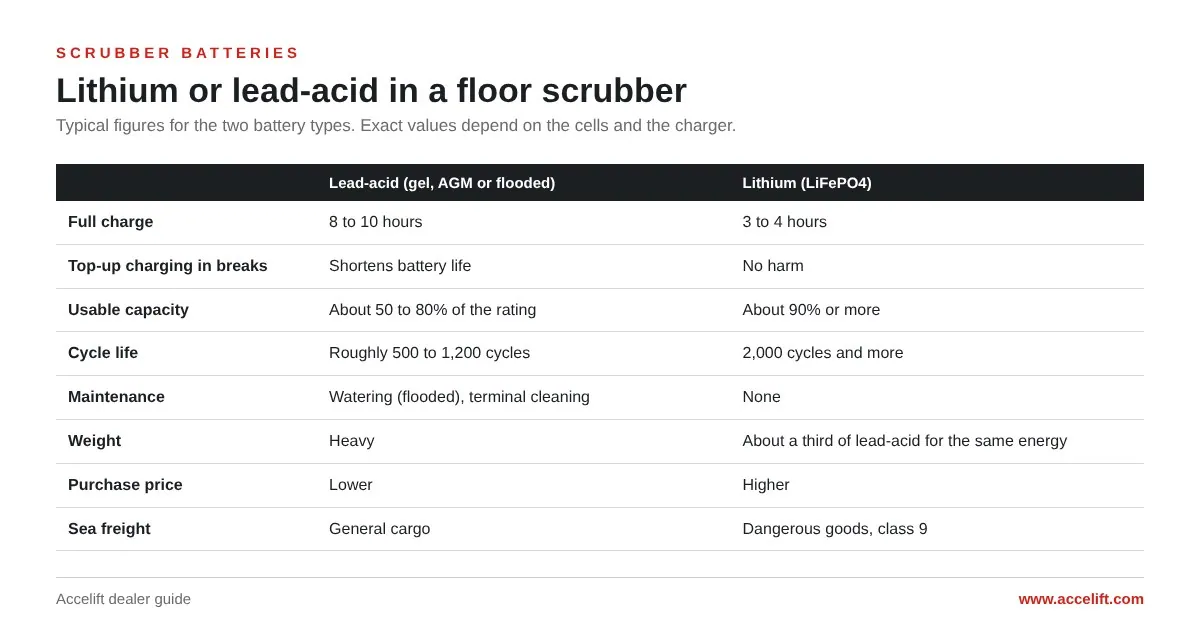
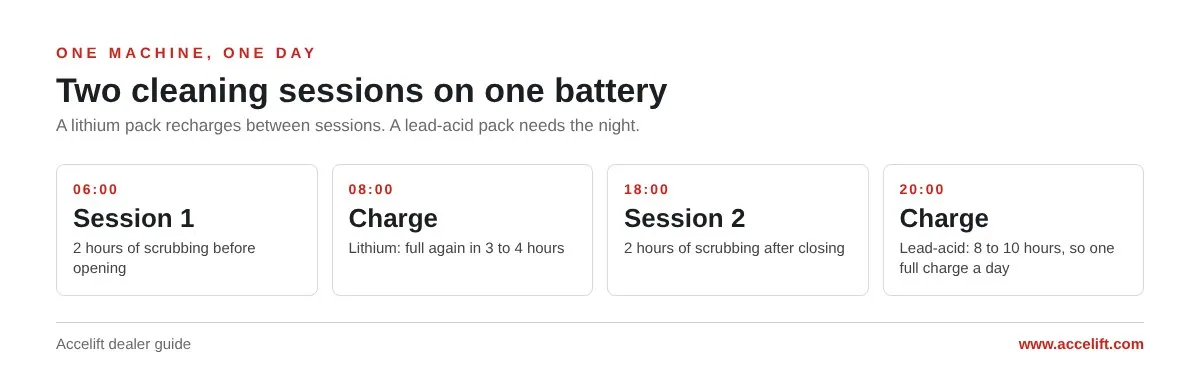
A lead-acid battery needs eight to ten hours for a full charge and should be charged fully each time. Short top-up charges and long periods at half charge shorten its life. In practice that means one cleaning session a day and a night on the charger.
A lithium battery charges in three to four hours and does not mind being topped up in a break. A machine that scrubs before opening can be full again by the afternoon and work a second session in the evening.
Life and running cost
- Cycle life. A lead-acid pack gives roughly 500 to 1,200 cycles, depending on its type and on how deeply it is discharged. A LiFePO4 pack gives 2,000 cycles and more. Cleaned once a day, that is the difference between about three years and the life of the machine.
- Usable capacity. Lead-acid should not be run flat; taking out more than about 80% on a regular basis wears it quickly. Lithium delivers almost its whole rated capacity, and the voltage stays steady until the end, so brush and suction do not fade in the last half hour.
- Maintenance. Flooded batteries need distilled water and clean terminals. Gel and AGM batteries need no water but still dislike deep discharge. Lithium needs nothing; the battery management system protects the cells.
- Next to water. A scrubber is a wet machine. A sealed lithium pack has no acid to spill and gives off no gas while charging, so it can be charged in a store room or a corridor.
When lead-acid still makes sense
- The machine works one short session a day and has all night to charge.
- The purchase price matters more than the cost over five years.
- Only one or two machines are being shipped. Lithium batteries are class 9 dangerous goods, and sending them as loose cargo is expensive. In a full container the difference is small.
What we fit
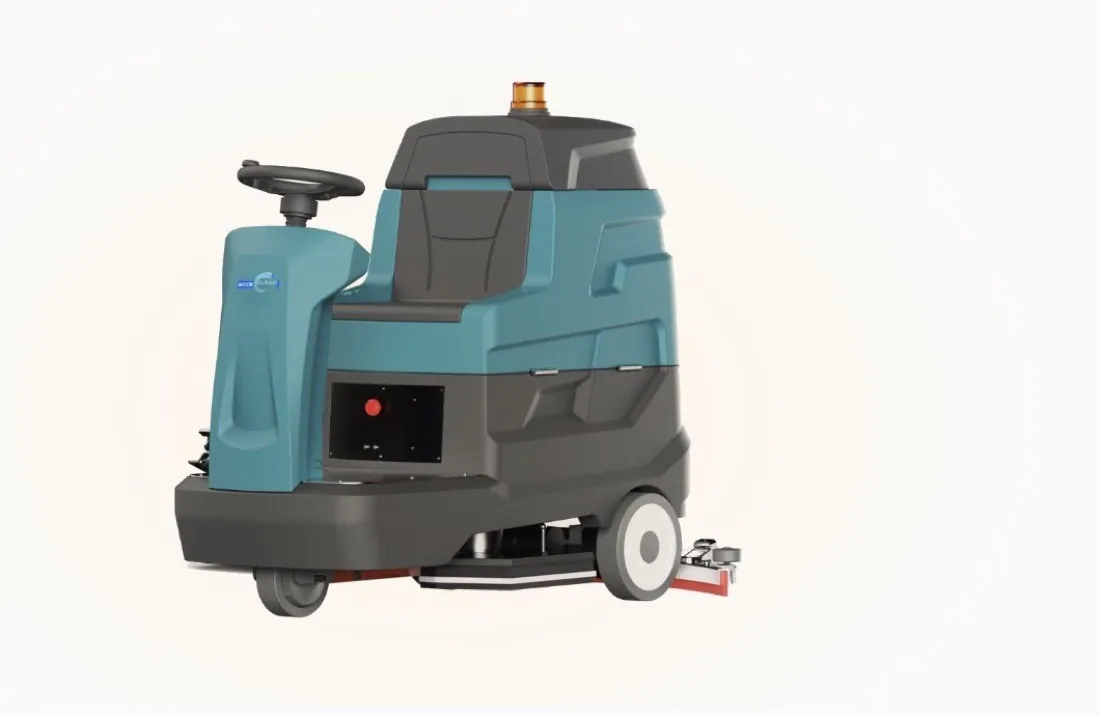
All AcceClean scrubbers now leave the factory with lithium batteries: 24 V / 80 Ah on the JC60 and the JC75/85 ride-ons, and 24 V / 150 Ah on the JC150. They charge in three to four hours and work for three to four hours, up to five on the JC60. On the JC60 and the JC150 the charging plug is on the outside of the machine.
Questions to ask the supplier
- Which chemistry is the battery, and what are its voltage and capacity?
- How long does a full charge take with the charger supplied?
- How many cycles is the battery rated for, and what does the warranty cover?
- Can a replacement battery be ordered later, and how is it shipped?
The same comparison for warehouse trucks, with a five-year cost calculation, is in lead-acid or lithium: the five-year cost. For the machines themselves, see our floor scrubbers, or contact us with your floor area and working hours.