
Buying guide
An electric tow tractor, often called a tugger, moves loads on wheels instead of carrying them on forks. One tractor can pull a string of carts, roll cages or trailers, so a single trip does the work of several trips with a pallet truck. Tow tractors are common in factories feeding assembly lines, in hospitals and hotels, in airports and in large distribution centres.
They come in three forms: pedestrian (walk-behind), stand-on and seated. The right one depends on how heavy the train is, how far it travels and whether the route includes ramps.
The three types
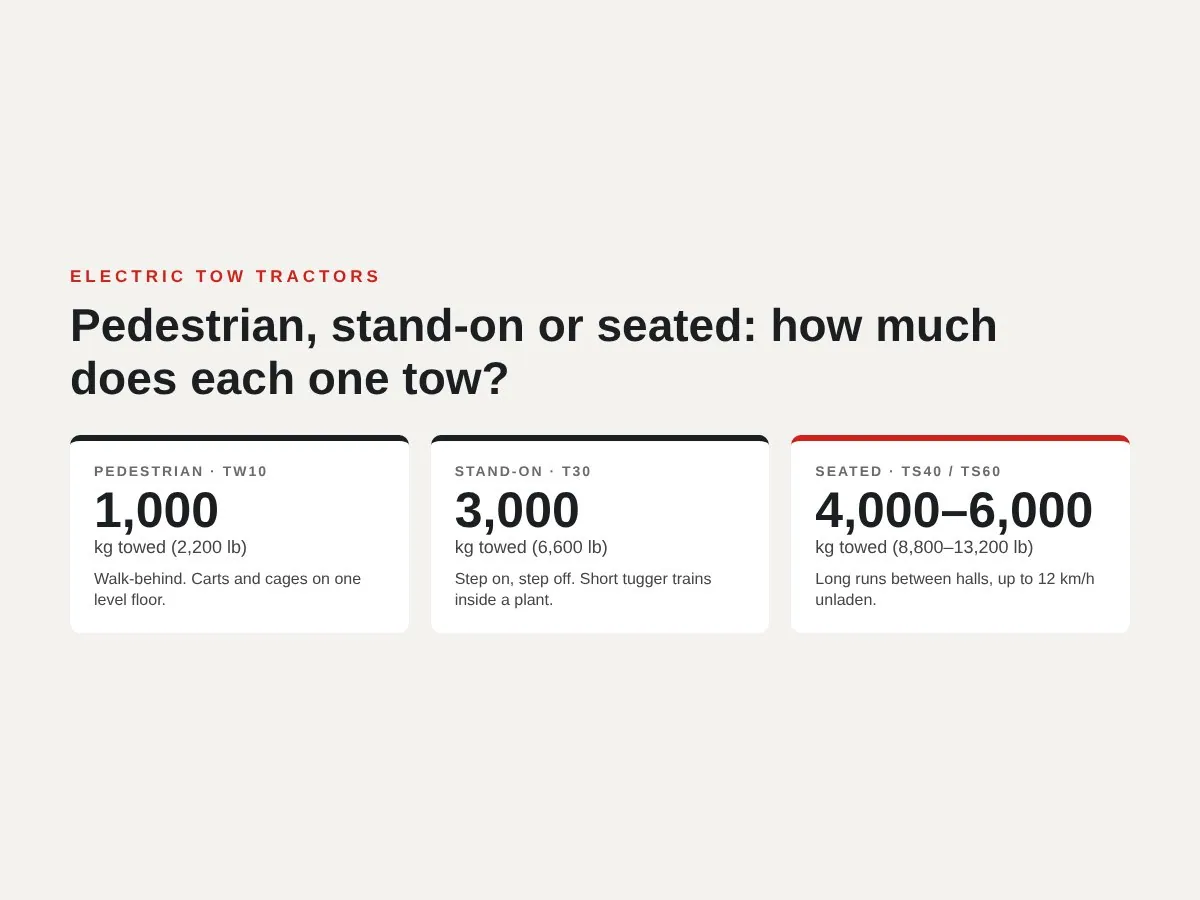
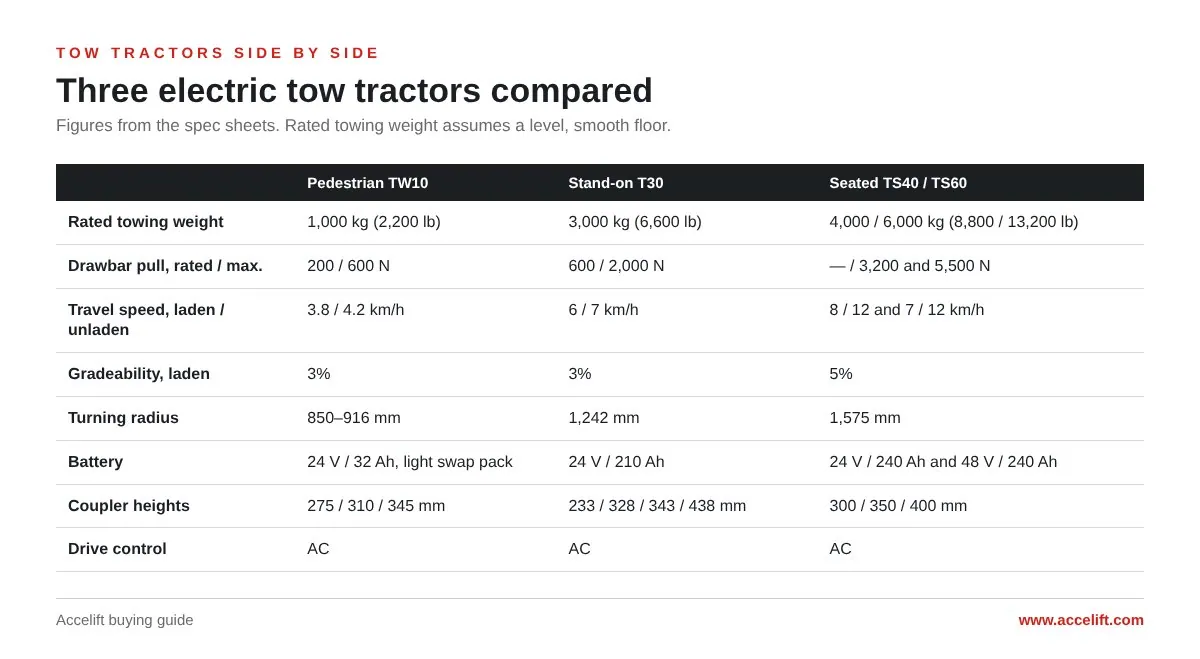
- Pedestrian. The operator walks behind with a tiller, as with a pallet jack. Our TW10 is rated to tow 1,000 kg (2,200 lb), weighs 116 kg with its battery and turns in under a metre. The handle folds down for storage. It suits carts and laundry or catering trolleys on one level floor.
- Stand-on. The operator steps onto a cushioned platform and rides. The T30 is rated to 3,000 kg (6,600 lb), travels at 6 to 7 km/h and has four coupler heights. It is the usual choice for short tugger trains inside a plant, where the driver gets on and off often.
- Seated. For long runs, between halls or across a yard. The TS40 and TS60 are rated to 4,000 and 6,000 kg (8,800 and 13,200 lb) and reach 12 km/h unladen.
Towing weight and drawbar pull
Two figures on a tow tractor spec sheet are easy to confuse.
- Rated towing weight (sometimes "rated traction weight" or "rated load capacity") is the total weight of the train the tractor is designed to pull: carts plus goods. It assumes a level, smooth, dry floor.
- Drawbar pull is the force at the coupling, in newtons. The rated figure is what the tractor can hold continuously; the maximum is a short peak for starting off and for a ramp.
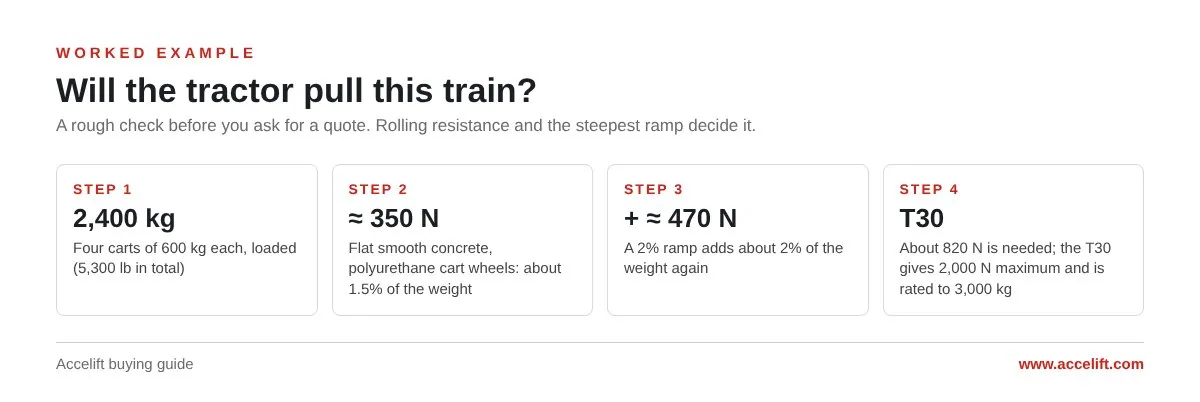
The weight of a train is not the force needed to move it. On smooth concrete, carts with good polyurethane or nylon wheels need a pull of roughly 1 to 2% of their weight to keep rolling. Poor wheels, a rough floor or a dirty floor can double that. A slope adds about 1% of the weight for every 1% of gradient. That is why the steepest ramp on the route, not the flat floor, usually decides the tractor.
Ramps and gradeability
Gradeability is given laden and unladen. The laden figure is measured at the rated towing weight. Our pedestrian and stand-on tractors climb 3% fully loaded, the seated TS series 5%. If your route has a steeper ramp, either tow less on that section or choose a larger tractor and run it below its rating. Never plan to stop and start a full train on a ramp; brakes are designed to hold, not to save a train that is already running back.
Speed and distance
A walk-behind tractor moves at walking pace, about 4 km/h. Over 100 m that is fine; over 500 m, several times a shift, it becomes the operator's whole day. Stand-on trucks at 6 to 7 km/h and seated trucks at up to 12 km/h shorten long runs considerably. Keep speeds down in mixed traffic with pedestrians, whatever the truck can do.
Coupler height and the carts
The coupling has to meet the drawbar of the carts at the right height. Our tractors offer several pin heights: 275 to 345 mm on the TW10, 233 to 438 mm on the T30 and 300 to 400 mm on the TS. Measure the drawbars of your existing carts before you order. Carts that track well, with two fixed and two swivel wheels and a drawbar that steers the front axle, follow the tractor through corners instead of cutting them.
Battery
All three use AC drive. The TW10 has a light 24 V pack that can be swapped by hand, so a spare pack keeps it running through several shifts. The T30 and TS have side-pull battery boxes for changing with a pallet truck. For two or three shifts a day, look at lithium: see lead-acid or lithium, the five-year cost.
Which one to choose
- Up to about 1 t, level floor, short runs: pedestrian.
- Up to 3 t, frequent stops, runs inside one building: stand-on.
- 4 to 6 t, long runs, ramps, outdoor sections on firm ground: seated.
See the full range of electric tow tractors. If you are not sure, send us the weight of a loaded cart, the number of carts, the steepest ramp and the length of the route, and we will suggest a model.