
Buyer’s guide
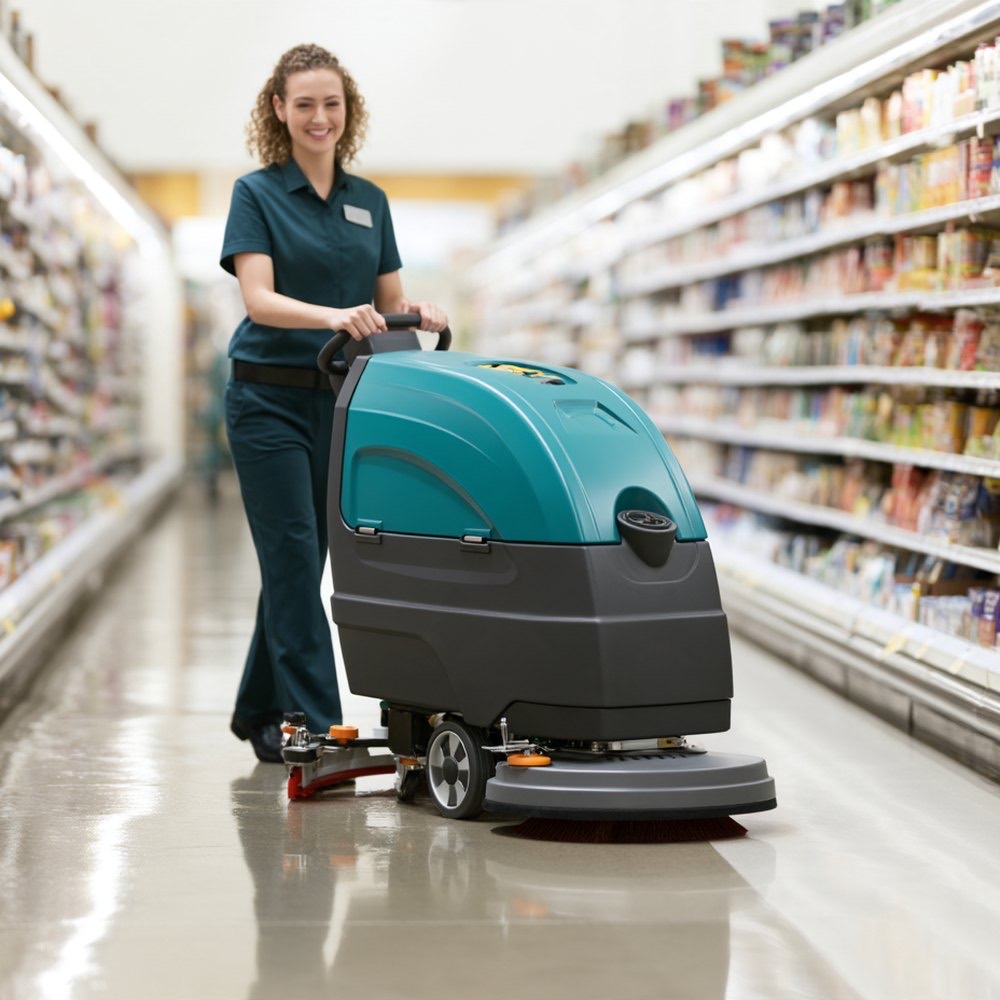
A floor scrubber puts down water and detergent, scrubs the floor with a brush or pad, and vacuums the dirty water back up through a rubber squeegee, all in one pass. Done right, the floor is clean and dry enough to walk on a minute later. Done with the wrong machine, someone spends two hours a night on a job that should take forty minutes, or a ride-on scrubber sits in a corner because it does not fit through the doors.
The first question most buyers ask is “which size?” The answer comes from the floor, not from the brochure. This guide goes through the decisions in the order we work through them with customers.
Scrubber or sweeper?
They are different machines for different dirt.
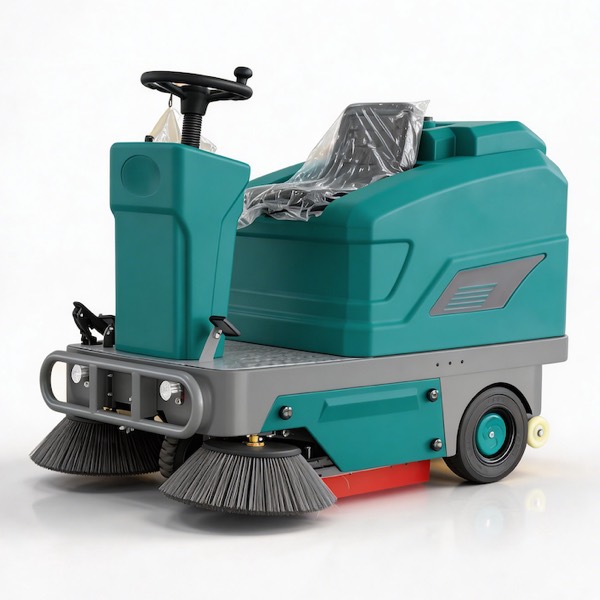
- A scrubber cleans hard, sealed floors with water: tile, epoxy, terrazzo, stone, PVC and sealed concrete. It removes the film of grease, tyre marks and ground-in dirt that a broom leaves behind. It is an indoor machine.
- A sweeper picks up dry, loose material: dust, sand, packaging scraps, leaves, gravel. It works indoors and out, in yards, car parks, loading areas and on roads.
A scrubber is not built to pick up debris. Stretch-wrap, cable ties and cardboard wrap round the brush, and grit blocks the suction hose and cuts the squeegee blades. In a warehouse or a factory with a lot of loose dirt, the usual routine is to sweep first and scrub second, and many sites run one of each.
Start with the area, not the brochure figure
Every scrubber is sold with a figure in square metres per hour. It is the cleaning width multiplied by the working speed: what the machine would clean if it drove in a straight line without stopping. Real floors have corners, shelving, pillars, people and doors, and the tanks need emptying and refilling.
In practice, plan on getting roughly half to two-thirds of the brochure figure. Then work backwards from your own floor:
- How many square metres are cleaned in one session?
- How long is the window: before opening, between shifts, overnight?
- How many times a day or a week?
A worked example: a 4,000 m² warehouse floor has to be scrubbed every evening in under two hours. That needs at least 2,000 m²/h of real output, so a brochure figure of 3,000–4,000 m²/h or more. A 500 mm walk-behind machine would take most of the evening. A twin-brush ride-on at 3,500 m²/h does it in the window; an 860 mm ride-on at 6,000 m²/h does it with time to spare, or covers a second hall as well.
Here is our own scrubber range with the figures that matter for sizing:
| Model | Type | Cleaning width | Solution / recovery tank | Brochure output | Battery | Working time |
| JC60 | Walk-behind, one brush | 500 mm | 60 L / 70 L | 2,350 m²/h | 24 V / 80 Ah lithium | 3–5 h |
| JC75/85-A | Ride-on, one brush | 560 mm | 75 or 85 L / 95 L | 3,000 m²/h | 24 V / 80 Ah lithium | 3–4 h |
| JC75/85-B | Ride-on, two brushes | 660 mm | 75 or 85 L / 95 L | 3,500 m²/h | 24 V / 80 Ah lithium | 3–4 h |
| JC150 | Ride-on, two brushes | 860 mm | 150 L / 170 L | 6,000 m²/h | 24 V / 150 Ah lithium | 3–4 h |
Walk-behind or ride-on
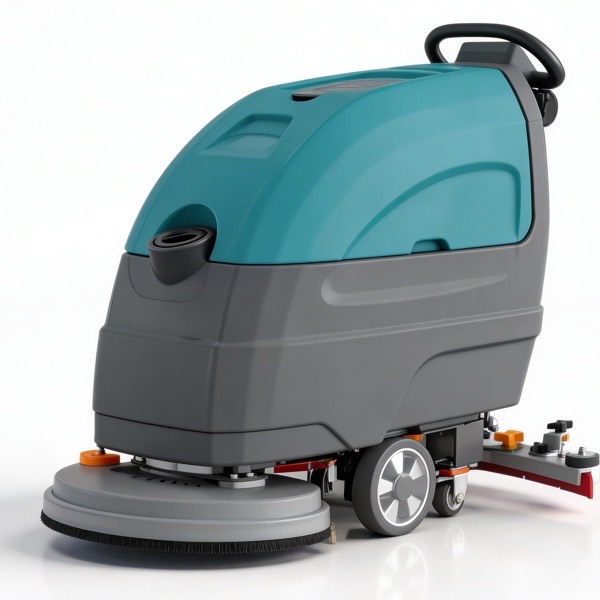
A walk-behind scrubber is the right machine for smaller areas and for crowded ones: shop aisles, corridors, washrooms, offices, small workshops. It goes where a person goes, turns in its own length, fits in a lift and costs less. The JC60 is 800 mm wide and 1,280 mm long.
A ride-on scrubber pays off when the area is large and the runs are long. The operator sits, so a two-hour session is not two hours of pushing; the tanks are bigger, so there are fewer stops; and the machine is faster. The trade-off is size. Before you order one, measure the narrowest door, the lift if it has to change floors, and the aisles between racking. Our largest scrubber, the JC150, is 1,240 mm wide and 1,680 mm long.
Tank size decides how often you stop
Every refill means driving to a tap, emptying the dirty water and filling up again. That is ten minutes or more each time, and it is the part of the job that brochure figures leave out.
- The recovery tank (dirty water) should be larger than the solution tank. Dirty water carries foam and air, and a recovery tank that fills first shuts the suction off before the clean water runs out.
- A water flow control lets the operator put down less water on a lightly soiled floor and stretch each tank further. The JC75/85-A, for example, has three flow rates and three cleaning modes.
- Check how the recovery tank empties. A drain hose, or a tank that tilts to empty, is quicker and cleaner than buckets.
Match the brushes to the floor and the dirt
All the machines above work on tile, terrazzo, epoxy and PVC; the ride-ons also suit emery and other hard industrial floors. What changes is the dirt.
- Light daily soil in shops, supermarkets, hospitals and schools: one brush is enough.
- Oil film and ground-in dirt in factories, food plants and logistics halls: two counter-rotating brushes, as on the JC75/85-B and the JC150, scrub harder in the same pass.
- Uneven or textured tile: suction and squeegee width matter more than brush power. A squeegee wider than the brush deck catches the water at the edges of each pass.
- Detergent: use a low-foam scrubber detergent. Ordinary floor cleaner foams in the recovery tank, and foam that reaches the vacuum motor damages it.
Battery and charging
All our scrubbers now run on lithium batteries. For a cleaning machine that matters more than on most equipment: there is no battery acid to top up next to a water tank, nothing to vent while charging, and a three-to-four-hour charge fits between a morning and an evening session. On the JC60 and the JC150 the charging plug sits on the outside of the machine, so they charge from any ordinary socket.
Size the battery to the longest single session, not the day. If the floor is cleaned twice a day, the machine charges in between.
Noise and working hours
If the floor has to be cleaned while the building is open, noise decides the machine. The JC60 works at 58 dB(A), quiet enough for hospital corridors, schools and shops during opening hours. Larger machines with bigger vacuum motors are louder and usually work before opening or after closing.
The checklist to send your supplier
- Floor area per session, and the time available to clean it
- How often: daily, twice daily, weekly
- Floor type, and the kind of dirt: dust, oil, food, tyre marks
- Narrowest door, aisle and lift the machine must pass
- Ramps or slopes on the route
- Whether the building is occupied while cleaning
- Whether loose debris also needs a sweeper
Send us those seven answers and we will tell you which machine fits, including when the honest answer is a smaller one.
AcceClean floor scrubbers and sweepers
AcceClean is the cleaning equipment line of Accelift: floor scrubbers from the 500 mm JC60 to the 860 mm JC150 ride-on, and ride-on sweepers from the compact JCF1250 to the enclosed-cab JCG-2400. Many of our dealers add scrubbers to a container of pallet trucks and stackers, because the warehouses, factories and supermarkets that buy one usually need the other. Contact us for specifications and a quotation.