
Dealer guide
Every quotation from a Chinese factory carries three letters next to the price. For most of our dealers they are FOB; some ask for CIF. The choice looks like a detail, but it decides who books the ship, who chooses the agent at your port, and who can be sent a bill you did not expect when the container arrives.
We quote both. We also tell new dealers the same thing each time: if you have a freight forwarder you trust, buy FOB and let them handle the sea leg. This guide explains why, and how to keep the charges at your own port under control.
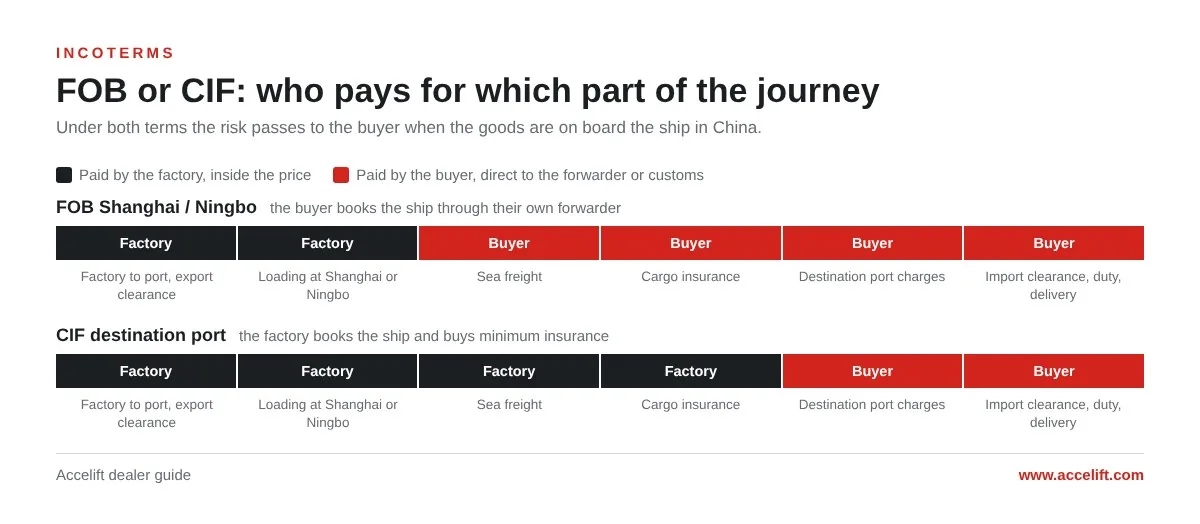
What FOB and CIF include
- FOB Shanghai or Ningbo. We build the trucks, deliver them to the port, clear them for export and pay the port charges in China. Your forwarder books the ship. You pay the sea freight, the insurance and everything at the destination.
- CIF your port. We also book the ship, pay the sea freight and buy cargo insurance to your port. You pay everything from the moment the ship arrives: port charges, customs clearance, duty and delivery.
Two points are often missed. First, the risk passes to you at the same moment under both terms, when the goods are loaded on the ship in China. CIF does not mean the factory carries the risk across the sea; it means the factory has paid for the freight and for insurance in your favour. Second, the insurance that CIF requires is the minimum cover. If you want all-risks cover for a container of trucks, say so, or arrange it yourself.
Where the surprise bills come from
Under CIF the factory chooses the forwarder, and that forwarder's partner at your port releases the container to you. You have no contract with either of them. The freight was paid in China, so the only place the destination agent can earn is on local charges, and you cannot collect the container until those are paid.
Most agents charge fairly. But this is the situation in which an importer receives a low CIF price, and then a list of handling, documentation and release fees that nobody mentioned. By then the container is on the quay and the free days are running.
With your own forwarder the position is reversed. They work for you, they quoted the local charges before the cargo left China, and they want your next shipment as well.
Why we recommend your own forwarder
- You see the whole cost before you order. One quotation covers freight, destination charges, clearance and delivery to your door.
- One company is responsible from port to warehouse. The same forwarder books the ship, clears customs and sends the truck.
- They know your customs. Tariff codes, import licences and local taxes are their daily work. Our guide to HS codes for pallet trucks, stackers and spare parts covers the part we can help with.
- They can combine shipments. A dealer who already imports from China can often add a few trucks to a container that is coming anyway.
Nearly all of our regular dealers work this way. They send us the forwarder's contact, the forwarder's office in Shanghai or Ningbo calls us about the loading date, and the dealer hears nothing more until the bill of lading arrives.
How to keep destination charges under control
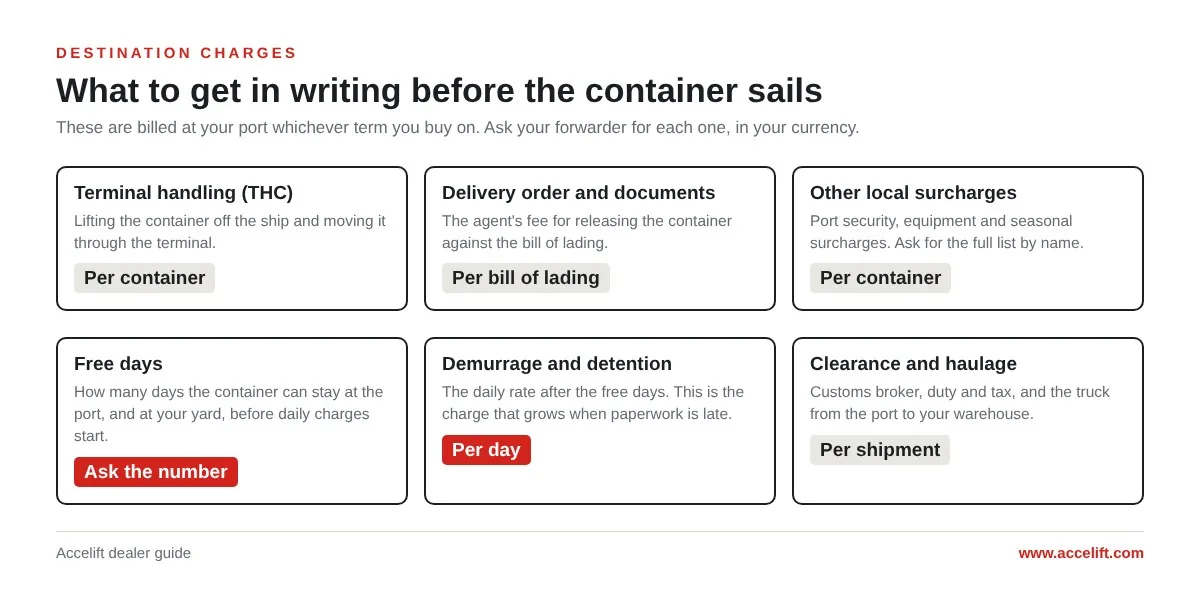
- Ask for the local charges in writing before you book. A freight rate on its own tells you little. Ask your forwarder for every charge at the destination, by name and in your currency.
- Ask how many free days you get. Free days are the time the container may stay at the port, and then at your yard, before daily charges begin. Ask for the daily rate after that as well.
- Have the documents ready before the ship arrives. We send the commercial invoice, packing list and bill of lading as soon as the vessel has sailed. Give them to your broker at once; a container waiting for paperwork is a container on demurrage.
- Pay the balance in time for the release. Our terms are 30% with the order and 70% when the goods are finished, so the bill of lading can be released without delay.
- Tell the forwarder about lithium batteries. Trucks with lithium batteries travel as dangerous goods. Booking takes longer and the freight is somewhat higher, and the forwarder must know before they quote. See shipping lithium pallet trucks.
When CIF makes sense
- Your first import. If you have never used a forwarder, a CIF price gets the cargo to your port while you find a customs broker. Ask us for the name of the agent at your port before the ship sails, and ask that agent for their local charges.
- A quick comparison. Ask us for FOB and CIF on the same quotation. The difference is what we would pay for freight, and you can put it beside your forwarder's rate.
- Tenders and letters of credit that state CIF in their conditions.
What to compare
Do not compare an FOB price with a CIF price. Compare the cost of the trucks standing in your warehouse: the price, the freight, the insurance, the charges at your port, clearance, duty and the last truck journey. A CIF offer that is cheaper at the port can be the dearer one at the door.
For transit times and ports, see shipping electric pallet trucks from China to Europe and importing warehouse equipment from China. When you are ready, send us the models, the quantities and your port, and we will quote FOB and CIF side by side.