
Buying guide
Put two 1.5-tonne walkie stackers next to each other and their spec sheets can look almost identical: the same capacity, the same 3.0 m lift, the same motors, the same turning radius. Yet one has its tiller arm at the side of the truck and the other has it in the middle. Operators notice the difference within a minute, and many customers have a firm preference.
This guide explains what the position of the tiller changes, what it does not change, and which layout makes more sense in a dealer's stock. We use two of our own stackers as the example, because their figures are almost the same: the CL1530JB with a side-mounted tiller, and the CDD15J-M with a centre-mounted tiller.
What stays the same
| Specification | CL1530JB (side) | CDD15J-M (centre) |
|---|---|---|
| Rated capacity | 1500 kg | 1500 kg |
| Lift height | 3000 mm | 3000 mm |
| Drive motor / lift motor | 0.75 kW / 2.2 kW | 0.75 kW / 2.2 kW |
| Battery | 2 × 12 V / 100 Ah | 2 × 12 V / 100 Ah |
| Travel speed, laden / unladen | 4.0 / 4.2 km/h | 4.0 / 4.2 km/h |
| Turning radius | 1405 mm | 1405 mm |
| Aisle width, 1000 × 1200 pallet across forks | 2245 mm | 2245 mm |
| Overall length / width | 1740 / 795 mm | 1770 / 800 mm |
| Service weight with battery | 500 kg | 500 kg |
Capacity, lift, motors, battery, turning radius and aisle width are the same. The position of the tiller is about how the operator drives the truck, not about what the truck can do.
Side-mounted tiller
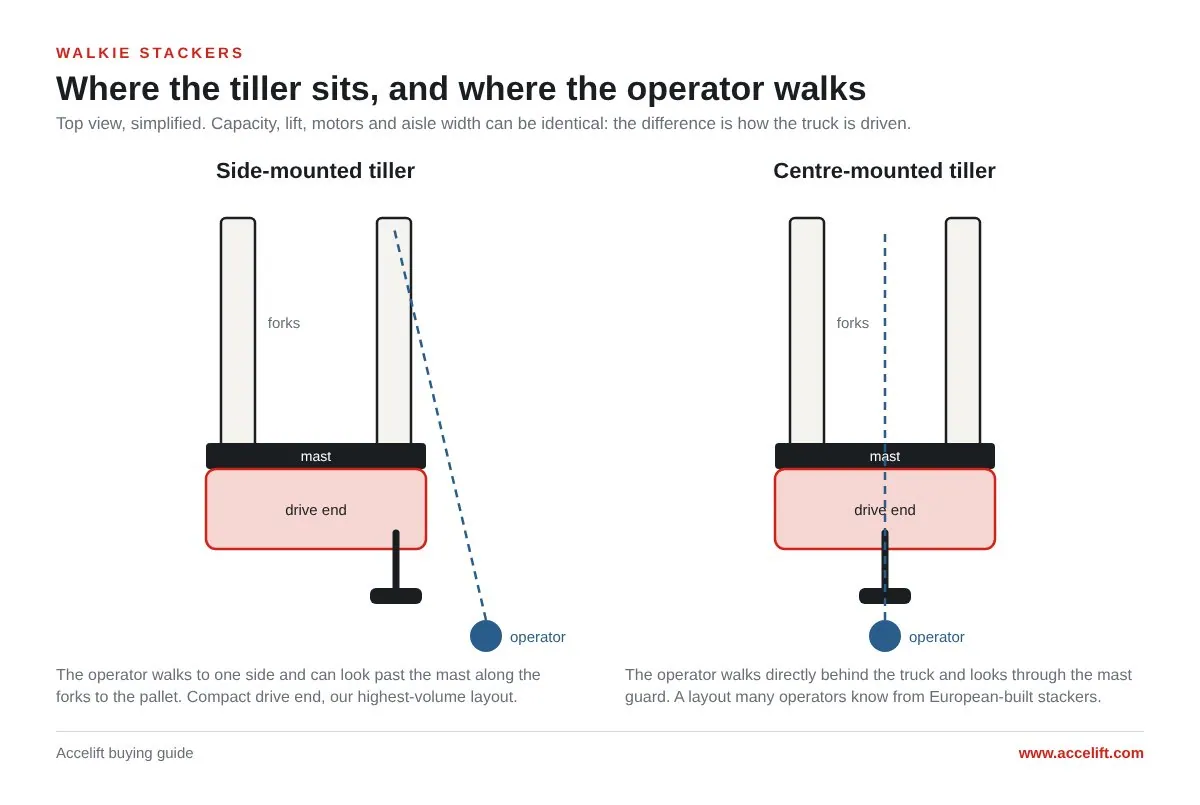
On a side-mounted design, the tiller arm and the drive sit towards one side of the truck's drive end.
- View past the mast. The operator walks slightly to one side of the truck rather than directly behind the mast, and can look along the forks to the pallet. That helps when entering a pallet and when placing a load.
- Compact drive end. The side layout keeps the drive end short and the turning radius small, which suits narrow aisles and small storerooms.
- Built in the largest numbers. It is the most common layout for walkie stackers made in China. Our CL15JB family is our highest-volume stacker, and we also build it for other companies under their own brands. Large volumes mean a lower price and spare parts that are easy to get.
Centre-mounted tiller
- Straight behind the truck. The operator walks directly behind the truck, in line with the forks, and looks forward through the mast guard. On the CDD15J-M, a mesh mast guard keeps the view open.
- A familiar position. Many European-built walkie stackers use a centre tiller. Operators who come from those trucks feel at home straight away.
- A higher price. Centre-mounted models are built in smaller numbers, so they cost more for the same capacity and lift.
Our CDD15J-M also has a C- and H-section steel mast, an explosion-proof valve that stops the mast dropping if a hose bursts, an emergency stop on the body and separate covers for easier servicing. Those features are not part of the tiller layout, but they are worth knowing when you compare the two trucks.
Which one to choose
- For a dealer's stock: side-mounted. A lower price, faster turnover, and parts shared with a large number of trucks already in the field. Most customers who buy on price and reliability never ask for a centre tiller.
- When a customer is replacing European trucks: offer the centre-mounted version. The operators keep the driving position they know, which makes the change easier to sell.
- When in doubt, let the operator decide. Ten minutes driving each truck through a real aisle with a real pallet tells you more than any spec sheet.
Other choices that matter more
For most customers, the tiller position is a question of habit. Three other choices change what the truck can do:
- Lift height and mast type. Check the beam height and the lowered mast height against the customer's racking and doors. Our guide to choosing an electric stacker walks through it.
- Proportional lifting. For racking at 2.5 m and above, smooth control of the lift speed makes more difference to the operator than the tiller position. See proportional lifting on electric stackers.
- Walkie or stand-on. For longer travel distances, a platform saves the operator walking. See when a stand-on stacker pays.
Dealers who want both layouts in their range can ask us for a quotation for the CL1530JB and the CDD15J-M side by side, or start with our distributor programme.