
Buying guide
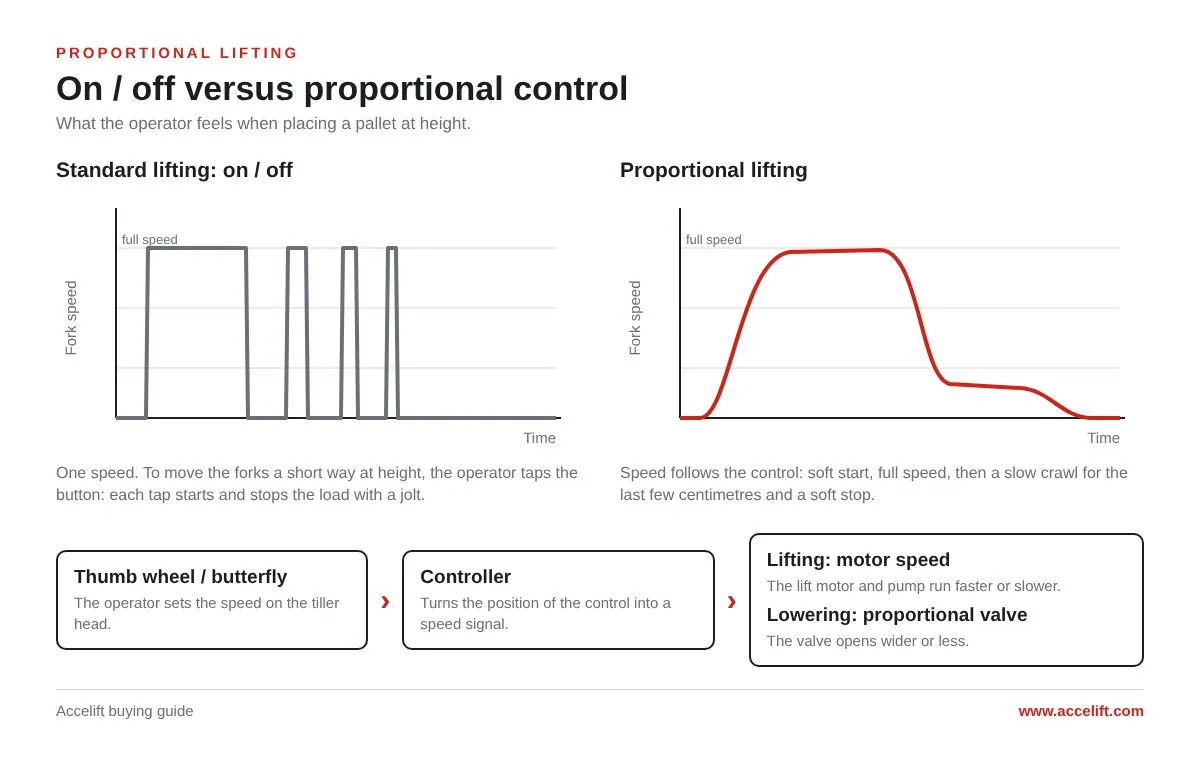
On most entry-level electric stackers, the lift button is a switch. Press it and the forks rise at one fixed speed; release it and they stop. Proportional lifting replaces that switch with a control that works like an accelerator. Turn it a little and the forks creep up; turn it fully and they rise at full speed. The same applies to lowering.
It sounds like a small detail. For an operator placing a pallet on a beam three metres up, it is the difference between one smooth movement and a series of taps on a button. This guide explains how proportional lifting works, when it is worth paying for, and what to ask before you buy.
Standard lifting: one speed, on or off
A standard stacker has two buttons on the tiller head, one for up and one for down.
- Lifting. The up button switches the lift motor on through a contactor. The motor and pump run at one speed, so the forks always rise at the same rate. On our CL1530JB walkie stacker that is 85 mm/s with a full load and 140 mm/s empty.
- Lowering. The down button opens a solenoid valve. Oil returns from the lift cylinder to the tank through a flow-control valve that sets a fixed lowering speed.
For a lot of work this is all you need. Taking pallets off the floor, loading trucks at dock level and block stacking two high do not call for fine control. The limit shows when the operator has to place the forks to within a few centimetres at height. The only way to move the forks a short distance is to tap the button, and every tap starts and stops the load with a small jolt.
Proportional lifting: the speed follows the control
With proportional lifting, the tiller head has a thumb wheel or butterfly control in place of simple up and down buttons. The further the operator turns it, the faster the forks move.
- Lifting. The truck's controller changes the speed of the lift motor according to the signal from the control. A slow motor drives the pump slowly, and the forks rise slowly.
- Lowering. A proportional solenoid valve opens in proportion to the signal, so oil returns to the tank slowly or quickly, as the operator chooses.
The result is a soft start and a soft stop on every movement, and a crawl speed of a few millimetres per second when the operator needs it.
When proportional lifting pays
- Racking at 2.5 m and above. The higher the beam, the harder it is to see the fork tips, and the more a small jolt moves the load. This is where operators notice the difference most.
- Fragile or unstable loads. Glass, bottled drinks, tall stacks of cartons, and pallets that are not wrapped. Soft starts and stops keep them on the pallet.
- Many lifts per shift. In a busy warehouse, smooth positioning saves a few seconds on every put-away, and the operator ends the shift less tired.
- New or changing operators. A proportional control is more forgiving. There are fewer knocks against beams and fewer dropped cartons.
- Less shock on the truck. Without the hard starts and stops of an on/off lift, the mast, chains and hoses take fewer knocks over the years.
When standard lifting is enough
- Lift heights up to about 2 m, or floor-level work such as loading and unloading trucks.
- Block stacking of robust loads.
- Light use: a few lifts a day in a workshop or a shop storeroom.
- Tenders decided on price, where the specification does not ask for it.
What it costs
Proportional lifting needs a controller that can regulate the lift motor, and a proportional valve in place of a simple on/off valve. That adds a modest amount to the price of the truck; it does not put the stacker in a different class. For a dealer it is a useful option to offer. A customer who stacks to 3 m or more every day usually sees the value as soon as an operator has tried both versions.
Read the spec sheet carefully
Not every manufacturer means the same thing by proportional lifting. Before you compare prices, ask four questions.
- Is it proportional lifting and lowering, or lowering only? Some stackers have a proportional lowering valve but an on/off lift. That helps when lowering at height, but the lift still starts with a jolt.
- What is the control? A thumb wheel or butterfly on the tiller head is the usual design. Up and down buttons alone cannot give proportional control.
- Can the maximum speeds be adjusted? On many controllers, the top lifting and lowering speeds can be set to suit the customer's loads.
- Is there still a safe maximum lowering speed, and an emergency lowering valve? A proportional valve should never let the forks fall faster than the truck is designed for.
Which of our stackers have it
Our CDD1530J-L pedestrian stacker (1.5 t, 3.0 m lift) has proportional lifting as standard. On most of our other walkie and stand-on stackers, including the CL15JB and the CL15E series, it is available as an option at a modest extra cost. It can be combined with a lead-acid or a lithium-ion battery; for that choice, see electric stacker batteries.
If you are choosing a stacker for a customer's racking, our guide to choosing an electric stacker covers lift height, aisle width and load, and reading a stacker spec sheet explains h3, h4 and Ast. Dealers can ask us for a quotation with and without proportional lifting, side by side.