
Buying guide
A stand-on electric stacker is longer than a walkie stacker of the same capacity, needs a wider aisle and costs more. In the right warehouse it still pays for itself, because the operator rides instead of walking. In the wrong one it is simply a bigger truck doing the same job.
This guide explains where the line falls, with a rule of thumb, the figures to compare and our own pedestrian and stand-on stackers as examples.
Walkie and stand-on: the difference
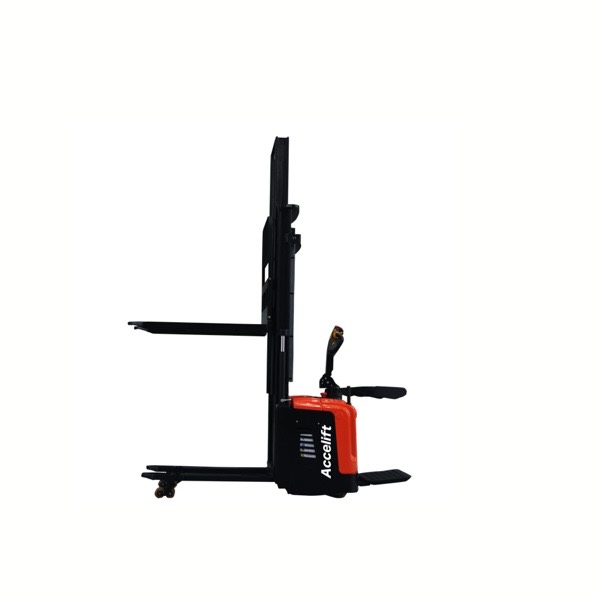
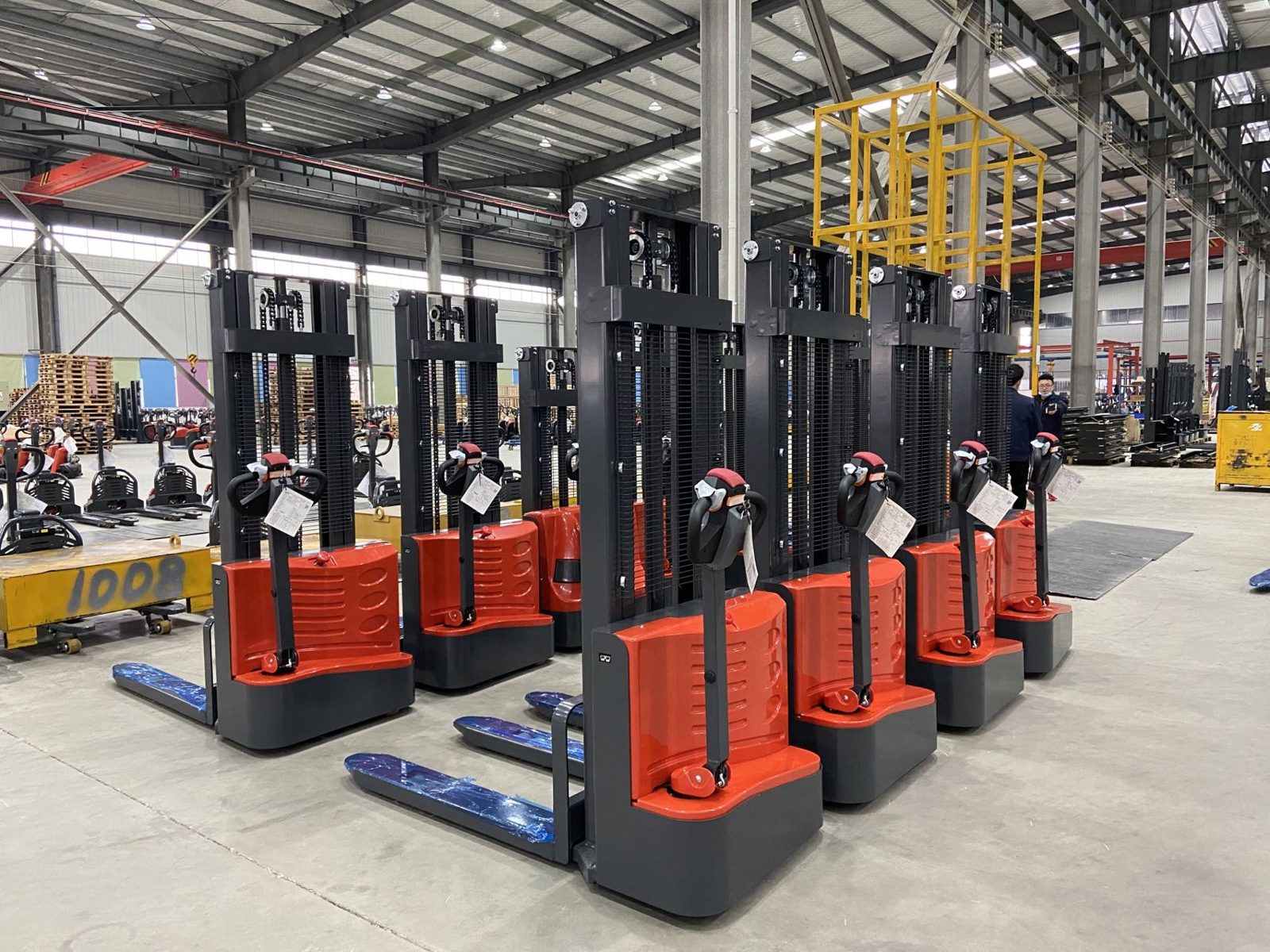
On a pedestrian (walkie) stacker the operator walks behind the tiller. It is the best truck for short runs, tight spaces and light duty: a small shop store, a workshop, a back room where pallets go up into one or two racks. It is compact, simple and cheaper to buy.
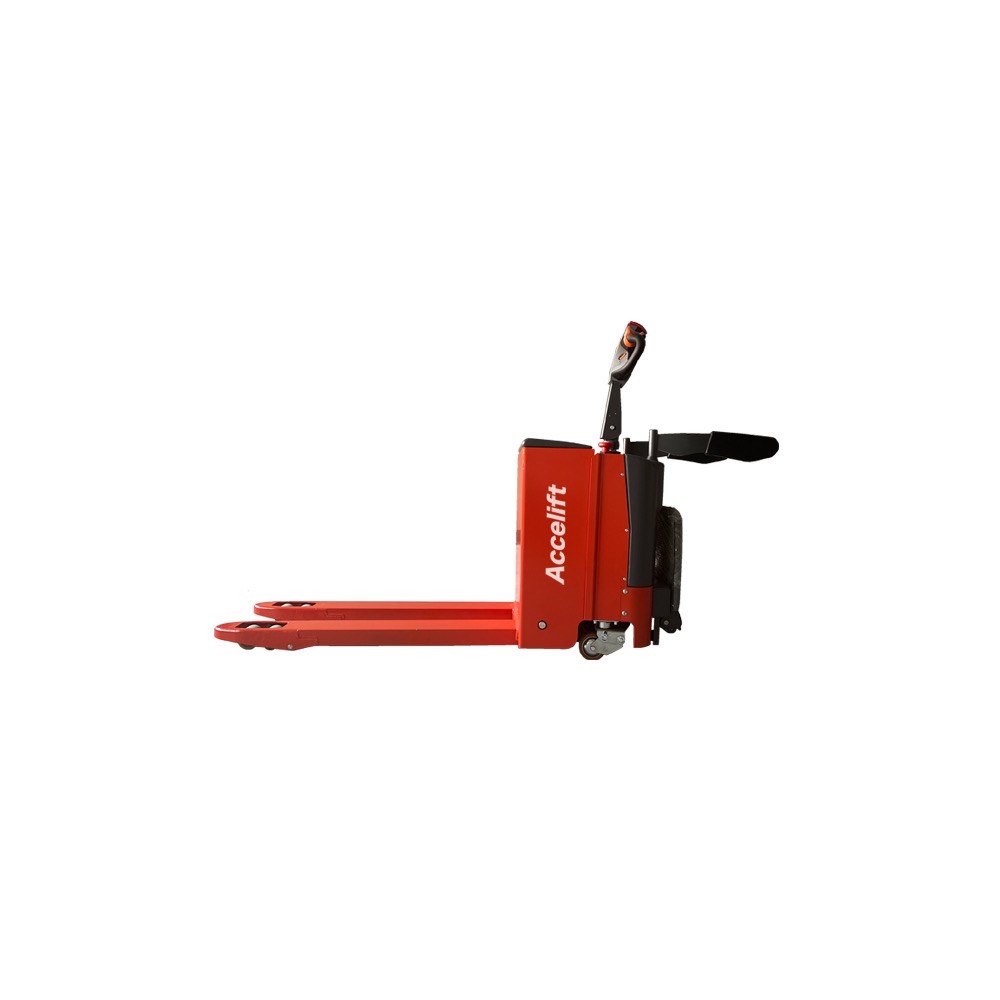
A stand-on stacker has a platform, fixed or folding, so the operator rides. That means less fatigue and a faster day over longer distances. Stand-on trucks usually have a higher travel speed and a bigger battery as well. The price is length: the platform adds to the overall length of the truck and to the aisle width it needs.
A folding platform gives you both. The operator rides on the long runs and folds the platform up to walk the truck through tight spaces.
The rule of thumb
If the operator travels more than about 30 to 50 m per cycle, or works the truck for full shifts, a platform pays back in productivity. For short runs in a small store, a walkie stacker is cheaper and more compact, and the operator does not walk far enough to tire.
The arithmetic is simple. Take a run of 50 m each way and 20 cycles an hour: that is 2 km an hour, or about 16 km over an eight-hour shift. A pedestrian operator walks all of it, at the truck’s pace. On a stand-on truck he rides it, and he works at the same pace at the end of the shift as at the start.
Be clear about what you are buying. On our stackers the gain in speed alone is small: the stand-on CL15E travels at 4.2 km/h laden and 4.5 km/h unladen, against 4.0 and 4.2 km/h for the walkie CL15JB. The real gain is an operator who is not walking. If you need a clear step up in speed as well, look at the trucks with 5.2/5.5 km/h further down this page.
Our stand-on stacker: the CL15E
The CL15E is a 1.5 t stand-on stacker with lift heights from 1,600 to 3,600 mm. It has a permanent-magnet drive motor, a built-in charger and a single-chain narrow mast, which gives the operator a clear view through the mast to the fork tips. The maintenance-free battery is 2 × 12 V/120 Ah and can be swapped without tools.
Overall length is 1,930 mm and width 808 mm. Ast is 2,430 mm with an 800 × 1,200 mm pallet carried lengthways, and the turning radius is 1,570 mm.
The two pedestrian stackers it is usually compared with are the CL15JB and the CL15SE. The CL15JB lifts 1.5 t to 3,000 mm on a 2 × 12 V/100 Ah battery, with an overall length of 1,740 mm. The CL15SE is a middle-drive pedestrian stacker, also 1.5 t, with lift heights from 1,600 to 3,500 mm and a built-in charger.
When you need a counterbalanced stacker: the CPD20J-R
A normal stacker carries the load between two straddle legs. That works with open-bottom pallets in racking, but not with closed-bottom pallets, which the legs cannot pass under, and it makes loading a lorry from the side awkward. A counterbalanced stacker has no straddle legs: like a forklift, it balances the load with the weight of the truck.
Our CPD20J-R is a counterbalanced stacker with a folding stand-on platform. It carries 2,000 kg, lifts to 3,000 or 4,500 mm and travels at 5.2 km/h laden and 5.5 km/h unladen. It has AC control, a 24 V/280 Ah battery, self-diagnostics and a lift limit. Gradeability is 6% laden and 8% unladen.
Without straddle legs the truck needs more room to turn: Ast is 3,530 mm with an 800 × 1,200 mm pallet lengthways, and the turning radius is 1,900 mm. Choose it when your pallets are closed-bottom or when you need to handle loads without straddle legs in the way, not as a general replacement for a straddle stacker.
Four stackers compared
| Model | Type | Capacity | Lift height | Ast | Turning radius Wa | Travel laden / unladen | Battery |
|---|---|---|---|---|---|---|---|
| CL15JB | Pedestrian | 1,500 kg | 3,000 mm | 2,185 mm | 1,405 mm | 4.0 / 4.2 km/h | 2 × 12 V/100 Ah |
| CL15SE | Pedestrian, middle drive | 1,500 kg | 1,600–3,500 mm | 2,190 mm | 1,410 mm | See spec sheet | Built-in charger |
| CL15E | Stand-on | 1,500 kg | 1,600–3,600 mm | 2,430 mm | 1,570 mm | 4.2 / 4.5 km/h | 2 × 12 V/120 Ah, built-in charger |
| CPD20J-R | Counterbalanced, folding platform | 2,000 kg | 3,000 or 4,500 mm | 3,530 mm | 1,900 mm | 5.2 / 5.5 km/h | 24 V/280 Ah |
Ast for the CL15JB, CL15E and CPD20J-R is with an 800 × 1,200 mm pallet carried lengthways.
Check the aisle width first
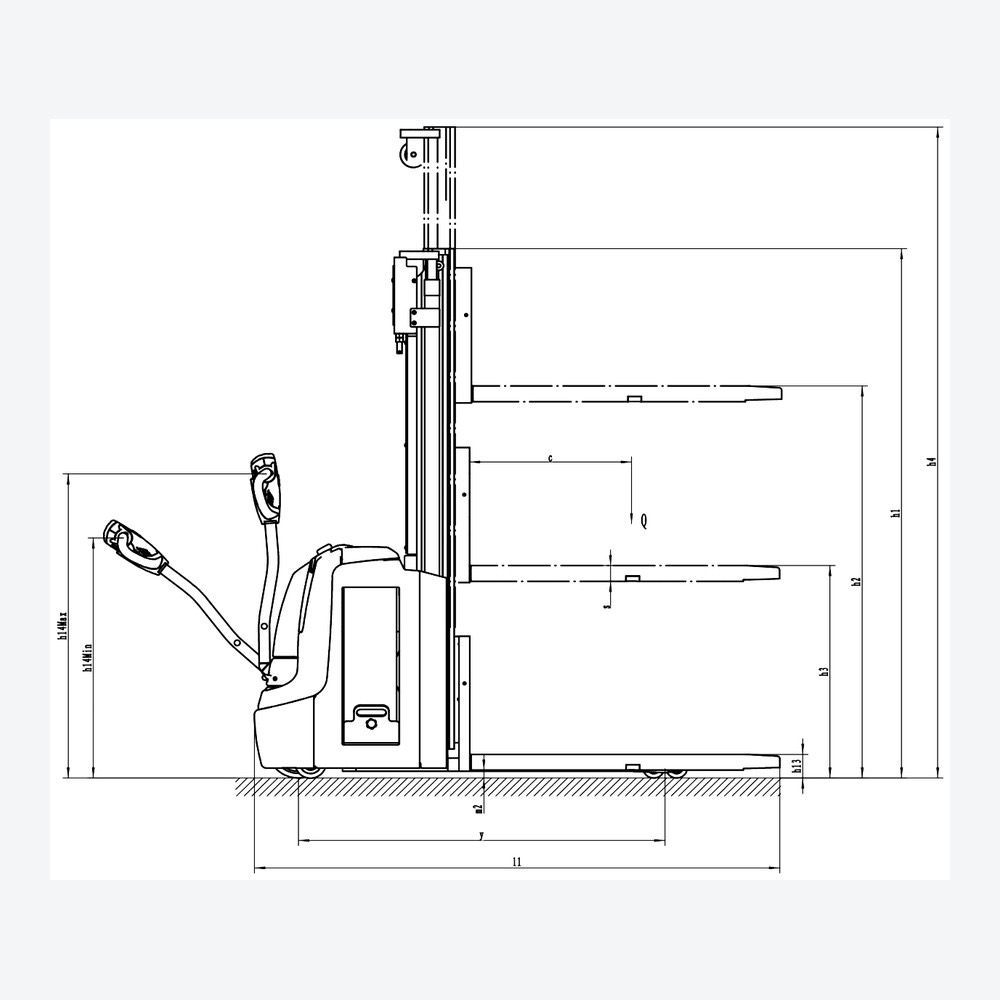
The platform has to go somewhere. The CL15E is 190 mm longer than the CL15JB and needs an aisle 245 mm wider: 2,430 mm against 2,185 mm. In a new warehouse that is easy to plan for. In an existing store with racking already in place, it can decide the matter before productivity comes into it.
Measure your narrowest aisle, between the racking uprights or between the pallets as they actually stand, not as the drawing shows them. Then compare it with the Ast on the spec sheet, quoted for the pallet you use and carried the way you carry it. Our guide to reading a stacker spec sheet explains Ast, the lift heights and the other figures.
The same choice for pallet trucks
The same logic applies when the job is moving pallets along the floor rather than lifting them. A stand-on pallet truck such as our SL20 carries 2.0 t at 5.2 km/h laden and 5.5 km/h unladen on a 24 V/200 Ah battery. It is 1,860 mm long and needs an Ast of 2,300 mm. For long runs from the dock to the storage area it does the work of a pedestrian truck with less effort from the operator. Our guide to pedestrian, stand-on and rider pallet trucks covers that choice in detail.
A checklist before you choose
- Travel distance per cycle: more than about 30 to 50 m points to a platform
- Cycles per hour, shift length, and whether the truck works more than one shift
- Your narrowest aisle, compared with Ast on the spec sheet
- Pallet type: open-bottom pallets suit a straddle stacker, closed-bottom pallets need a counterbalanced one
- Floors and ramps, compared with the truck’s gradeability
- Battery capacity and charging: built-in charger, and whether the battery can be swapped
For the wider picture of lift height, capacity and battery choice, read how to choose an electric stacker. If you are deciding between a walkie and a stand-on stacker, contact us with your travel distances, aisle widths and pallet types, and we will recommend the model that fits.