
Buyer’s guide
Three machines move most of the pallets in the world’s warehouses: the electric pallet jack, the walkie stacker and the forklift. They overlap, so buyers often pay for more machine than they need, or buy the cheap one and find it cannot reach the racking. This guide sets out what each one does, where each one stops, and how to choose.
The short answer
- Moving pallets across a floor, loading trucks at a dock: an electric pallet jack.
- Putting pallets onto racking indoors, up to about 3.5 m, at moderate volume: a walkie stacker.
- Higher racking, heavy loads, outdoors, rough floors or long distances: a forklift, or a reach truck for high racking in narrow aisles.
Electric pallet jack
An electric pallet jack, also called an electric pallet truck, lifts a pallet just clear of the floor, typically around 200 mm, and moves it horizontally. It cannot stack.
Good at: horizontal transport, loading and unloading trucks and containers, order picking at floor level, supermarket and retail back rooms.
Limits: no stacking, and on long distances a pedestrian model is slow because the operator walks. A stand-on or rider model fixes the distance problem.
Typical range: 1.5 to 3 t. Examples: SL15GI (1.5 t), SL20GH (2 t), SL30R (3 t, rider). More in electric pallet trucks: what they do and how to choose one.
Walkie stacker
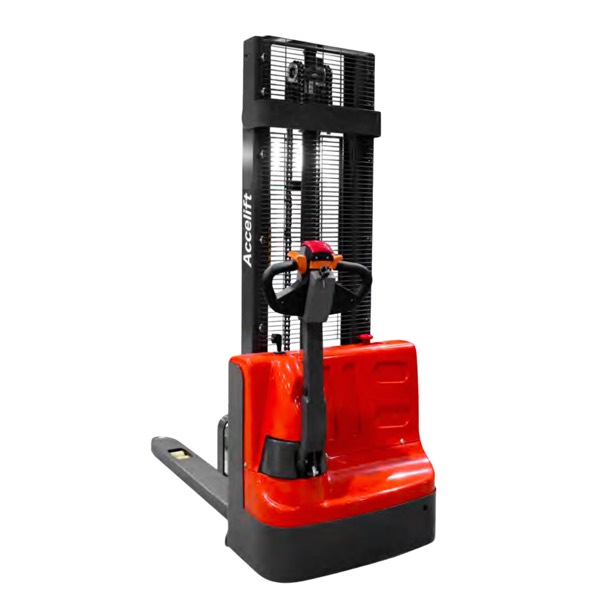
A walkie stacker is a pallet jack with a mast. The operator walks behind it, as with a pedestrian pallet jack, but the forks lift to rack height, commonly 1.6 to 3.5 m and higher on some models.
Good at: putting pallets onto racking in small and medium warehouses, workshops and stores, where a forklift would be too large or too expensive for the volume.
Limits:
- Pallet type. On most walkie stackers the support legs run under the forks and into the pallet, so the pallet must have openings in its bottom boards for the legs, as with a pallet jack. Closed-bottom pallets need a straddle-leg model such as the CL13GHY, whose legs pass outside the pallet.
- Capacity at height. The rated capacity applies at low lift. Ask for the load chart at the height you actually use.
- Floor. Small wheels and low ground clearance mean smooth indoor floors only.
- Throughput. Walking speed limits how many pallets per hour one operator can move. For higher volume, a stand-on stacker such as the CL15E helps.
Typical range: 1.0 to 2.0 t. Examples: CL1230J (1.2 t), CLGA (1–2 t), CL2036A/B (2 t, up to 3.6 m). See how to choose an electric stacker.
Forklift
A counterbalanced forklift carries the load in front of the wheels and balances it with weight at the back. It needs no legs under the load, so it can pick up anything it can get its forks under.
Good at: heavy loads, any pallet type, loading lorries from the ground, yards and outdoor work, ramps, high lifts, long distances at driving speed.
Limits: it needs the widest aisle of the three, the highest purchase price and a trained, usually licensed, driver. Indoors with high racking and narrow aisles, a reach truck usually beats it.
Typical range: electric counterbalanced trucks from 1 t to 2.5 t and up, for example the three-wheel E1030GS (1.0–1.5 t) and four-wheel E1630A (1.6–2.5 t).
Side by side
| Electric pallet jack | Walkie stacker | Forklift | |
| Lifts to | About 200 mm | About 1.6–3.5 m | 3 m and much higher |
| Typical capacity | 1.5–3 t | 1–2 t | 1–5 t and up |
| Operator | Walks or stands | Walks or stands | Sits |
| Aisle needed | Narrow | Narrow to medium | Widest |
| Floor | Smooth | Smooth indoor | Indoor and outdoor |
| Pallet type | Open-bottom | Depends on model | Any |
| Relative cost | Lowest | Medium | Highest |
Four questions that decide it
- Do you need to stack? No: pallet jack. Yes: stacker or forklift.
- How high is the top beam? Up to about 3.5 m with light to medium loads: a stacker is usually enough. Higher, or heavy loads at height: reach truck or forklift.
- Indoors only, on a smooth floor? If the truck must go outside, over ramps or across a yard, you need a forklift.
- How many pallets per hour? A pedestrian machine is fine for occasional work. For all-day, high-volume work, choose a stand-on or ride-on version, or a forklift.
The common combination
Many small and medium warehouses end up with two machines rather than one: an electric pallet jack at the dock for loading and unloading, and a walkie stacker for the racking. Together they often cost less than one forklift, need narrower aisles, and do not need a seated licensed driver. Add a forklift only when the heights, loads or outdoor work demand it.
Not sure which fits your site? Send us your aisle width, top beam height, heaviest load and pallet type, and we will suggest the models that fit.