
Buying guide
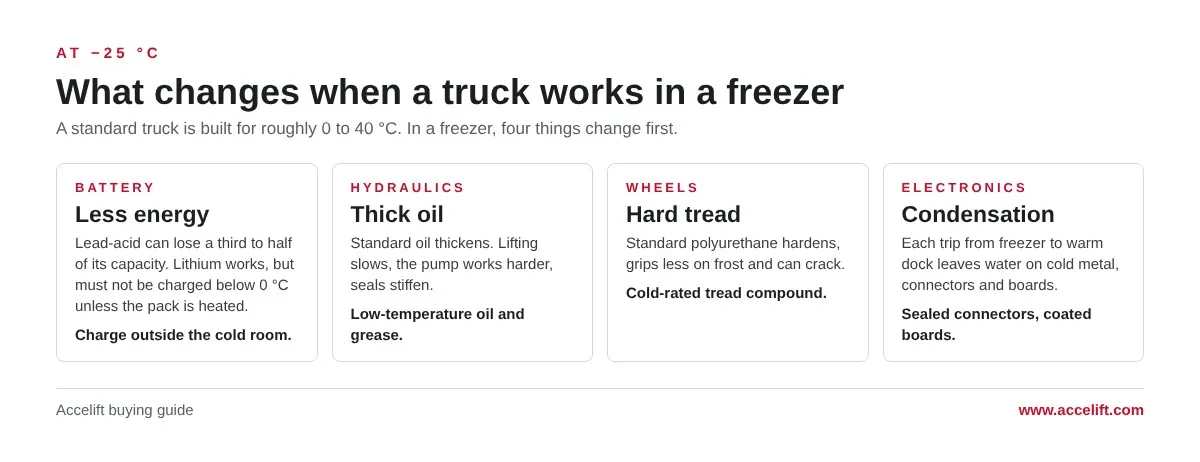
A pallet truck or stacker that runs well in a normal warehouse can struggle in a freezer. At −25 °C the battery gives less, the hydraulic oil thickens, the wheels harden and every trip back to the warm loading dock leaves water on the electronics.
None of this means you need a special truck for every cold room. It means you need to tell your supplier how cold the room is and how the truck will be used, so the right parts go on before it ships.
A standard truck is built for roughly 0 to 40 °C. Below that, it needs a cold-store specification.
How the truck is used matters as much as the temperature
There are two very different ways to work in a cold store:
- In and out. The truck lives on the dock and drives into the freezer for a few minutes at a time. The cold is short, but every trip back into warm, humid air causes condensation.
- Inside all shift. The truck stays in the freezer for hours. Condensation is less of a problem, but the battery, oil and wheels are cold all day.
A chilled room at 0 to +5 °C is a much smaller step than a freezer at −20 to −30 °C. Tell your supplier the temperature, how long the truck stays inside and how often it goes in and out.
Battery: less energy, and no charging in the cold
Every battery delivers less energy when it is cold. A lead-acid battery in a freezer can lose a third to half of its usable capacity, and a deeply discharged lead-acid battery can freeze. Plan for shorter runtime, and never leave a flat lead-acid battery in the cold.
Lithium (LiFePO4) batteries cope better with discharging in the cold, but they must not be charged below 0 °C. A good battery management system blocks charging at low temperature to protect the cells. For freezer work, either charge the truck outside the cold room or choose a pack with built-in heating.
In practice: give the truck a charging place outside the freezer, choose the battery size for the shorter cold runtime, and keep a lead-acid battery charged.
Hydraulic oil and grease
Standard hydraulic oil thickens in the cold. Lifting gets slow, the pump motor draws more current and seals can stiffen and leak. On a hand pallet truck, the pump becomes heavy to operate.
The answer is low-temperature hydraulic oil and grease. Our hand pallet truck manual, for example, specifies standard oil for −5 to 40 °C and low-temperature anti-wear oil for −35 to −5 °C. Ask for it when you order; it is cheaper to fill the right oil at the factory than to drain and refill later.
Wheels and floors
Standard polyurethane hardens in the cold. It grips less, rolls more noisily and can crack after a while. Freezer floors also carry frost and ice near the doors.
For freezers, ask for a tread compound rated for low temperatures. On wet and frosty floors, grip matters more than rolling resistance. See also our guide to polyurethane and nylon pallet truck wheels.
Electronics and condensation
When a cold truck comes out into warm, humid air, water condenses on every cold surface, including the controller, the connectors and the display. Repeated hundreds of times, this corrodes contacts and causes faults that come and go.
- Sealed connectors and coated circuit boards keep the water off the electronics.
- A sealed or heated display stays readable.
- Fewer, longer stays in the freezer are kinder to the truck than many short ones.
- Let a truck that has been in the freezer warm up before charging or opening covers.
The truck body and the operator
Paint and plain steel suffer where condensation and wash-down are constant. In food cold stores, a stainless steel pallet truck avoids rust in the first place. Operators wear thick gloves, so controls, buttons and the emergency stop should be easy to use with gloves on.
What to tell your supplier
- The room temperature, for example −25 °C.
- How long the truck stays inside per trip and per shift.
- How often it goes between the freezer and the dock.
- Where it will be charged.
- The floor: smooth, frosty, wet, with door thresholds or ramps.
- Whether the area is washed down.
Send us these details at [email protected] and we will tell you what the truck needs: battery type and size, oil, wheels and protection for the electronics.