
Buying guide
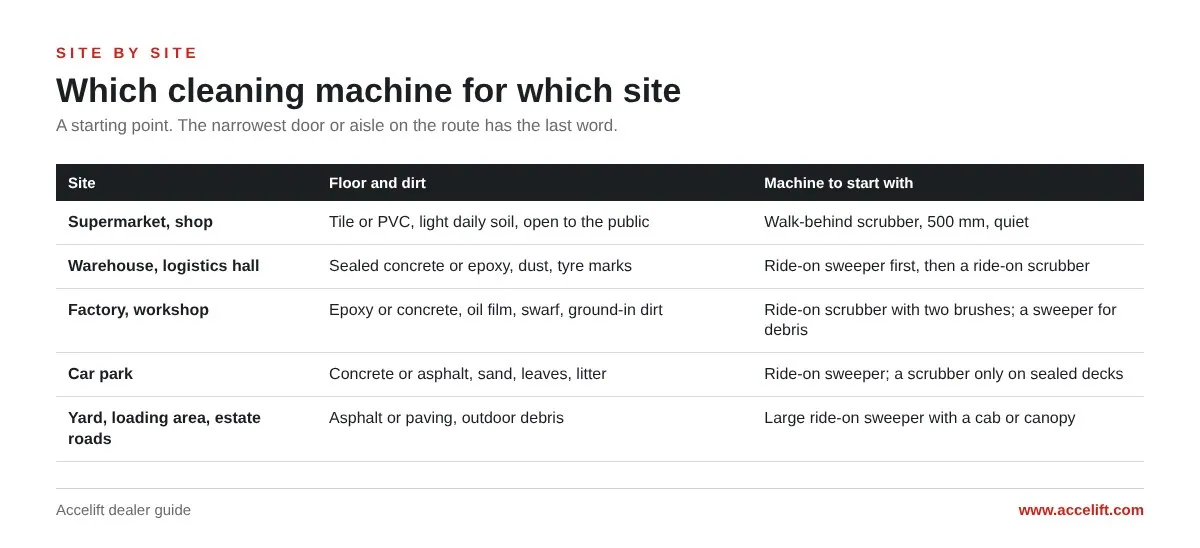
Dealers are usually asked for “a cleaning machine”, not for a model. The right answer depends on the site: what the floor is made of, what kind of dirt lands on it, who is in the building while it is cleaned, and how wide the narrowest passage is. This guide goes through five common sites.
Supermarkets and shops
Smooth tile or PVC, light daily soil, and customers in the aisles. The machine has to be narrow, quiet and leave the floor dry at once, because a wet floor in a shop is an accident waiting to happen. A 500 mm walk-behind scrubber is the usual choice. Our JC60 is 800 mm wide, works at 58 dB(A) and has an 830 mm squeegee that is wider than the brush, so it picks up the water at the edges of each pass. For a hypermarket with long, wide aisles, a compact ride-on saves the operator a lot of walking.
Warehouses and logistics halls
Sealed concrete or epoxy, with dust, bits of stretch film and pallet wood, and tyre marks in the traffic lanes. Two machines work better than one here. A ride-on sweeper clears the loose dirt; a ride-on scrubber then removes the film and the marks. A scrubber sent over debris blocks its squeegee and leaves streaks. For halls of several thousand square metres, look at a twin-brush ride-on such as the JC75/85-B or the 860 mm JC150, and check the width between racks before you order.
Factories and workshops
The dirt is heavier: oil film, coolant, metal swarf, ground-in grime. Choose a scrubber with two brushes and enough brush pressure, and fit harder brushes if the floor allows it. Swarf and scrap must be swept up first, by hand or with a sweeper, because metal chips cut squeegee blades. In food plants, where floors are washed every shift, tank size and a quick drain matter more than speed.
Car parks
Sand, leaves, litter and tyre dust on concrete or asphalt. This is sweeper work. A ride-on sweeper with side brushes reaches along kerbs and into corners, and a water spray on the side brushes keeps the dust down. Check the ramps: a sweeper should climb the steepest ramp on the site with a full hopper. A scrubber is worth adding only on sealed or coated decks, where oil stains have to be washed off.
Yards, loading areas and estate roads
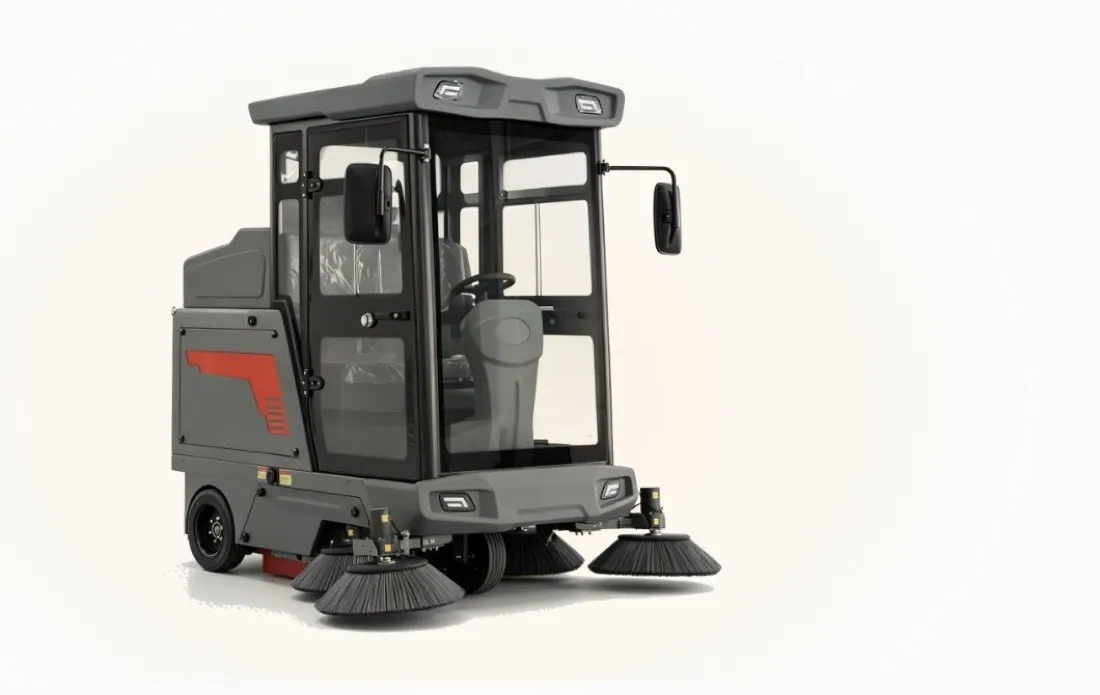
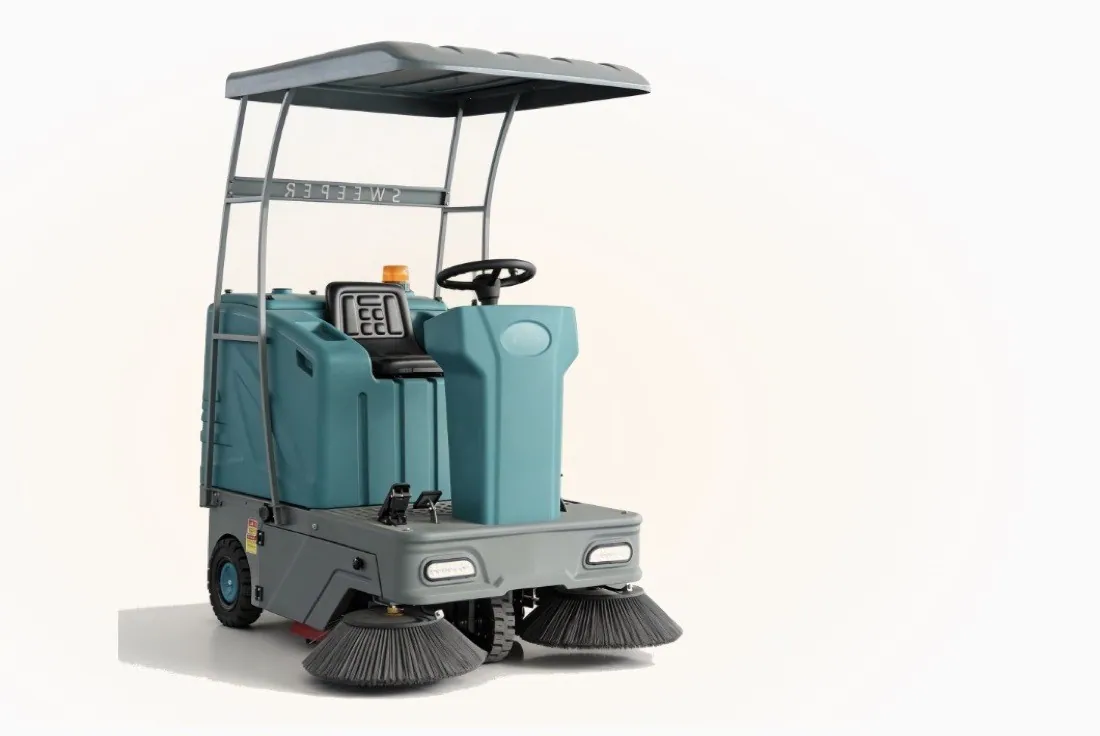
Large outdoor areas need width, hopper volume and protection for the driver. Sweepers of 1,800 mm and more, with a canopy or a closed cab, cover 11,000 m²/h and upwards on paper. Our range runs from the compact JCF1250 at 1,100 mm to the four-wheel JCG-2400, which travels at up to 16 km/h between work areas.
Four questions before you quote
- What is the floor made of, and is it sealed?
- Is the dirt loose, stuck, or both?
- How many square metres are cleaned in one session, and in how much time?
- What is the narrowest door, aisle or lift on the route?
More detail on each machine type is in how to choose a floor scrubber and how to choose a sweeper. If you send us the four answers above, we will suggest a model.