
Buying guide
A stacker sold as "1.5 tonnes" does not lift 1.5 tonnes to every height. As the forks go up, the load the truck can safely carry goes down. At the top of a tall mast it can be less than half the rated capacity.
This is the most common mistake we see when a buyer chooses a stacker: the pallet weight is right, the lift height is right, but the stacker cannot carry that pallet to that height.
The figure that matters is the capacity at the height of your top beam, not the capacity on the nameplate.
Rated capacity and residual capacity
The rated capacity is what the stacker lifts at low height, with the load centre at the standard distance from the fork face, usually 600 mm for a Euro pallet. That is the number in the model name.
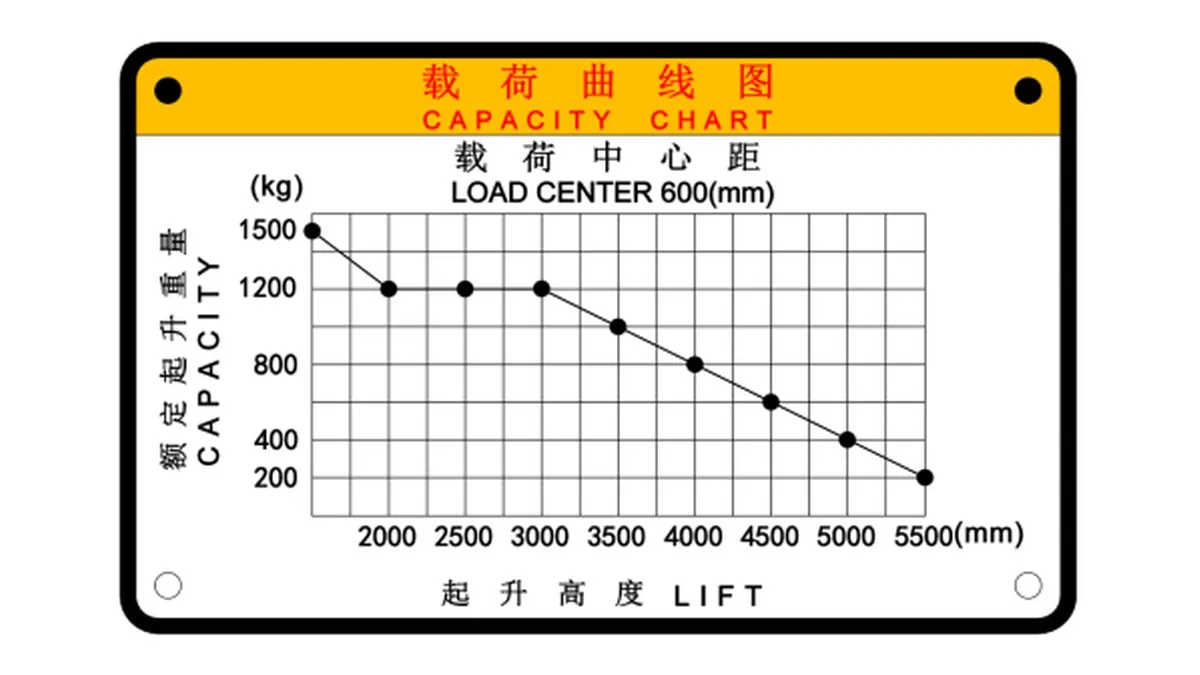
The residual capacity is what it may lift at a given height. As the mast extends, the load sits higher above the wheels and the mast bends more, so the truck becomes less stable. The manufacturer reduces the allowed load to keep the truck from tipping. The figures are shown on the load chart, also called the load diagram or capacity plate, fixed to the truck and given in the spec sheet.
How much it drops: real figures
Here are the figures from our own stacker spec sheets. The pattern is the same for every make.
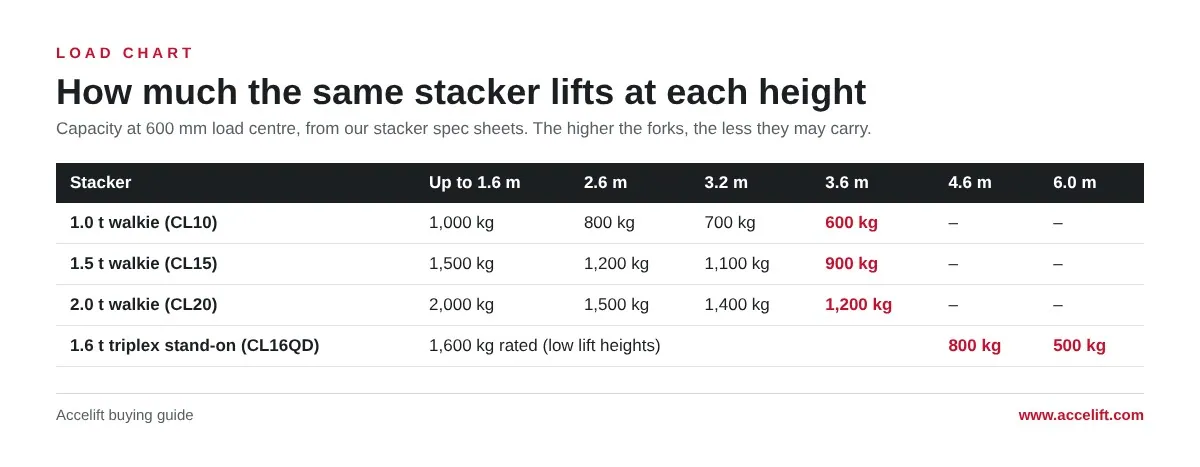
- A 1.5 t walkie stacker lifts 1,500 kg to 1.6 m, but 900 kg to 3.6 m.
- A 2.0 t walkie stacker lifts 2,000 kg to 1.6 m, but 1,200 kg to 3.6 m.
- A 1.6 t triplex stand-on stacker lifts 800 kg to 4.6 m and 500 kg to 6.0 m.
The last line is the one that surprises people. A stacker with a 6 m mast is the right machine for light pallets on high racking, not for heavy pallets at the top.
The load centre changes it again
The load chart assumes the centre of gravity of the load is 600 mm from the fork face, which is the middle of a 1,200 mm Euro pallet loaded evenly. If the load is longer, or heavier at the far end, its centre of gravity moves out and the allowed load drops further.
Typical cases: a 1,200 mm pallet carried across instead of along the forks is fine, but long crates, rolls, or pallets loaded heavy at the front are not. If your loads are not standard Euro pallets, send us the dimensions and the weight distribution.
A worked example
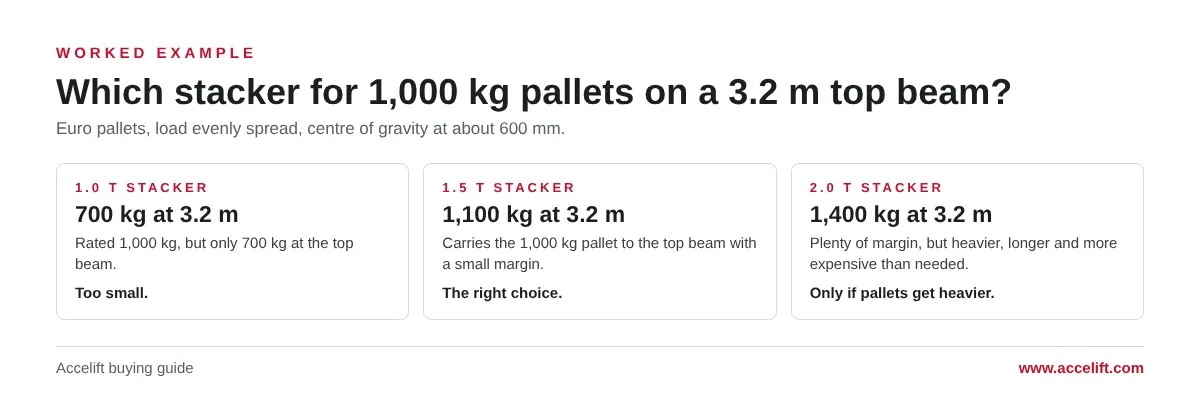
A warehouse stores 1,000 kg pallets with the top beam at 3,200 mm. A 1.0 t stacker looks right on paper and is the cheapest, but at 3.2 m it carries only 700 kg. A 1.5 t stacker carries 1,100 kg at that height, which covers the pallet. A 2.0 t stacker would also work, but it is heavier, longer and more expensive than this job needs.
How to choose, in four steps
- Measure the top beam, and add about 100 to 150 mm so the pallet clears the beam when you set it down. That is your lift height.
- Weigh your heaviest pallet that goes to the top level, not the average one.
- Check the load centre. If loads are longer than a Euro pallet or uneven, ask for the reduced figure.
- Read the load chart at that height and keep a margin. Choose the smallest truck whose residual capacity covers the pallet.
Also check the lowered mast height against your doors, and the extended mast height against the ceiling, sprinklers and lights. Our guide on how to choose an electric stacker goes through these in order.
Ask for the load chart before you order
Any serious supplier can give you the load chart for the exact mast you are buying. If a quotation shows only the rated capacity, ask for the capacity at your lift height in writing. Send us your top beam height and pallet weight at [email protected], and we will tell you which stacker and mast fit.