
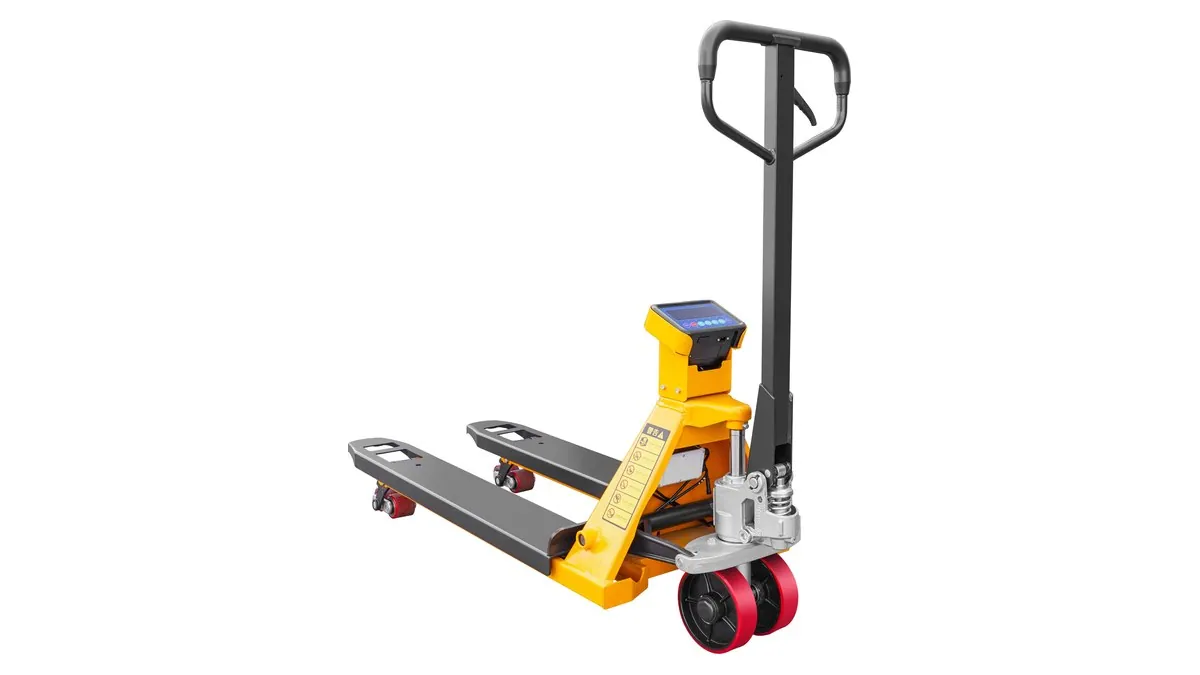
Buying guide
A pallet truck with a built-in scale weighs the pallet while it moves it. Lift the forks, read the weight, carry on. It saves a trip to a floor scale, and it catches short or overweight pallets at the point where somebody can still do something about it.
It is not the right truck for every warehouse. A scale truck costs more than a plain hand pallet truck, it is heavier, and it carries electronics that need a little care. Whether it pays comes down to two things: how often you need a weight, and how accurate that weight has to be.
Decide what the weight is for first. That tells you how much accuracy you need, and accuracy decides whether a scale truck is worth buying.
What a scale pallet truck does, and what it does not
Most scale pallet trucks carry load cells in the fork frame. When the forks are raised, the load cells measure the weight on the forks and the indicator on the pump housing shows it. The truck itself is an ordinary hand pallet truck: you pump the handle to lift, pull the lever to lower and push it like any other.
It is a weighing tool for the warehouse floor:
- Check-weighing at goods-in, to see whether a delivery matches the paperwork.
- Dispatch weights for freight booking, axle loads and container loading plans.
- Batching and stock-taking: weighing raw materials, counting small parts by weight, totalling a day's output.
It is not a laboratory balance, and it does not replace a weighbridge for trucks or a certified scale where you sell goods by weight. More on that below.
When a scale truck pays for itself
The saving is time. Without a scale on the truck, every weighing means driving the pallet to a floor scale, setting it down, reading, lifting and driving back. That is easily two or three minutes a pallet, more if the scale is at the other end of the building or someone else is using it.
A scale truck usually pays where:
- You weigh more than a handful of pallets a day. At 30 pallets a day, two minutes saved per pallet is an hour of labour every day.
- Weighing happens in several places. Goods-in, production and dispatch can each have a truck instead of sharing one floor scale.
- There is no room for a floor scale, or the floor scale is in the wrong place.
- Freight is charged or limited by weight, so a few hundred kilograms over or under matters on every shipment.
- You pay for goods by weight and want to check deliveries before you sign for them.
If you weigh two pallets a week, a floor scale or a crane scale is cheaper. If you weigh all day at one fixed spot, a floor scale built into the line may suit better. The scale truck wins when weighing is frequent and mobile.
Accuracy: the part that decides whether it is worth buying
A scale that reads wrong is worse than no scale at all, because people trust the number. Before buying, understand three terms on the spec sheet and what spoils the reading on a real warehouse floor.
Graduation is not accuracy
The graduation (also called the division or step) is how finely the display counts: 0.5 kg, 1 kg, 2 kg. A truck that shows 0.5 kg steps is not necessarily accurate to 0.5 kg. It only means the last digit moves in 0.5 kg steps.
The accuracy or tolerance is how far the reading may be from the true weight. For pallet scale trucks it is usually quoted as a percentage of capacity, and around ±0.1% of capacity is a figure commonly given for this type of truck under good conditions. On a 2,000 kg truck that is about ±2 kg, whatever the load.
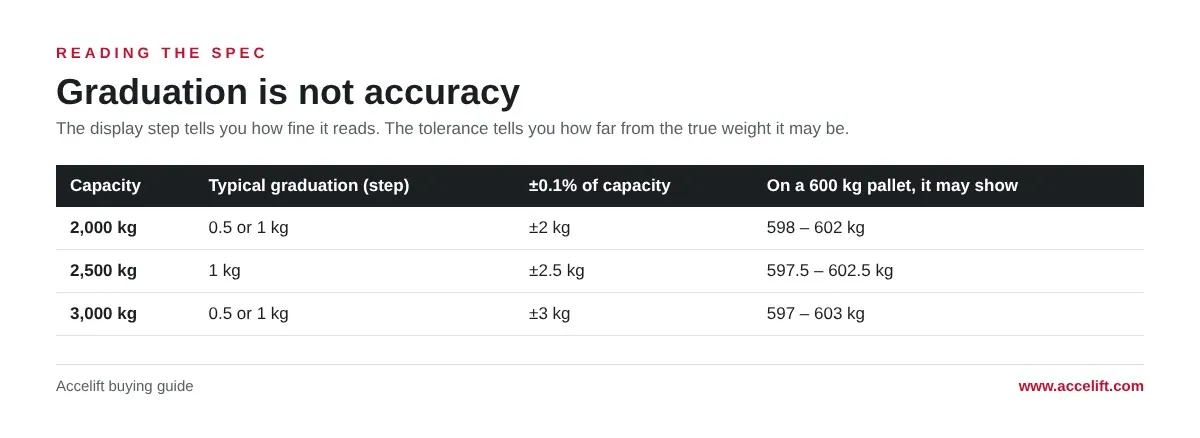
Two things follow from this. First, a tolerance quoted as a percentage of capacity matters more on light loads: ±2 kg is 0.1% of a 2,000 kg pallet but 1% of a 200 kg one. If most of your pallets are light, a lower-capacity truck with a finer graduation may give you a better reading. Second, the accuracy class of the indicator (for example class III, the class used for most industrial platform scales) describes the electronics, not the whole truck. The truck's real-world tolerance also depends on the load cells, the frame and how it is used.
What spoils the reading on site
- An uneven floor. Weigh on flat, level concrete. A slope, a floor joint or a dock plate under one wheel puts the load on the load cells at an angle.
- Lifting too high, or not high enough. Lift until the pallet is just clear of the floor. If the pallet or a fork tip still touches the floor, part of the weight never reaches the load cells.
- Off-centre loads. Most trucks read best with the load centred between and along the forks. Check how much the reading changes when the load sits towards the fork tips.
- Weighing while moving. Stop, let the reading settle, then read. Most indicators show a stable sign when the weight is steady.
- Shock and overload. Dropping a pallet onto the forks or lifting more than the rated load can damage a load cell. A damaged cell often still gives a number, just the wrong one.
- Temperature and a flat battery. Electronics have an operating temperature range; ours is rated for −10 to 40 °C. A low indicator battery can make readings unstable, so charge it as the manual says.
Check it on delivery, and then regularly
Test a new truck before you rely on it. You need a load whose weight you know: certified test weights, or a pallet weighed on a scale you trust.
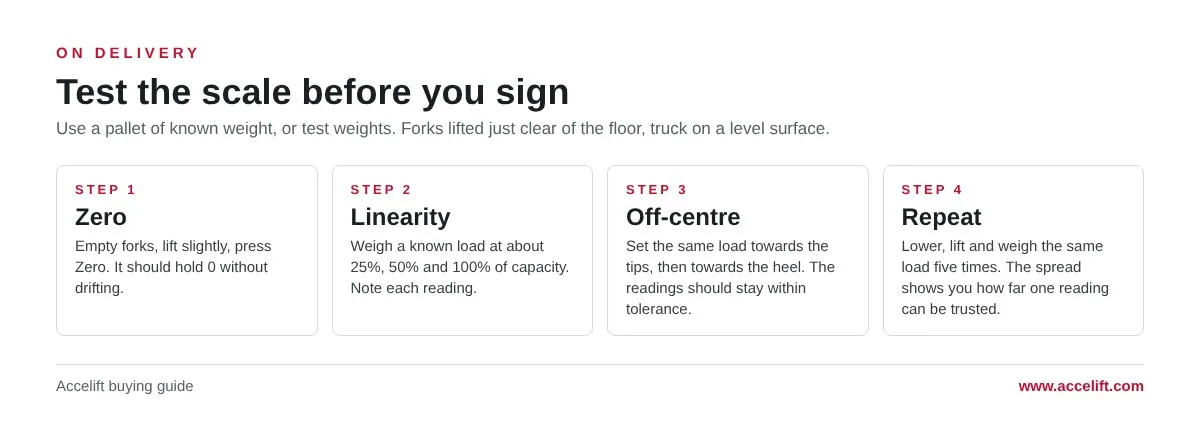
After that, repeat a quick check with the same known load every month or so, and after any knock or overload. If the reading has moved outside your tolerance, recalibrate. Calibration itself is simple: the indicator is zeroed with the forks empty, then a known weight is placed on the forks and entered into the indicator, which sets its scale from it. The manual for each indicator gives the exact key sequence.
Ask one more question before you buy: what happens when the indicator fails? On some trucks a replacement indicator has to be calibrated against test weights before it can be used. On others, including our BFC series, the calibration data stays with the truck, so a new indicator can be fitted and used without recalibrating. For a dealer who has to support trucks in the field, that saves a service visit.
Check-weighing or selling by weight?
Most scale trucks are used for internal checks: freight, stock and goods-in. For that, the accuracy your own tests confirm is what counts.
Selling goods by weight, or charging for services by weight, is different. In the EU and many other countries this is legal-for-trade weighing, and the instrument must be type-approved and verified for that use; in the EU, verified instruments carry the metrology marking next to the CE mark. If you need a scale truck for trade use, say so before ordering, so the supplier can tell you what the model is and is not approved for.
Versions to choose from
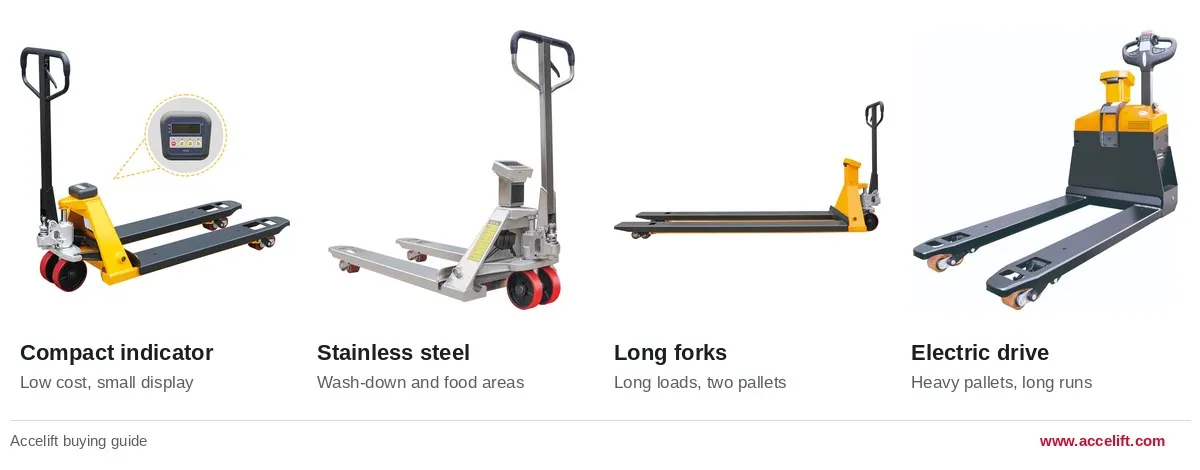
The basic scale truck is a hand pallet truck with a standard indicator. Four variations cover most of the special cases:
- Compact indicator. A small display with the basic keys. The lowest-cost way to weigh on the truck when you only need the number.
- Stainless steel. Frame, forks and indicator housing in stainless steel, for food plants, cold stores and areas that are washed down.
- Long forks. For long loads, or two pallets nose to tail. Check that the load cells and the stated accuracy cover the full fork length.
- Electric drive. A powered pallet truck with the scale built in, for heavy pallets and long runs where pushing a loaded hand truck all day is hard work.
Indicator features worth having
- Tare, to subtract the weight of the pallet or container and show net weight.
- Accumulation, to add up several weighings, for example a whole delivery pallet by pallet.
- Counting, to count small parts by weight from a sample.
- kg / lb switching, if you ship to the US or the UK.
- A printer, built into the indicator housing, for a paper slip or a sticker label on each pallet.
- A rechargeable battery with a plug-in charger. The BFC indicator runs on a lead-acid or lithium battery and charges in 6 to 8 hours.
What to send before ordering
- What the weight is used for: freight, stock, goods-in, or selling by weight.
- The heaviest and the typical pallet weight.
- The accuracy you need, as a figure in kg.
- Pallet size and fork width needed.
- Whether you need a printer, and paper slips or labels.
- The working temperature, if the truck goes into a cold room.
Our BFC and BFC-7 scale pallet trucks
The BFC and BFC-7 hand scale pallet trucks are built for 2,000, 2,500 and 3,000 kg, with 1,150 mm forks and five fork widths. The BFC has a compact LED indicator, the BFC-7 a larger display; both can take a paper or sticker printer, and a stainless steel version is available. Send us your pallet weights and the accuracy you need at [email protected], and we will tell you which version fits.