
Buying guide
Every floor scrubber has a figure in square metres per hour on its spec sheet. Buyers compare these figures, and then find that the machine cleans much less. The figure is not wrong; it describes something else. This guide explains where it comes from and how to size a machine from your own floor.
Where the rated figure comes from
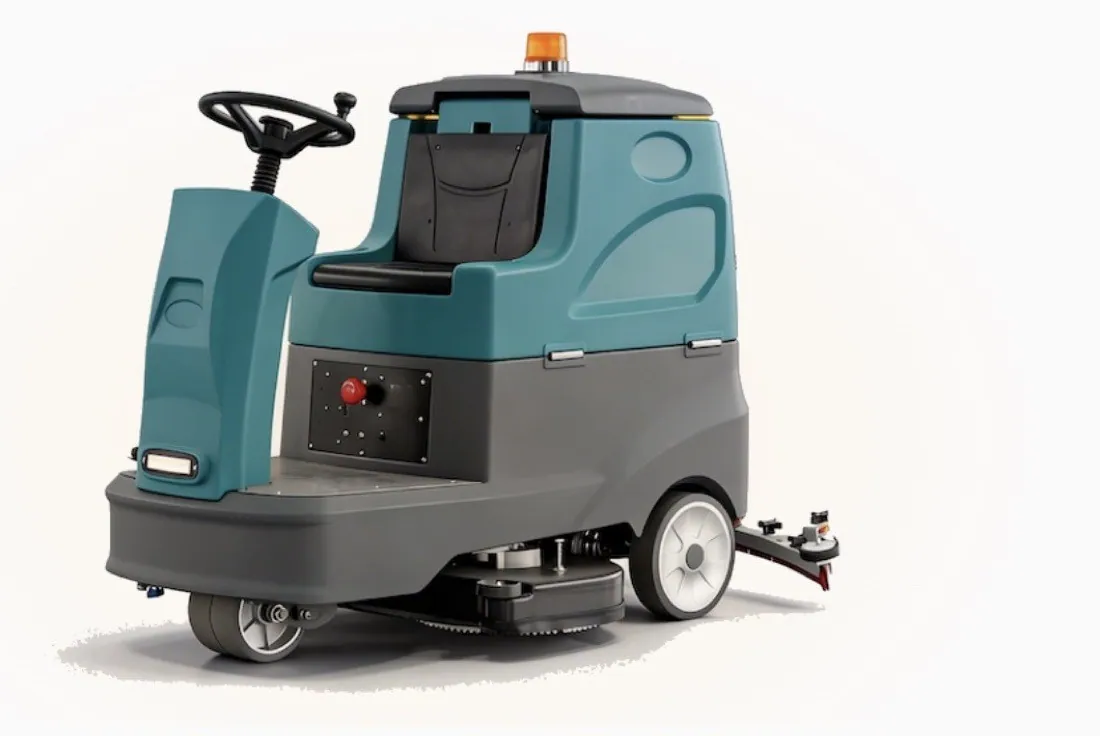
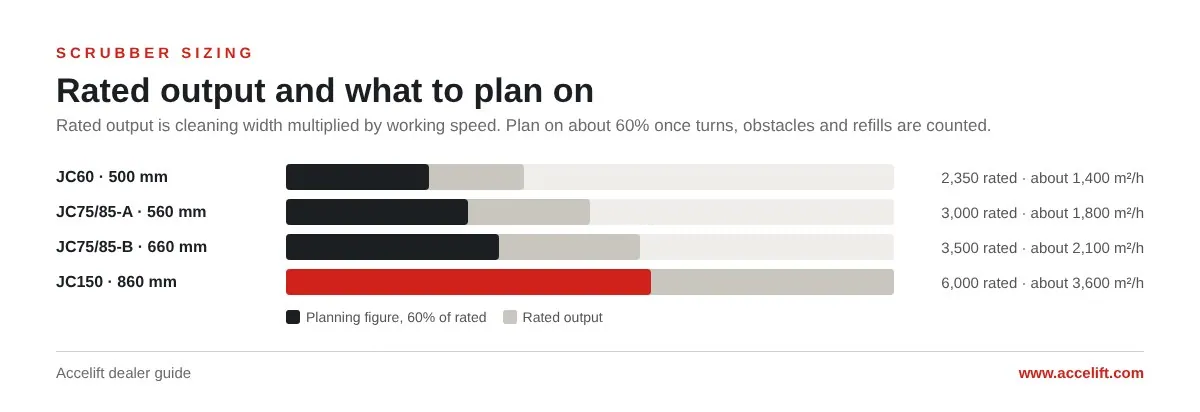
Rated output is the cleaning width multiplied by the working speed. A 500 mm machine that moves at 4.7 km/h covers 0.5 m × 4,700 m = 2,350 m² in an hour. That is the JC60. The same sum gives 6,000 m²/h for the 860 mm JC150 at about 7 km/h.
The sum assumes a straight line with no end: no turns, no overlap between passes, no pillars, no stops.
What you get in practice
Four things take output away.
- Overlap. Each pass overlaps the last by a few centimetres so that no strip is missed. On a narrow machine that is a large share of the width.
- Turns. The machine slows at the end of every lane. Short lanes mean more turns per square metre.
- Obstacles. Racking legs, pallets left in the aisle, doors, people.
- Tanks. When the clean water runs out, the operator drives to the tap, drains the dirty water and refills. Allow ten minutes each time. At a flow of about one litre a minute, a 60 L tank lasts roughly an hour.
As a planning figure, take 60% of the rated output in an open hall and 50% in a building with many aisles and obstacles.
Sizing in three steps
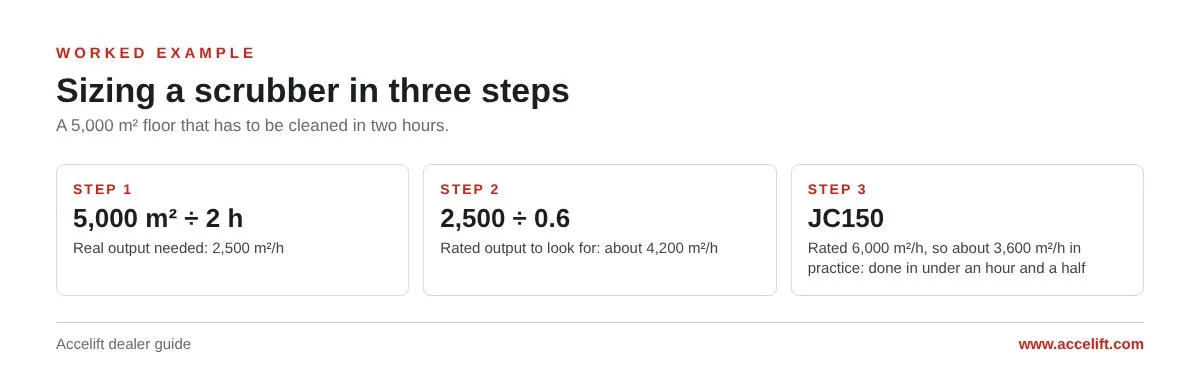
- Divide the area by the time. Take the area cleaned in one session and the time available for it. That is the real output you need.
- Divide by 0.6. The result is the rated output to look for on the spec sheet. Use 0.5 for a crowded site.
- Check the tanks and the battery. The battery should last the whole session, and the number of refills should be acceptable.
Three examples
| Site | Area and time | Rated output needed | Machine |
|---|---|---|---|
| Shop | 800 m² in one hour | About 1,350 m²/h | JC60, walk-behind, 500 mm |
| Workshop | 2,500 m² in an hour and a half | About 2,800 m²/h | JC75/85-A or JC75/85-B, ride-on |
| Logistics hall | 5,000 m² in two hours | About 4,200 m²/h | JC150, ride-on, 860 mm |
One large machine or two small ones?
Above about 8,000 m² per session, two machines are often better than one very large one. Two operators finish in half the time, the site is not left without a machine when one is being serviced, and a smaller scrubber still fits through the doors and between the racks. Below that, one machine sized with some reserve is cheaper to buy and to run.
Do not size by area alone. A ride-on that cannot pass the narrowest door will clean nothing behind it. The other choices, such as tanks, brushes and noise, are covered in how to choose a floor scrubber. If you send us the area, the time window and the narrowest passage, we will do the sum for you.